Spartans Did Not Throw Weak Babies off Cliffs
THE MOVIE VERSION
Popular graphic novels and historical films depict Spartan elders inspecting newborn babies and hurling frail or deformed infants into a chasm at Mount Taygetos.
THE RECORD
REF #011Extensive osteological excavations inside the Taygetos chasm recovered remains of forty-six individuals, all adult males and prisoners of war, with zero infant bones present.
Popular accounts of ancient Sparta present an image of state-enforced eugenics. In popular fiction and modern cinema, tribal elders inspect newborn infants immediately after birth, casting sickly babies into a chasm at Mount Taygetos. The legendary abyss, known in Greek sources as Apothetae or Kaiadas, has stood for centuries as shorthand for Spartan brutality. Yet modern bioarchaeological excavations inside the cavern tell a completely different story. Physical anthropological analysis of human skeletal material recovered from the Taygetos gorge revealed that not a single infant was ever thrown into the chasm. The remains belonged entirely to executed adult men, exposing the famous baby culling narrative as a literary invention written centuries after Sparta fell.
The Claim
The belief that Spartan society routinely executed physically flawed newborns originates from a single classical author writing long after Sparta had ceased to be an independent military power. In section sixteen of the Life of Lycurgus, the Greek biographer Plutarch described the supposed birth procedures enforced under early Spartan law.
SOURCE: Plutarch, Life of Lycurgus 16.1-2
Plutarch recounted that a Spartan father was not free to rear his own child:
“Offspring was not reared at the will of the father, but was taken and carried by him to a place called Lesche, where the elders of the tribes officially examined the infant, and if the number of its joints was sound and its body robust, they ordered it to be reared. But if it was puny and ill-formed, they sent it to what was called the Apothetae, a chasm-like place at the foot of Mount Taygetus.” Plutarch, Life of Lycurgus 16.1-2 (trans. Bernadotte Perrin)
Plutarch maintained that Spartans believed a life poorly equipped for physical health was advantageous neither to the child nor to the commonwealth. This passage became the foundation for modern assumptions about Spartan severity. Just as popular accounts mistakenly assumed Spartans hoarded gold coins rather than relying on iron spits as documented in the dossier on Spartan iron currency, writers accepted Plutarch’s infanticide passage at face value. Roman biographers writing under imperial rule romanticized archaic Sparta, transforming local customs into extreme caricatures.
The Mechanism
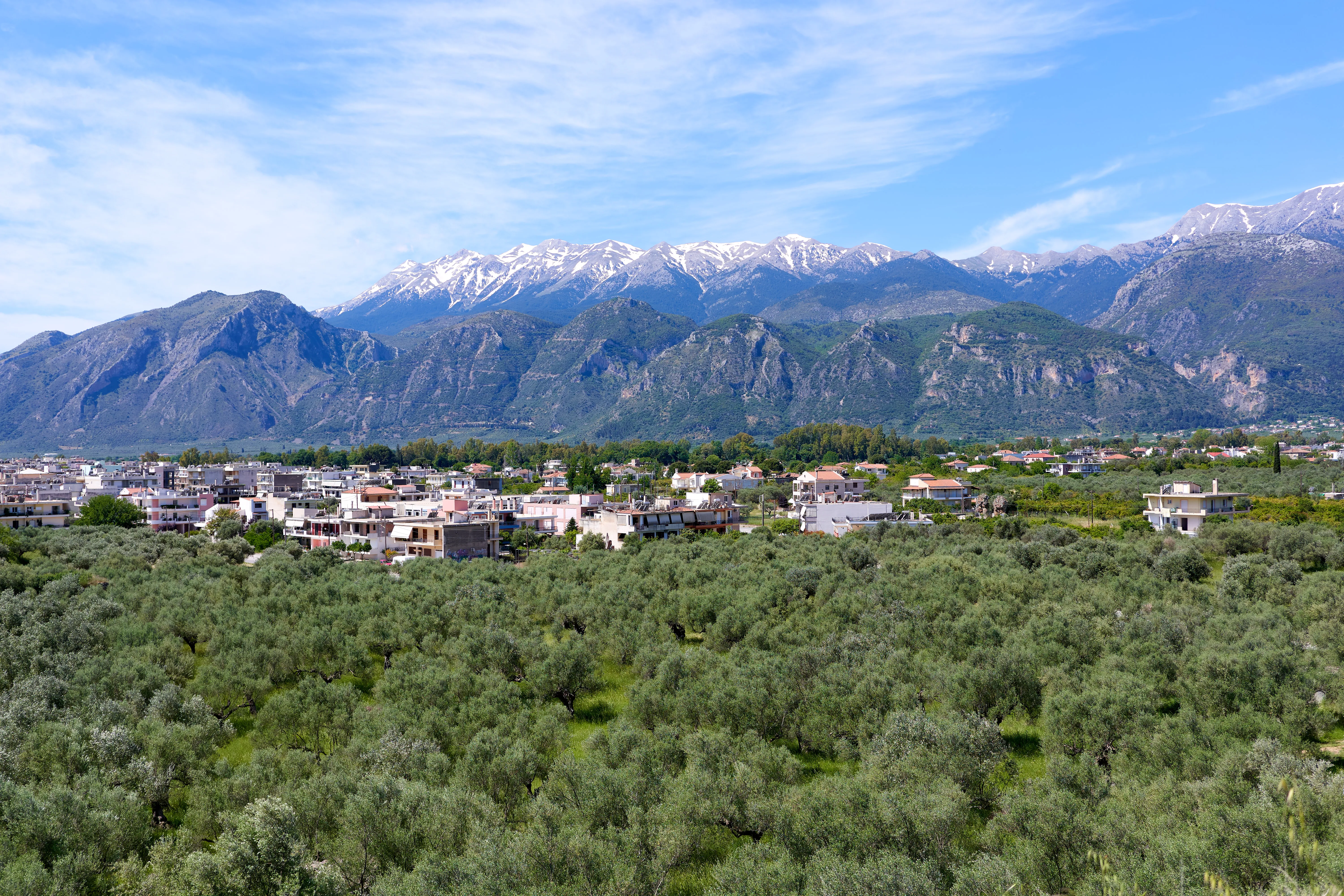
To understand why the infanticide legend gained traction, one must examine how the geography of Mount Taygetos functioned in Laconian politics. Mount Taygetos forms an imposing limestone barrier west of the Eurotas valley. Near the modern village of Trypi, approximately ten kilometers northwest of ancient Sparta, sits the steep geological fissure traditionally identified with Kaiadas.
In archaic and classical Greek history, chasms served as sites of state execution. The Athenians maintained the Barathron, a deep pit into which condemned political criminals were hurled. The Spartans maintained Kaiadas for identical purposes. When the Spartan regent Pausanias was starved inside the Temple of Athena of the Brazen House for alleged treason with Persia, Thucydides recorded that the ephors originally intended to cast his corpse into Kaiadas, before burying him nearby.
Similarly, the geographer Pausanias recorded in the fourth book of his Description of Greece that during the Second Messenian War, Spartans threw the Messenian leader Aristomenes and fifty captured comrades into the Kaiadas abyss. Execution by throwing prisoners into natural clefts was a standard penal practice throughout the ancient Aegean. It represented judicial capital punishment directed at hostile combatants and traitors, not biological screening of Spartan citizens.
The Evidence
Physical evidence for what actually occurred inside the Taygetos chasm emerged from systematic excavations directed by Dr. Theodoros Pitsios, professor of physical anthropology at the Medical School of the National and Kapodistrian University of Athens. Working with teams of speleologists and geologists, Pitsios conducted detailed field research inside the Kaiadas cave from 2003 through 2010.
The cavern entrance drops down a vertical shaft into a subterranean chamber filled with centuries of sediment, rockfalls, and human bone deposits. The research team systematically cataloged and recovered thousands of skeletal elements from the cavern floor. Radiocarbon dating performed in collaboration with the NCSR Demokritos laboratory established that the human remains dated from the eighth through fifth centuries BC, matching the era of the Messenian Wars and Classical Sparta.
The anthropological findings directly contradicted Plutarch’s narrative:
- Complete Absence of Neonatal Remains: Across more than forty-six individually identified human skeletons recovered from the site, the anthropological team found zero bones belonging to a newborn infant or young child. In bioarchaeological excavations, delicate perinatal bones survive well in sheltered limestone caves. Had infants been tossed into the pit over generations, their unfused cranial bones and small long bones would have left an unmistakable osteological layer.
- Age Distribution: The skeletal remains belonged exclusively to mature adolescents and adults, predominantly between ages eighteen and thirty-five.
- Sex Profile: The identified remains were adult males, consistent with captured enemy soldiers and condemned political prisoners.
- Perimortem Trauma: Several skulls and long bones exhibited perimortem fractures caused by high-impact falls onto jagged subterranean boulders. Archaeologists also recovered personal military gear, including bronze arrowheads embedded in cranial fragments and iron shackles, indicating that the individuals were bound prisoners dropped into the abyss while restrained.
The physical record proves that Kaiadas was an execution site for political enemies and prisoners of war. The supposed infanticide cemetery never existed.
The Human Turn
The collapse of the Spartan baby-culling myth forces a fundamental reassessment of ancient child-rearing. Infanticide in the Mediterranean generally took the form of exposure, leaving unwanted newborns in public sanctuaries where they might be claimed as household dependents.
In Classical Sparta, where the citizen population suffered from persistent demographic decline (oliganthropia), infants were intensely valued. Spartan families needed male heirs to maintain land allotments (kleroi) and sustain voting numbers in the assembly. Casting viable infants into mountain chasms would have constituted demographic suicide for a state whose adult male warrior corps dropped from roughly nine thousand in the archaic period to fewer than one thousand by the Battle of Leuctra in 371 BC.
Furthermore, classical sources provide clear examples of Spartan leaders who possessed physical deformities and rose to royal authority. King Agesilaus the Second, who ruled Sparta from 400 to 360 BC, was lame in one leg from birth. Under Plutarch’s imagined regime of infant culling, Agesilaus would have been executed on the slopes of Taygetos within hours of delivery. Instead, he was educated through the formal agoge, inherited the throne, and became one of the most successful battlefield commanders in Greek history.
Just as Roman battlefield tactics depended on disciplined thrusting drills rather than chaotic brawling, as analyzed in the study of Roman legionary stabbing mechanics, Spartan social organization depended on calculated legal frameworks rather than cartoonish savagery.
The Artifact
The decisive physical artifact in this inquiry is the osteological collection recovered from the Kaiadas chasm, currently conserved at the Anthropological Museum of the Medical School at the University of Athens. Among the recovered cranial specimens is a mature adult male skull exhibiting an unhealed impact fracture along the parietal bone, alongside an iron arrow tip excavated within the same stratigraphic layer.
The stratigraphy shows that the victims were thrown into the darkness from the upper opening of the gorge, striking rock ledges before settling into the cold limestone silt. Associated metal artifacts, including bronze fragments and binding iron, place these deaths during the eighth to fifth centuries BC, contemporaneous with the brutal subjugation of Messenia recorded by Thucydides and Pausanias.
The bones preserved in the Athens museum preserve silent, irrefutable testimony. They do not record the murder of disabled infants by cruel elders. They record the cold political violence of archaic warfare, where captured enemy hoplites were marched to the cliffs of Mount Taygetos and dropped into the earth.
Primary Sources & Archaeological References
- [01]
- [02]
- [03]
- [04]
Related Dossiers
Spartans Were Not Mindless Grunters: The Art of Laconic Wit
Pop culture depicts Spartans as illiterate brutes. Plato and Plutarch prove Laconic wit was the most admired, calculated verbal art in classical Greece.
The Spartan 300 Did Not Stand Alone at Thermopylae
Herodotus proves King Leonidas fought alongside 7,000 allied Greeks and made his last stand with 700 volunteer Thespians who died to the last man.
Spartan Iron Currency: The Ban on Gold and Silver
Plutarch and British School excavations prove Sparta banned precious coins, enforcing brittle iron spits quenched in vinegar to crush commercial luxury.