Spartans Were Not Mindless Grunters: The Art of Laconic Wit
THE MOVIE VERSION
Modern films portray Spartans as monosyllabic, uncultured meatheads who communicate only in furious roars and savage battle cries.
THE RECORD
REF #024Plato and Plutarch record that Spartans were trained in calculated verbal economy, developing Laconic wit as the most revered rhetoric in antiquity.
In modern action cinema, comic books, and popular fiction, ancient Sparta is depicted as a totalitarian society of illiterate muscle. The cinematic Spartan is a brooding brute clad in a leather harness, roaring bloodthirsty battle cries, and sneering at philosophy, art, and intellectual debate. Athenian philosophers are presented as the refined thinkers of Hellas, while Spartans appear as monosyllabic killers who solve every social interaction with an iron spear or a kick into a bottomless well.
The caricature is visceral and dramatic.
It is also an absolute inversion of classical reality.
In the ancient Greek world, Spartans were famous not for primitive grunting, but for producing the sharpest, most sophisticated verbal wit in the Mediterranean. The English word laconic derives directly from Laconia, the Spartan homeland. Far from being uneducated savages, Spartans underwent rigorous intellectual training in verbal economy, using razor-sharp humor, devastating brevity, and philosophical irony to dismantle long-winded Athenian orators. Ancient philosophers did not despise Spartan speech; they celebrated it as the highest form of Hellenic intellect.
The Claim
The belief that Spartans were anti-intellectual barbarians who could barely speak stems from a misunderstanding of their deliberate public reserve.
Sparta was a secretive, closed society that practiced xenelasia, the periodic expulsion of foreigners. Because the Spartiates avoided writing long treatises and barred itinerant Athenian rhetoricians from opening schools in the Eurotas valley, outside observers assumed they possessed no culture. Modern historians, reading Athenian sources through nineteenth-century romantic lenses, assumed that a society dedicated to hoplite drill must have neglected the mind.
Just as modern mythmakers falsely claimed that Spartans threw deformed infants off Mount Taygetos, as disproved by skeletal excavation in our analysis of Spartan bioarchaeology, popular culture reduced a complex society to a single violent stereotype.
Yet when classical authors who actually knew Sparta wrote about its culture, they reported the exact opposite. Classical Greeks recognized that Spartan speech was an elite intellectual weapon, crafted to expose pretense and puncture verbose arrogance.
The Mechanism
The social mechanism behind Laconic brevity was institutional, embedded within the Spartan educational system (agoge):
Spartan children were not merely trained in physical endurance. At the communal dining messes (syssitia), young boys sat with mature warriors and were subjected to intense intellectual interrogation. Under the supervision of the youth magistrates (iren), boys were asked rapid-fire questions testing both civic judgment and linguistic precision: “Who is the finest citizen in Sparta?” or “How do you evaluate this magistrate’s decision?”
Plutarch records in his Life of Lycurgus that the boy was required to answer immediately, stating his judgment along with a reasoned defense, compressed into the fewest possible words:
- Precision of Thought: Rambling speech, hedging, and flowery metaphors were strictly forbidden. If a boy gave a flippant or verbose answer, the elder bitten his thumb as a physical correction.
- Iron Discipline of Irony: Spartans prized a sharp sense of humor (charis) combined with sting. A good answer had to be at once humorous, truthful, and concise.
- Contempt for Rhetorical Fluff: While Athenian politicians charged high fees to teach students how to argue both sides of an issue with endless circular logic, Spartans viewed wordiness as a sign of intellectual cowardice.
Just as Lycurgus banished silver coinage to prevent financial corruption, as examined in our study of Spartan iron currency, Spartan law banned rhetorical bloat to preserve clarity of thought.
The Evidence
The classical documentary record contains unanimous praise for Spartan philosophical wit:
In Plato’s dialogue Protagoras, Socrates delivers an astonishing analysis of Spartan culture. Socrates argues that the Spartans are secretly the most philosophical people in all of Greece, disguising their wisdom so other city-states do not copy their methods:
SOURCE: Plato, Protagoras, 342b-342e
“If someone converses with the most ordinary Spartan, for a long time he will find him a clumsy speaker; but in the end, at some sudden point in the discussion, he shoots out a brief, pungent remark like a master archer, making his conversational partner look no better than a child.” Plato, Protagoras 342e (trans. W. R. M. Lamb)
Socrates notes that the legendary Seven Sages of Greece, including Chilon of Sparta, adopted the Spartan method of compressed wisdom. The famous maxims inscribed on the Temple of Apollo at Delphi, including “Know thyself” and “Nothing in excess”, were direct products of Laconic verbal discipline.
Plutarch was so captivated by this rhetorical mastery that he compiled an entire book titled Sayings of the Spartans (Apophthegmata Laconica), preserving hundreds of historical retorts:
When King Philip II of Macedon sent a threatening letter to the Spartan magistrates, warning: “If I invade Laconia, I shall drive you out, destroy your farms, and enslave your people.” The ephors sent back a written reply containing a single word: “Aika” (“If”).
When a visiting Athenian sneered: “You Spartans know nothing, and have learned no arts.” King Archidamus calmly replied: “Quite true. We alone have learned no evil from you.”
Even on the battlefield of Thermopylae, where three hundred Spartans fought alongside seven hundred Thespians, as documented in our study of allied hoplite forces, Spartan soldiers were famous for mordant humor. When a scout reported that Persian archers were so numerous their arrows would block out the sun, the Spartan warrior Dienekes replied without breaking stride: “Good news; then we shall fight in the shade.”
The Human Turn
Why do we prefer to imagine Spartans as roaring barbarians rather than subtle masters of satire?
Modern pop culture thrives on simplistic contrasts. In our cinematic storytelling, intellect and martial prowess are treated as mutually exclusive traits: thinkers are weak, while warriors are stupid. We project this false dichotomy onto the classical past, transforming Athens into an idealized university seminar and Sparta into an asylum of screaming bodybuilders.
In doing so, we lose sight of the profound philosophical lesson the Spartans understood: language is power, and excess words dilute truth.
To the Spartan mind, a man who required twenty minutes to make a point was a man who did not know what he was talking about. Laconic wit was not born of ignorance, but of supreme self-control. In an age of performative posturing, the Spartan stood in quiet amusement, waiting for his opponent to exhaust himself with boastful speeches, before delivering a single devastating sentence that ended the argument forever.
The Artifact
The physical evidence of Spartan culture survives in classical sculpture and epigraphy:
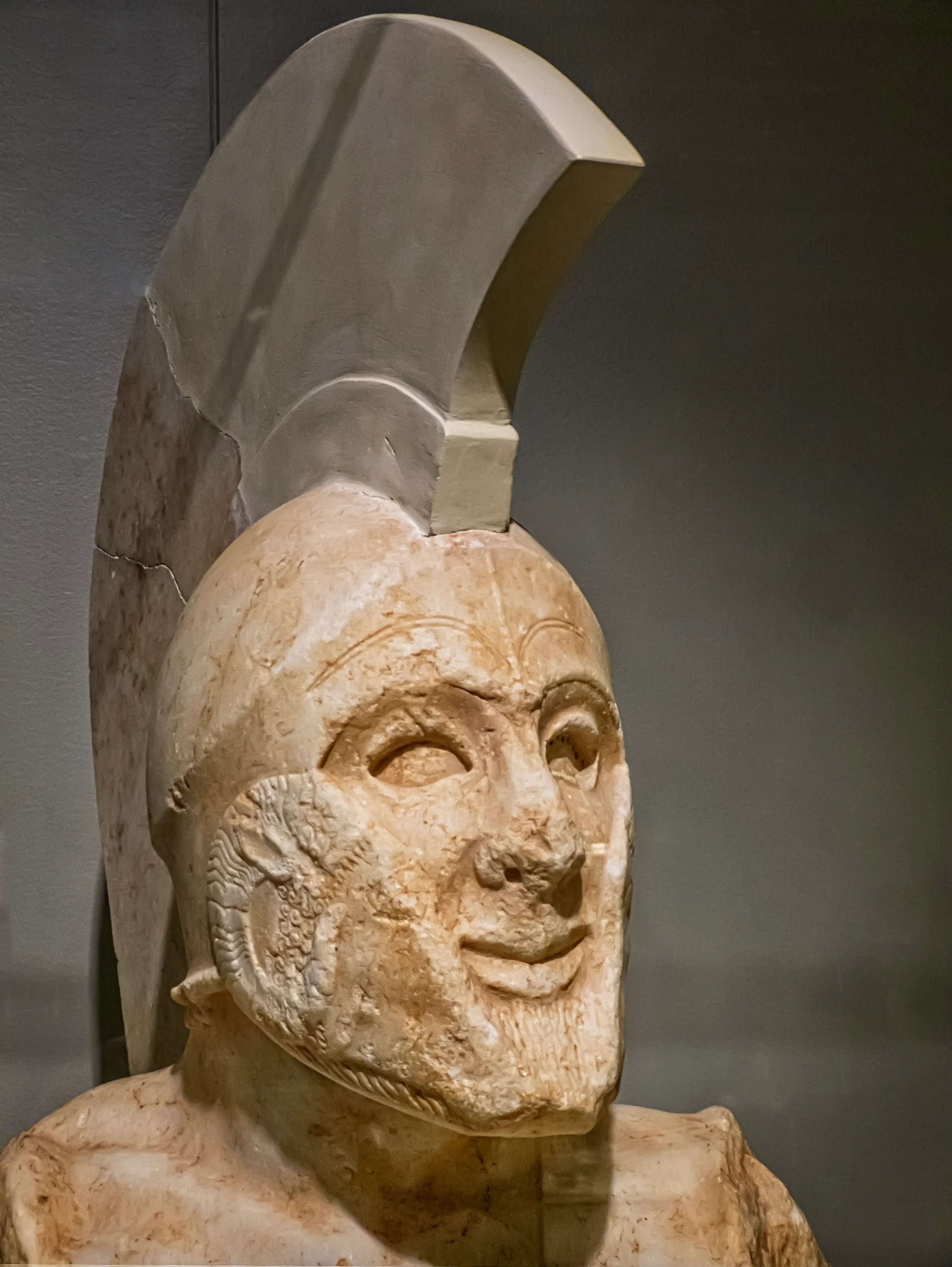
In the Archaeological Museum of Sparta, visitors can examine the famous Parian marble statue known as “Leonidas” (inventory 3365). Excavated in 1925 by the British School at Athens near the Sanctuary of Athena Chalkioikos on the Spartan acropolis, this magnificent fifth-century BCE hoplite head depicts a serene, composed warrior beneath a high Corinthian helmet. The face shows no feral grimace or mindless battle rage; it radiates calm, focused discipline.
Across the Peloponnese, surviving Laconian bronze statuettes, preserved in the British Museum and the National Archaeological Museum in Athens, depict Spartan citizens standing with poised dignity, cloaked in heavy woolen mantles.
These stone and bronze artifacts preserve the true image of classical Sparta: not a horde of wild howling berserkers, but a proud, calculating aristocracy that mastered the iron sword on the battlefield and the sharpest tongue in the ancient world.
Primary Sources & Archaeological References
- [01]
- [02]
- [03]
- [04]
Related Dossiers
The Spartan 300 Did Not Stand Alone at Thermopylae
Herodotus proves King Leonidas fought alongside 7,000 allied Greeks and made his last stand with 700 volunteer Thespians who died to the last man.
Spartans Did Not Throw Weak Babies off Cliffs
Excavations of the Taygetos chasm revealed dozens of adult execution victims but zero infant bones, refuting Plutarch's famous Spartan infanticide myth.
Spartan Iron Currency: The Ban on Gold and Silver
Plutarch and British School excavations prove Sparta banned precious coins, enforcing brittle iron spits quenched in vinegar to crush commercial luxury.