Roman Legionaries Stabbed Instead of Slashing
THE MOVIE VERSION
Cinema depicts Roman soldiers swinging their swords in wide overhead hacking motions like medieval broadswords.
THE RECORD
REF #007Roman doctrine punished swinging blades, drilling recruits to deliver short two-inch puncturing thrusts from behind the shield.
Roman legionaries were trained under strict disciplinary threat never to swing their swords in combat. According to the twelfth chapter of the first book of Vegetius’s military manual Epitoma Rei Militaris, the Roman legion drilled its recruits to fight exclusively with the thrust, mocking barbarian adversaries who relied on sweeping edge cuts. Archaeological finds of Mainz and Pompeii pattern gladii confirm that the Roman infantry sword was engineered as a rigid, double-edged puncturing instrument.
The Claim
A Roman soldier who swung his gladius like a broadsword endangered the entire cohort. In Hollywood blockbusters, legionaries break formation, step into open clearings, and deliver wide horizontal slashes that cleave through enemy ranks. In the operational reality of Roman infantry combat, that motion was a fatal tactical error. A wide cut exposed the soldier’s right armpit, ribs, and neck to incoming spear thrusts while disrupting the interlocking wall of curved rectangular shields (scuta).
The Roman military system transformed swordsmanship from an individual heroic duel into an industrial killing drill. Recruits were taught that slashing cuts rarely produced immediate battlefield deaths because edge blows were absorbed by helmets, heavy cloaks, and ribs. In contrast, a straight thrust required minimal clearance, kept the soldier protected behind four feet of plywood, and drove directly into vital internal organs.
SOURCE: Vegetius, Epitoma Rei Militaris 1.12
Vegetius recorded this foundational military doctrine with blunt clinical precision in his late fourth-century treatise on Roman arms.
“Besides, they were taught not to cut, but to thrust with their swords… for a blow, with whatever force it is delivered, seldom proves fatal… whereas a stab, though entering only two inches, is mortal.” Vegetius, The Military Institutions of the Romans 1.12 (trans. John Clarke)
The Roman army did not debate this philosophy. Instructors ridiculed warriors who slashed, viewing the cutting motion as an unrefined barbarian habit that traded tactical safety for theatrical display.
The Mechanism
The biomechanical superiority of the thrust over the cut was a product of weapon geometry and close-order formation physics. A Roman legionary operated in an files spaced roughly three feet apart. To the soldier’s left was the overlapping shield of his comrade; to his front was his own curved scutum, held firmly by a horizontal central handgrip behind an iron boss.
In this compressed environment, delivering a powerful cut (caesim) requires winding up the arm backward or upward. This preparatory motion requires at least two feet of lateral clearance. If a soldier winds up his sword arm in a tight line, his elbow strikes his file mate’s shield, stalling the strike. Furthermore, during the upward swing, the right side of the torso lifts away from the shield rim, exposing the brachial artery and intercostal spaces.
A thrust (punctim) operates on a direct linear vector. The soldier punches forward from the hip or shoulder without moving his elbow outside the perimeter of the shield. The point of the gladius shoots forward between interlocking shield rims like the piston of an engine. The strike travels eighteen to twenty-four inches, enters the enemy’s abdomen, groin, or throat, and retracts in a fraction of a second.
The lethality of this linear strike relies on internal anatomy. A slash must cut through leather armor, muscle fibers, and ribs to reach deep organs. Even if it inflicts a painful flesh wound, the victim often retains consciousness and muscular control for several minutes before bleeding out. In contrast, a narrow two-inch puncture into the abdominal cavity lacerates major vascular trunks, punctures the liver or intestines, and triggers instantaneous neurogenic shock, dropping the opponent to the ground immediately.
The Evidence
The physical evolution of the Roman sword confirms this tactical focus on the point. In their foundational archaeological survey Roman Military Equipment, archaeologists M. C. Bishop and J. C. N. Coulston traced the typology of surviving legionary blades from the Republic through the Principate.
SOURCE: Bishop and Coulston, Roman Military Equipment (2006)
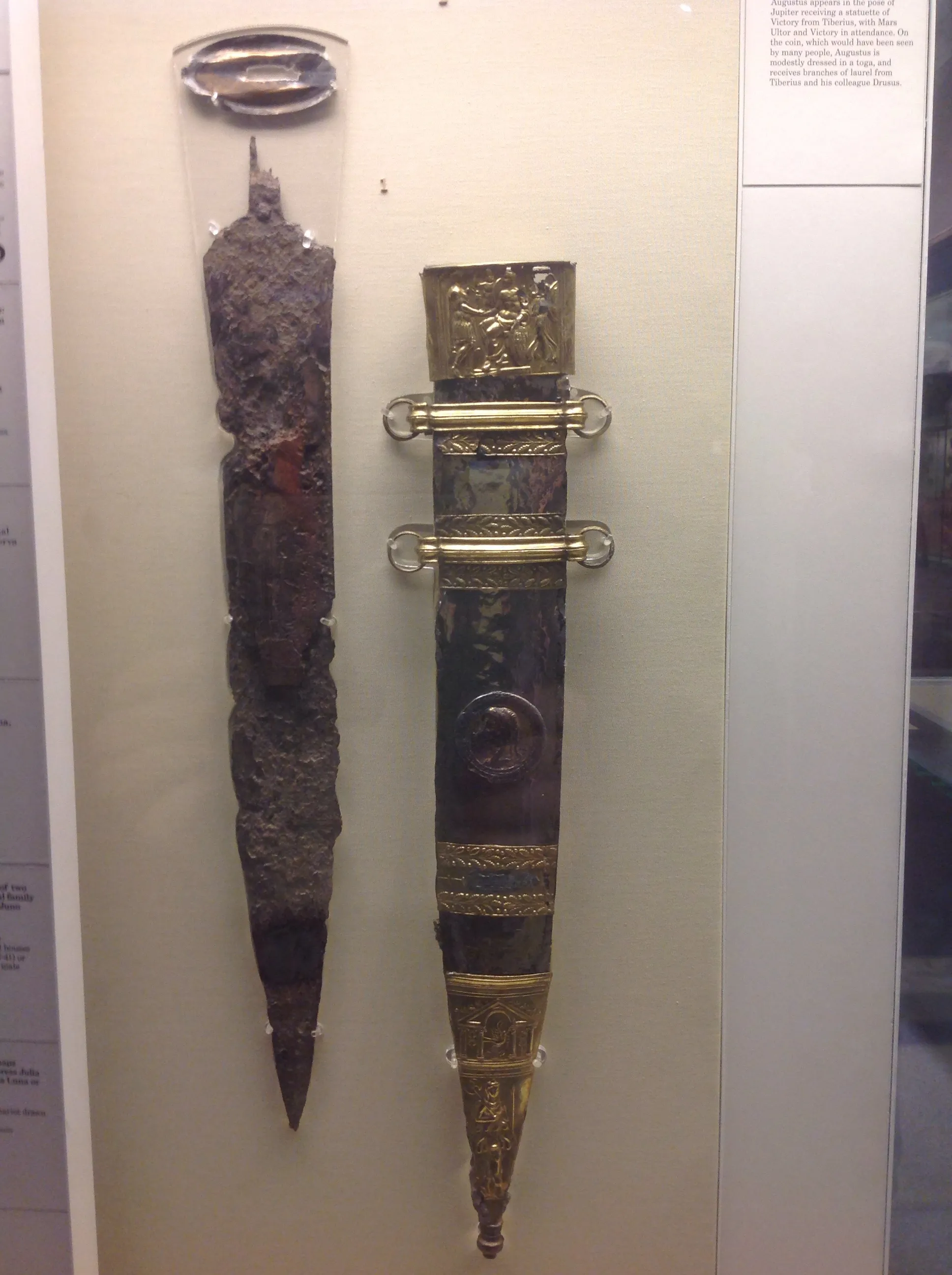
Early republican legions adopted the gladius hispaniensis (Spanish sword) following the Second Punic War. By the reign of Augustus, armorers standardized the weapon into the famous Mainz pattern. The Mainz gladius, such as the celebrated “Sword of Tiberius” excavated in Germany and preserved at the British Museum under registration 1866,0806.1, features an iron blade measuring fifty to fifty-five centimeters in length and up to seven centimeters in width.
The blade tapers with a waist before swelling into a reinforced diamond cross-section and terminating in a long, needle-sharp point measuring up to ten centimeters. This exaggerated point was forged with a thickened central rib designed specifically to puncture ring maille and split bronze breastplates without bending on impact.
By the first century CE, the legion adopted the Pompeii pattern gladius. The Pompeii design straightened the blade edges into parallel lines and shortened the point to a sharp triangular tip. This adjustment made manufacturing cheaper and faster while retaining the rigidity required for repeated forward stabbing through dense shield walls.
SOURCE: Polybius, The Histories 18.30
Greek historian Polybius analyzed this tactical efficiency when comparing the Roman legionary to the Macedonian phalangite. Polybius noted that while the Hellenistic pike required two hands and open ground to operate effectively, the Roman soldier operated behind a large shield with a short, stout sword that could strike in any direction from a protected stance, turning tight melees into a slaughter of enemy infantry.
This doctrine of restrained efficiency mirrors Roman ranged warfare. Roman commanders never relied on the cinematic spectacle of massed archery duels, instead deploying specialized slingers who launched dense inscribed lead bullets capable of shattering skulls through iron helmets. Similar tactical realism guided the diet of Roman arena fighters, where bone isotope studies prove gladiators were not shredded bodybuilders but starch-fed fighters protected by subcutaneous fat layers.
The Human Turn
For the teenage recruit arriving at a legionary training camp in Pannonia or Germania, learning to stab was an exhausting physiological transformation. Soldiers trained with wooden practice swords (rudes) and heavy wicker shields (crates) that weighed twice as much as battle-ready weapons.
Recruits stood before six-foot wooden stakes driven into the earth, practicing the rapid thrust thousands of times daily under the watchful gaze of the camp drillmaster (campidoctor). They were instructed to target specific anatomical zones: the throat, the eyes, the armpit, and the groin. If a soldier defaulted to a swinging cut during sword drill, the drillmaster corrected him with strikes from a hard vine staff (vitis).
On the battlefield, this training produced chilling psychological detachment. A legion did not charge forward with wild war cries. Men advanced in disciplined silence at a measured pace, locked their shields against the enemy line, and began the monotonous mechanical work of puncturing flesh. The legionary did not look for dramatic combat; he stepped forward, punched his iron point into an exposed belly, stepped over the fallen body, and repeated the motion for sixty continuous minutes.
The Artifact
The Sword of Tiberius in the British Museum, with its ornate bronze and silver-plated scabbard depicting Emperor Tiberius receiving Germanicus, looks like an imperial parade weapon. Yet beneath the gilded mythological relief lies a heavy, functional iron blade shaped by decades of frontier warfare.
The diamond cross-section is thick, rigid, and cold. The weapon was built not to slice through air for cameras, but to drive through steel, bone, and flesh with mechanical certainty. It represents an empire that conquered the Mediterranean world through discipline, formation cohesion, and the cold mathematics of the point.
Primary Sources & Archaeological References
- [01]
- [02]
- [03]
- [04]
Related Dossiers
Roman Slingers Wrote Death Notes on Lead Bullets
Excavated lead sling bullets from the Perusine War carry cast inscriptions naming commanders, crude military insults, and mocking surgical threats.
Vikings Did Not Swing Double-Bladed Battle Axes
Surviving Norse axes from Petersen Type A through M have single edges weighing under two pounds, balancing speed and cutting power over fantasy bulk.
The Library of Alexandria Did Not Burn in a Single Cataclysm
Pop culture blames one fire for destroying ancient wisdom. Historical records prove the Library of Alexandria suffered centuries of gradual bureaucratic decay.