Classical Marble Statues Were Painted Garishly
THE MOVIE VERSION
Cinema and neoclassical art galleries present ancient Greece and Rome as worlds of pure, unpainted white marble.
THE RECORD
REF #009Multispectral ultraviolet imaging proves classical statues were coated in saturated mineral pigments, gold leaf, and encaustic wax.
Ancient Greek and Roman marble statues were never meant to be white. Ultraviolet-induced visible luminescence and chemical pigment analyses conducted by archaeologist Vinzenz Brinkmann and the British Museum demonstrate that classical temples, busts, and monumental sculptures were coated in saturated mineral paints. The gleaming monochrome marble celebrated by neoclassical art critics and Hollywood set designers is a historical accident caused by centuries of soil erosion and aggressive museum scrubbing.
The Claim
A citizen of Classical Athens walking through the Acropolis did not see bare white stone. Popular cinema, neoclassical museums, and architectural textbooks present ancient antiquity as a quiet, sterile landscape of polished white marble pillars and chalk-white figures. In the historical reality of the fifth and fourth centuries BCE, sanctuaries were vibrant, intense environments filled with color.
Greek sculptors regarded unpainted marble as incomplete, raw stonework. The white surface of Parian and Pentelic marble was prized not as an aesthetic finish, but as a luminous primer that reflected light through semi-translucent layers of paint. Carvers worked side by side with professional painters to cover human skin in warm ochres, hair in golden yellows, lips in vermilion cinnabar, and tunics in brilliant Egyptian blue.
SOURCE: Pliny the Elder, Naturalis Historia 35.40 (133)
Pliny the Elder documented this artistic collaboration in his thirty-fifth book of Natural History, recording a famous remark by the legendary Athenian sculptor Praxiteles.
“It is this Nicias of whom Praxiteles used to say, when asked which of his own works in marble he placed highest, ‘The ones to which Nicias has set his hand.’” Pliny the Elder, Natural History 35.40 (trans. John Bostock and H.T. Riley)
The greatest sculptor of the fourth century BCE considered his own marble carving incomplete until Nicias, one of the foremost painters of Greece, applied the colored surface finish (circumlitio). The master sculptor did not worship blank stone; he valued the hand that brought the stone to life with paint.
The Mechanism
The application of ancient sculptural polychromy was a sophisticated chemical technology. Artists did not simply brush watery dyes over stone. They utilized the encaustic technique, mixing powdered mineral pigments into molten beeswax and resin.
The molten wax was applied to the porous marble using heated metal spatulas (cauteria). The warm mixture penetrated the crystalline structure of the calcite stone, bonding the pigment securely against wind and rain while creating a gentle, lifelike sheen that resembled living human skin. The finished surface was buffed with linen cloths rubbed in candle oil, a waterproofing process known in Latin as ganosis.
The pigments themselves were costly natural minerals extracted from mines across the Mediterranean and Near East:
Red pigments were produced from cinnabar (mercuric sulfide) imported from Spain or realgar (arsenic sulfide). Blue was synthesized through Egyptian blue (cuprorivaite), a ground calcium copper silicate frit, or imported azurite. Green came from malachite; yellows from iron-rich ochres. Garments were decorated with geometric meanders, checkerboards, and mythical beasts painted in gold leaf and saturated reds.
When statues were buried in moist soil following the collapse of ancient civic sanctuaries, these organic wax binders decomposed over centuries. The mineral pigments flaked away, leaving bare white stone. When early Renaissance antiquarians unearthed these artifacts in Rome during the fifteenth century, they mistakenly assumed that the weathered stone represented the original artistic ideal.
The Evidence
Scientific imaging has definitively exposed the paint hidden on surviving marble. In the 1980s, German classical archaeologist Vinzenz Brinkmann began analyzing ancient sculpture using raking light photography and high-powered ultraviolet fluorescence.
SOURCE: Brinkmann and Wünsche, Gods in Color (2007)
Brinkmann demonstrated that even when all visible paint appears gone to the naked eye, microscopic pigment crystals remain embedded in the marble’s surface pores. Furthermore, different pigments weathered the underlying stone at different rates. Areas painted with lead white shielded the marble from atmospheric corrosion, leaving raised patterns on the stone surface known as “weathering relief.”
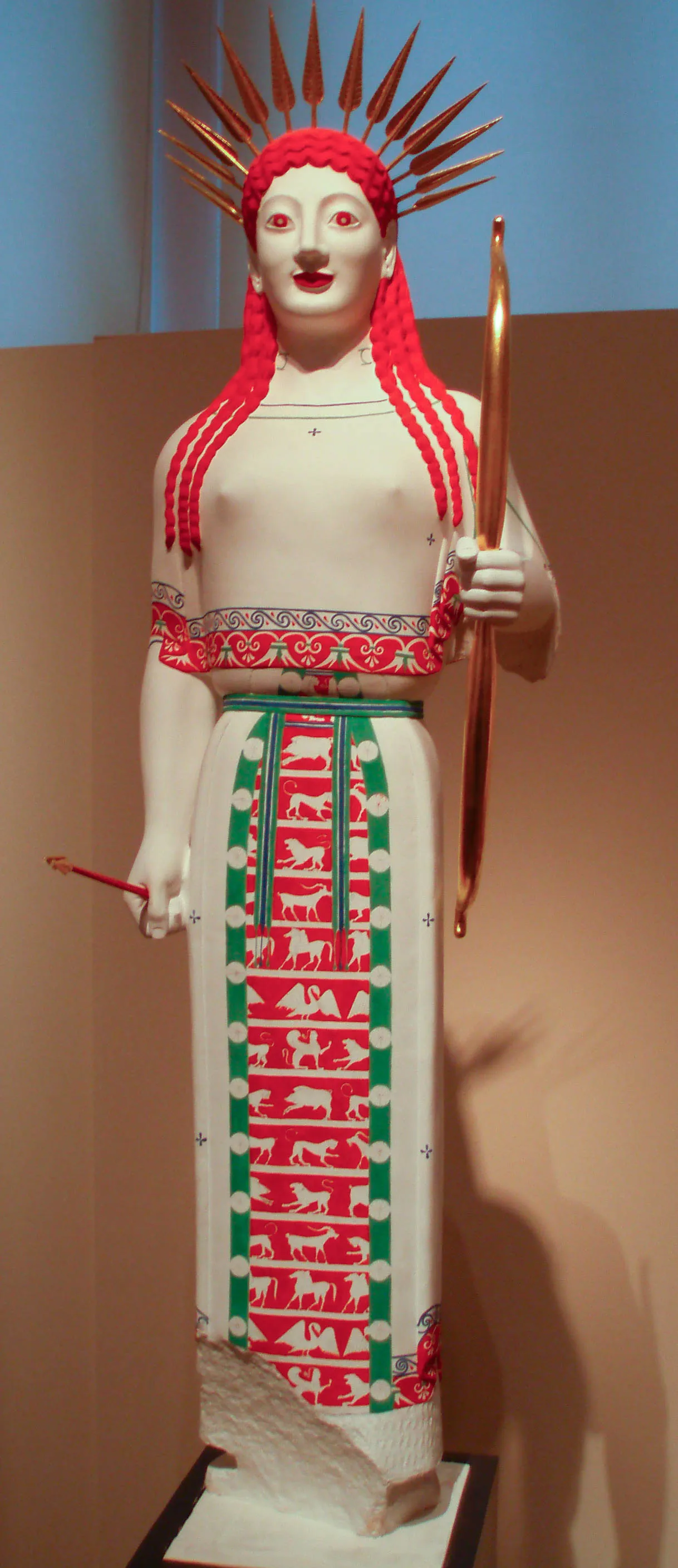
Working with the Glyptothek in Munich and the Liebieghaus Polychromy Research Project, Brinkmann’s team developed the landmark exhibition Gods in Color (Bunte Götter). By measuring trace elements using X-ray fluorescence (XRF) and Raman spectroscopy, researchers created exact plaster and synthetic marble reconstructions of famous artifacts, such as the archaic Peplos Kore from the Acropolis of Athens and the Trojan Archer from the pediment of the Temple of Aphaia at Aegina.
The reconstructions shocked modern museum visitors. The Peplos Kore, carved around 530 BCE, was not a serene white figure. She was clothed in a brilliant saffron-yellow tunic covered in detailed rosettes, animal borders, and geometric bands rendered in intense greens, blues, and reds.
SOURCE: Verri et al., British Museum Technical Research Bulletin 3 (2009)
In 2009, British Museum scientists Giovanni Verri and Thorsten Opper applied visible-induced infrared luminescence (VIL) to the Parthenon sculptures and the Roman “Treu Head.” The infrared imaging detected widespread luminescent traces of Egyptian blue across the folds of the goddesses’ chitons and hair ribbons, proving that the highest achievements of classical monumental sculpture were saturated with blue pigment.
Classical literature confirms that ancient Greeks found unpainted stone strange. In Euripides’s tragedy Helen, written in 412 BCE, Helen laments her devastating beauty and wishes she could alter her appearance just as an artisan washes color away from a statue.
“Could I but strip my beauty off and take a duller aspect, as when one rubs color from a statue.” Euripides, Helen 260-263 (trans. E. P. Coleridge)
Euripides used the removal of paint from a statue as a metaphor for becoming ugly and blank. To an ancient Greek, a white statue was an unpainted, disfigured object.
This gap between cinematic perception and archaeological fact parallels ancient military history. Just as viewers expect classical statues to be pure white, they picture Roman legionaries swinging broadswords in wide theatrical arcs, or imagine gladiators with shredded bodybuilder physiques instead of the starch-fed frames revealed by bioarchaeological digs. The physical record consistently replaces modern minimalism with ancient sensory intensity.
The Human Turn
The myth of white marble was not merely an aesthetic misunderstanding. In the eighteenth century, German art historian Johann Joachim Winckelmann established the intellectual foundation of modern art history with his 1764 work History of the Art of Antiquity.
Winckelmann argued that pure white was the color of supreme beauty, declaring that color was superficial and distracted from noble form. European academies adopted Winckelmann’s neoclassical doctrine, equating white stone with intellectual purity and cultural restraint. When eighteenth and nineteenth-century excavators uncovered statues with surviving paint, museum conservators frequently scrubbed the stone with acid, pumice, and wire brushes to force ancient artifacts into compliance with the neoclassical ideal.
For ancient Greeks and Romans, however, life was lived under a blinding Mediterranean sun. In open-air sanctuaries surrounded by dusty limestone hills and dry summer scrub, a white marble statue reflected glare and washed out fine details. Intense, saturated mineral colors allowed facial expressions, anatomical musculature, and mythological narratives to be read clearly from one hundred paces away.
The Artifact
The painted scientific reconstruction of the Peplos Kore, developed through the research of Vinzenz Brinkmann and Ulrike Koch-Brinkmann, disrupts centuries of comfortable neoclassical assumptions. Her tunic vibrates with detailed geometric bands, and her almond eyes gaze outward with realistic vitality.
Looking at the painted kore forces us to unlearn the clean, sanitized version of antiquity manufactured by later centuries. Ancient Greece and Rome were not quiet mausoleums of white stone. They were loud, bright, sensory worlds where stone was merely the skeleton, and vivid color was the breath of life.
Primary Sources & Archaeological References
- [01]
- [02]
- [03]
- [04]
Related Dossiers
The Library of Alexandria Did Not Burn in a Single Cataclysm
Pop culture blames one fire for destroying ancient wisdom. Historical records prove the Library of Alexandria suffered centuries of gradual bureaucratic decay.
Romans Did Not Salt the Earth at Carthage: The Myth of Scipio
Pop culture claims Scipio sowed Carthage with salt in 146 BCE. Ancient texts and archaeological record prove this nineteenth-century myth never happened.
Julius Caesar Never Said Et Tu Brute: The Greek Curse Record
Shakespeare invented Et tu Brute in 1599. Roman historians Suetonius and Plutarch prove Caesar died in silence or uttered a chilling Greek curse.