The Spartan 300 Did Not Stand Alone at Thermopylae
THE MOVIE VERSION
Popular graphic novels and cinema depict three hundred isolated Spartans holding the narrow pass of Thermopylae alone against the Persian imperial army.
THE RECORD
REF #015Classical accounts prove King Leonidas commanded over seven thousand allied Greeks, and his final stand included seven hundred Thespians who died alongside them.
The defense of Thermopylae in 480 BC is celebrated as the defining martyrdom of Western military history. In modern popular culture, graphic novels, and Hollywood blockbusters, King Leonidas and three hundred Spartan bodyguards march north alone to hold the narrow cliff road against Xerxes and the million-man army of the Persian Empire. The narrative of three hundred solitary warriors sacrificing themselves for Greek freedom is legendary. It is also an erasure of ancient historical reality. Classical texts and archaeological excavations on the battlefield demonstrate that the Spartans never fought alone. Leonidas commanded a federal coalition of over seven thousand Greek soldiers, and when the final encirclement came, seven hundred citizens of Thespiae chose to stay, fighting and dying to the last man alongside the Spartans.
The Claim
The standard popular myth portrays Thermopylae as an exclusively Spartan achievement. In cinema, neighboring Greek city-states are portrayed as terrified amateurs who either fled before combat began or sent token contingents of potters and blacksmiths who broke under pressure.
This narrative was constructed through deliberate Spartan state propaganda and perpetuated by later writers. Sparta maintained an obsessive culture of prestige, projecting invincibility through extreme social discipline, whether by banning gold coinage in favor of iron rods as analyzed in our study of Spartan iron currency, or cultivating legends of austerity.
The Greek historian Herodotus recorded the actual order of battle in the seventh book of his Histories. When Xerxes arrived at the pass, the Greek army barring his advance numbered over seven thousand heavy hoplites:
SOURCE: Herodotus, Histories 7.202-203
“The Hellenes that awaited the Persian in that place were these: of the Spartans three hundred hoplites, of the Tegeans and Mantineans a thousand, from Orchomenus in Arcadia one hundred and twenty, and from the rest of Arcadia a thousand. So many were the Arcadians; from Corinth four hundred, from Phlius two hundred, and from Mycenae eighty. These came from the Peloponnese; from Boeotia there were seven hundred Thespians and four hundred Thebans. Besides these the Opuntian Locrians had answered the summons with all their force, and a thousand Phocians.” Herodotus, Histories 7.202-203 (trans. A. D. Godley)
For two full days of savage frontal assaults, these seven thousand allied Greeks rotated through the phalanx front line, holding the stone Phocian wall and slaughtering Persian infantry, including the elite Immortals.
The Mechanism
To understand why the coalition held the pass so effectively, one must analyze the tactical geography of ancient Thermopylae. In 480 BC, the Malian Gulf washed directly against the northern base of Mount Kallidromo. The pass consisted of three natural bottlenecks, known as the Gates, where the traversable road narrowed to little more than the width of a single wagon track.
Holding a front this narrow did not require vast hordes. It required armored shock troops standing shoulder to shoulder behind interlocking bronze shields. Greek hoplites deployed as a unified phalanx. Their oak shields, bronze greaves, and long cornel-wood thrusting spears outmatched the short wicker shields and light javelins of Persian levies.
Just as disciplined Roman formations relied on tight mechanical thrusts rather than wide swings, as demonstrated in our report on Roman legionary stabbing drills, the allied Greeks functioned as an impenetrable barrier. Allied contingents from Tegea, Mantinea, Corinth, and Thespiae fought in regular rotations. Spartan hoplites were the professional spearhead, but holding the wall depended on the stamina of seven thousand men.
The Evidence
The turning point of the battle arrived when a local Greek named Ephialtes guided Persian forces along the mountain path known as the Anopaea, bypassing the Phocian guard and outflanking the Greek rear. Realizing that the position was lost, Leonidas held a council of war.
Herodotus recorded that Leonidas dismissed the bulk of the allied army to preserve their forces for future defense. However, the common belief that only the three hundred Spartans remained to face death is refuted by primary text:
SOURCE: Herodotus, Histories 7.222
“So the allies who were dismissed departed and obeyed, but the Thespians and the Thebans remained alone with the Lacedaemonians. The Thebans were kept against their will, held as hostages by Leonidas; but the Thespians remained by their own free will. They refused to leave Leonidas and those with him, but stayed and died with them. Their general was Demophilus son of Diadromes.” Herodotus, Histories 7.222 (trans. A. D. Godley)
The seven hundred Thespians who remained represented the entire mobilization of their small Boeotian city. Unlike Sparta, which sent a royal guard of three hundred men out of a warrior citizen body numbering several thousands, Thespiae staked its entire male population on the mountain road. When Leonidas made his final stand on the hillock of Kolonos, the seven hundred Thespians stood beside him. Every single Thespian hoplite was killed.
Furthermore, classical sources document another forgotten contingent: the Spartan helots. Each Spartan took enslaved helot attendants on campaign to carry armor and serve as light infantry. Herodotus recorded in book eight that four thousand Greek dead were buried at Thermopylae. Hundreds of helots fought and died on the hillside beside their masters, yet their names were excluded from public monuments.
In 1939, Greek archaeologist Spyridon Marinatos excavated the Kolonos hill. His team unearthed hundreds of bronze Persian arrowheads and spear points matching fifth-century BC Achaemenid patterns, confirming Herodotus’s account that the encircled rearguard was overwhelmed under volleys of missile fire after spears shattered.
The Human Turn
The erasure of the Thespians from popular memory reveals how political storytelling shapes historical memory. In the aftermath of the Persian Wars, Sparta used its political leverage to cast Thermopylae as a uniquely Spartan achievement. Epitaphs composed by Simonides celebrated the Spartans who lay buried “obedient to their laws,” while the Thespians were relegated to obscure footnotes.
Yet the sacrifice of the Thespians was far more devastating to their community than the loss of three hundred men was to Sparta. Thespiae was burned to the ground by Xerxes weeks later, and its citizen body was so depleted that decades elapsed before the city recovered.
Just as biographers invented sensational myths about Spartans throwing deformed infants into mountain chasms, disproved by osteological excavations as shown in our investigation of Spartan infanticide myths, modern popular culture preferred a myth of three hundred supermen over the reality of a democratic coalition.
Demophilus and his seven hundred Thespians did not possess the lifelong training of the Spartan agoge. They were citizen farmers, tradesmen, and landowners. When offered the chance to retreat safely to their families, they chose voluntarily to die beside Leonidas in a hopeless tactical rearguard.
The Artifact
The material reality of this joint defense is preserved in the Kolonos Hill excavation finds, curated in the National Archaeological Museum in Athens.
Among the recovered objects are triangular three-bladed socketed bronze arrowheads characteristic of Persian archers. Alongside these missile points are Greek iron spear ferrules, known as sauroters. Several butt-spikes show deep impact deformation from repeated thrusts into gravel and bronze armor.
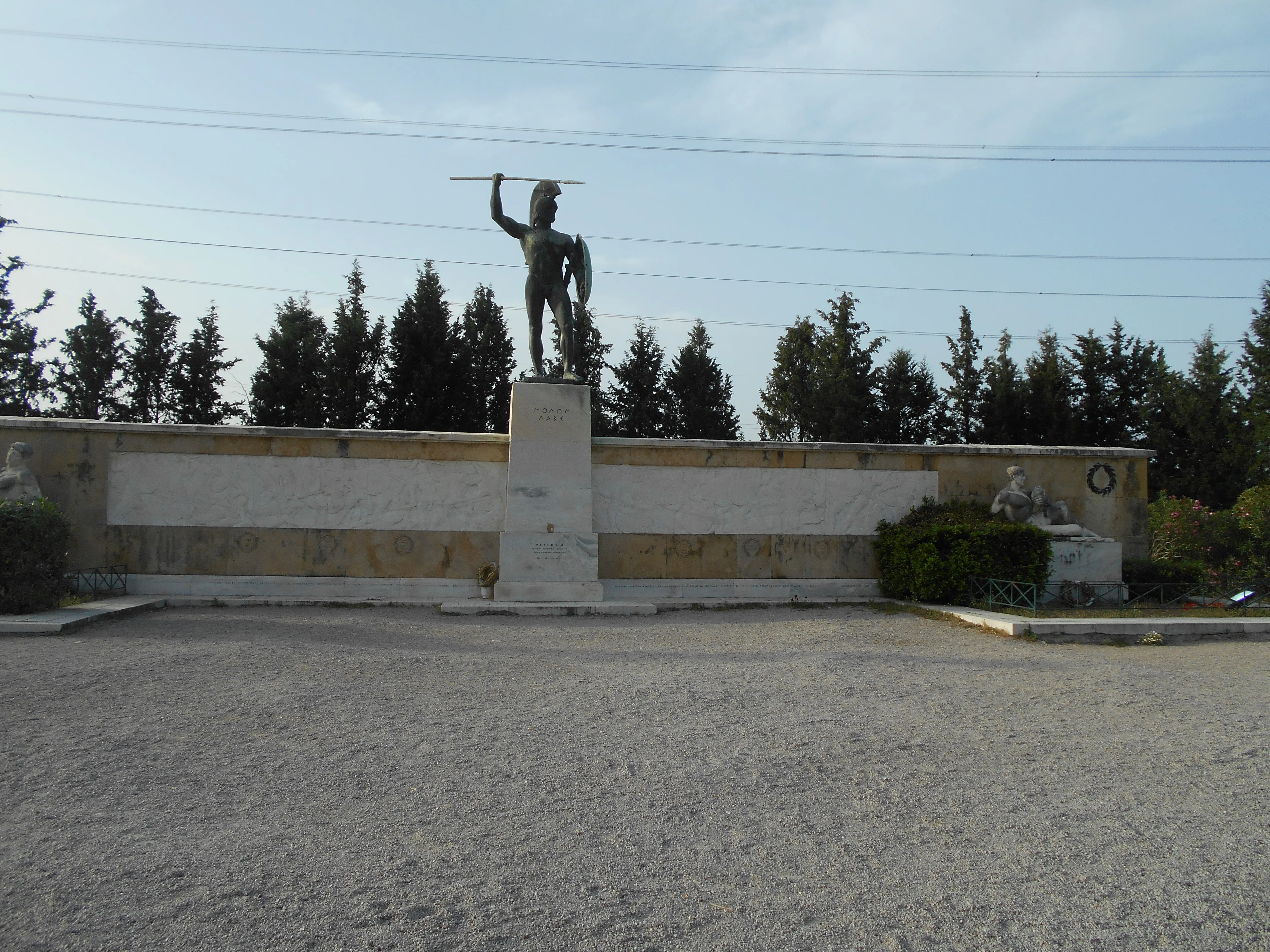
Near the modern highway at Thermopylae stands the famous bronze monument of Leonidas. But adjacent to the Spartan memorial stands a second, smaller monument erected to honor the seven hundred Thespians. It depicts a bronze statue of Eros, the god patronizing civic brotherhood in ancient Thespiae, with an inscription commemorating the seven hundred who refused to abandon their allies.
The archaeological and literary record stands clear. Thermopylae was not the triumph of three hundred isolated warriors. It was the collective sacrifice of thousands of allied Greeks, led to the end by three hundred Spartans and seven hundred forgotten Thespians who shared their grave.
Primary Sources & Archaeological References
- [01]
- [02]
- [03]
- [04]
Related Dossiers
Spartans Were Not Mindless Grunters: The Art of Laconic Wit
Pop culture depicts Spartans as illiterate brutes. Plato and Plutarch prove Laconic wit was the most admired, calculated verbal art in classical Greece.
Spartans Did Not Throw Weak Babies off Cliffs
Excavations of the Taygetos chasm revealed dozens of adult execution victims but zero infant bones, refuting Plutarch's famous Spartan infanticide myth.
Spartan Iron Currency: The Ban on Gold and Silver
Plutarch and British School excavations prove Sparta banned precious coins, enforcing brittle iron spits quenched in vinegar to crush commercial luxury.