Julius Caesar Never Said Et Tu Brute: The Greek Curse Record
THE MOVIE VERSION
Pop culture portrays Julius Caesar gasping his famous dying words in Latin: Et tu, Brute? before collapsing at the feet of Pompey's statue.
THE RECORD
REF #023Classical Roman sources record Caesar made no sound except an initial groan, or at most uttered a chilling Greek curse: Kai su, teknon.
No quotation in world history is more famous than the dying words attributed to Gaius Julius Caesar. On the Ides of March in 44 BCE, inside the Curia of Pompey in Rome, a conspiracy of senators draws daggers from their togas. As the dictator bleeds from multiple wounds, his trusted protege Marcus Junius Brutus steps forward to deliver a blow. Seeing the young man he loved like a son, Caesar collapses in heartbroken resignation, gasping in Latin: Et tu, Brute? (“And you, Brutus?”).
The moment is theatrical perfection: intimate, tragic, and iconic.
It is also an absolute literary invention.
Julius Caesar never spoke the phrase Et tu, Brute. The Latin line does not exist in any ancient Roman historical document. It was coined sixteen centuries later by William Shakespeare for an Elizabethan playhouse. When examined through surviving Roman accounts and classical forensics, the true death of Caesar was far bleaker: a desperate physical brawl followed by stoic silence, or, according to a rival classical tradition, a menacing ancient Greek death curse.
The Claim
The belief that Caesar uttered Et tu, Brute on the Senate floor stems entirely from sixteenth-century English theater.
In 1599, William Shakespeare wrote The Tragedy of Julius Caesar for performance at the Globe Theatre in London. In Act 3, Scene 1, line 77, Shakespeare had the dying dictator speak the Latin line before falling:
“Et tu, Brute? Then fall, Caesar.”
Shakespeare did not find this phrase in classical texts. He likely borrowed it from Richard Eedes’s 1582 Oxford Latin play Caesar Interfectus, or the 1595 drama The True Tragedy of Richard Duke of York. By the late Renaissance, English schoolboys recited Shakespeare’s line as historical fact, cementing the phrase into Western vernacular culture.
Yet an exhaustive search of classical literature confirms that no ancient Roman historian, from Cicero and Livy to Seneca and Tacitus, ever recorded Caesar speaking those words.
The Mechanism
The biological trauma of the assassination and ancient aristocratic etiquette reveal why a formal dying speech was impossible:
First, consider the physical mechanics of the assault. When Tillius Cimber seized Caesar’s toga to pin his shoulders, Servilius Casca struck first, slashing Caesar across the neck. Caesar fought back instantly, driving his iron writing stylus (graphium) through Casca’s arm. Within seconds, more than twenty conspirators surrounded him, thrusting their daggers in a frenzied circle, accidentally cutting each other’s hands. The assassins attacked not with wide slashing motions, but with close-quarter stabbing, mirroring the lethal infantry tactics examined in our analysis of Roman gladius combat.
Second, forensic medicine explains the physiological reality of Caesar’s final moments. Following the murder, the physician Antistius examined the corpse in the first recorded medical autopsy in Western history. Antistius determined that of the twenty-three stab wounds, only one was fatal: a penetrating thrust through the chest between the first and second ribs. That blade punctured Caesar’s left lung and severed major thoracic blood vessels.
When a lung is punctured and the thoracic cavity fills with arterial blood, intrapleural pressure collapses the respiratory tract. A victim suffocates rapidly on his own blood while entering hypovolemic shock. Caesar could not have delivered a clear philosophical sentence; he was choking on his own blood.
The Evidence
Surviving accounts from the three greatest classical chroniclers of the assassination demolish the Shakespearean myth:
The imperial biographer Gaius Suetonius Tranquillus, writing in the second century CE with access to palace archives, provides the most explicit description of Caesar’s vocalizations:
SOURCE: Suetonius, The Lives of the Twelve Caesars: The Deified Julius, Chapter 82
“And thus he was stabbed with three and twenty wounds, uttering not a word, but merely a groan at the first stroke; though some have reported that when Marcus Brutus rushed at him, he said: ‘Kai su, teknon;’” Suetonius, Life of Julius 82 (trans. J. C. Rolfe)
Suetonius records that Caesar’s predominant historical reaction was total silence after an initial guttural groan (sine voce edito). He uttered no dying speeches.
The Greek historian Plutarch, writing around the same period in his Life of Caesar, confirms Caesar’s refusal to speak once the daggers converged:
SOURCE: Plutarch, Parallel Lives: Life of Caesar, Chapter 66
“When he saw Brutus with his sword drawn, he pulled his toga over his head and gave up his body to the blows.” Plutarch, Life of Caesar 66 (trans. Bernadotte Perrin)
Plutarch records that Caesar maintained the solemn dignity required of a Roman aristocrat. Recognizing that escape was impossible, he arranged his robes to cover his legs and enveloped his face in his hood, ensuring that he fell honorably without exposing his dying contortions to the crowd.
What about the secondary tradition that Caesar spoke the Greek words Kai su, teknon (“You too, child”)?
Modern readers who interpret this phrase as an affectionate whimper misunderstand ancient elite linguistics. Upper-class Romans spoke fluent Greek as their private language of culture. Furthermore, classicists note that in Hellenistic tragedy and Mediterranean folklore, Kai su functioned as an apotropaic curse formula: “The same to you, boy.”
Rather than weeping in betrayed heartbreak, Caesar was issuing an ominous death-curse. Just as Roman slingers etched curses into their lead bullets, as documented in our study of inscribed Roman ammunition, Caesar was telling Brutus: “May your fate be the same as mine.” Two years later, at the Battle of Philippi in 42 BCE, Brutus took his own life after his army was crushed.
The Human Turn
The enduring popularity of Et tu, Brute reflects our need to transform brutal political violence into moral tragedy.
Assassinations in the real world are chaotic, bloody, and terrifyingly abrupt. They do not pause for philosophical epigrams. In stabbing Caesar to death, the conspirators triggered fourteen years of civil war that obliterated the Roman Republic and established autocratic rule under Augustus. Just as the political drama of the arena weaponized public spectacle, as seen in our analysis of Roman arena gestures, Caesar’s death was a raw display of factional slaughter.
Shakespeare understood that theatrical audiences crave psychological closure. A great conqueror who subjugated Gaul could not simply collapse under a flurry of panicked daggers like a slaughtered ox. He needed a poetic moment of recognition: the realization that personal affection cannot survive political ambition.
By replacing Caesar’s silent suffocation with a Latin cry of betrayal, Shakespeare gave humanity an enduring symbol of treason. But in doing so, modern culture forgot the hard Roman reality: Gaius Julius Caesar died as he had lived, locked in ruthless aristocratic combat, pulling his cloak across his face in defiant silence.
The Artifact
The material record of Caesar’s assassination survives in Roman sculpture and numismatics:
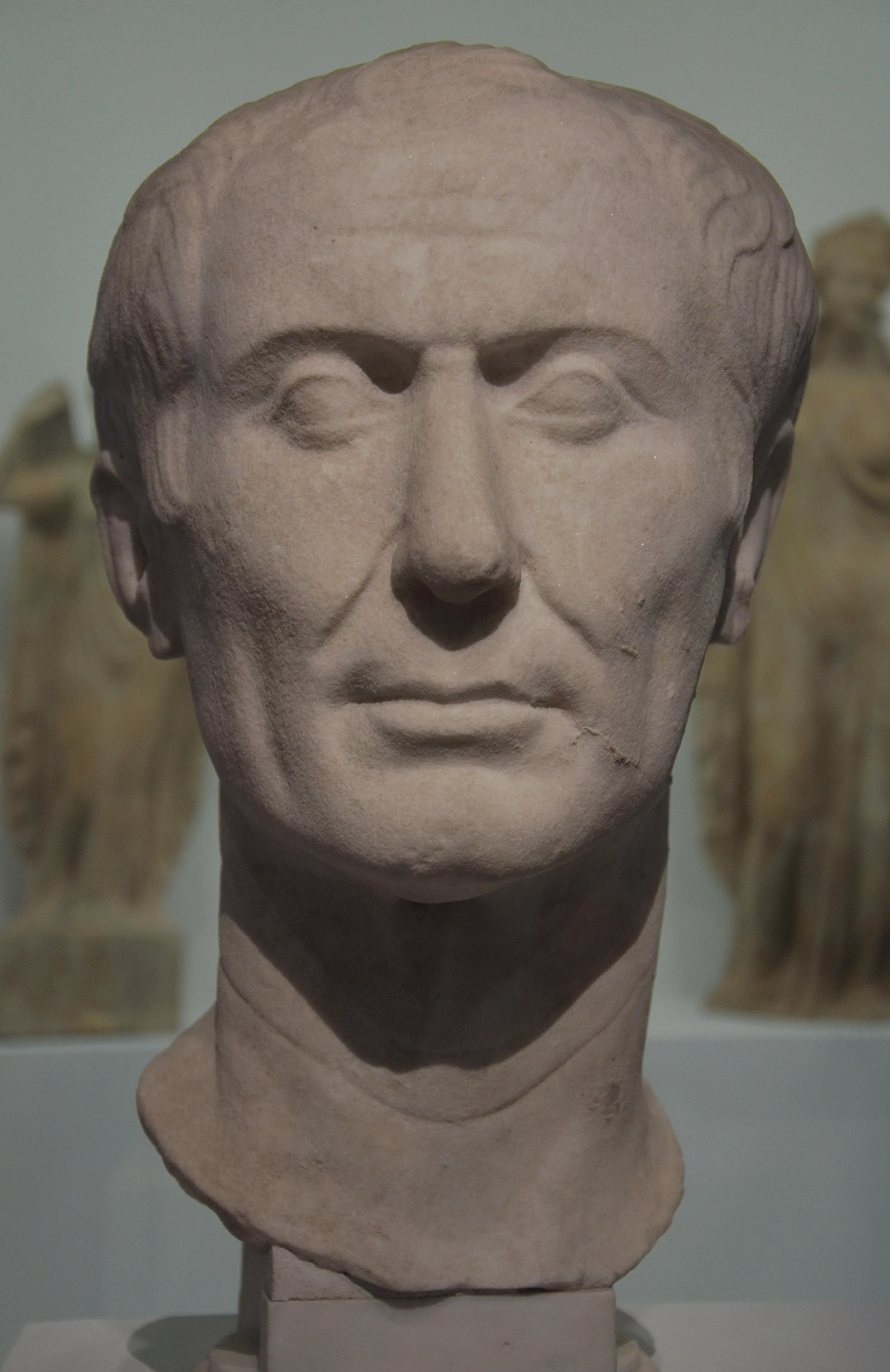
In the Museo di Antichita in Turin, the celebrated Tusculum portrait (inventory 2089) preserves the only surviving likeness of Julius Caesar sculpted during his lifetime, between 50 and 44 BCE. Excavated in 1825 by Lucien Bonaparte at ancient Tusculum, the fine marble bust depicts a gaunt, wrinkled, aging commander with a thinning hairline and hollow cheeks, capturing the physical reality of the dictator in his final months.
In coin cabinets such as the British Museum (registration 1860,0328.32), historians can examine the notorious silver denarius struck in 42 BCE by Marcus Junius Brutus himself. Known as the EID MAR coin, the reverse features two assassination daggers flanking the pileus (the felt cap given to freed slaves), accompanied by the date of the murder.
On this tiny piece of silver, Brutus celebrated the assassination as an act of liberation. Yet the daggers depicted on the coin struck down a man whose real final moments were defined by silent dignity, not Elizabethan Latin poetry.
Primary Sources & Archaeological References
- [01]
- [02]
- [03]
- [04]
Related Dossiers
Romans Did Not Salt the Earth at Carthage: The Myth of Scipio
Pop culture claims Scipio sowed Carthage with salt in 146 BCE. Ancient texts and archaeological record prove this nineteenth-century myth never happened.
Nero Did Not Fiddle While Rome Burned: The Antium Relief Record
Tacitus proves Nero was thirty miles away in Antium when Rome caught fire. He rushed back to build refugee shelters and slash grain prices, not play violin.
Roman Vomitoriums Were Not for Puking: The Exit Hall Myth
Roman vomitoria were not decadent banquet regurgitation rooms. Classical texts and amphitheater engineering prove they were crowd evacuation tunnels.