Medieval People Did Not Believe the Earth Was Flat: The 1828 Hoax
THE MOVIE VERSION
Schoolbooks depict Christopher Columbus begging dogmatic medieval clerics to believe the Earth was round rather than flat.
THE RECORD
REF #022Every educated medieval scholar knew the Earth was spherical; the royal committee rejected Columbus because his math on Earth's size was wrong.
Generations of schoolchildren grew up learning a famous dramatic scene: in 1492, Christopher Columbus stood before Catholic bishops at Salamanca. The clerics warned him that the world was flat like a tabletop, claiming that ships sailing too far west would plunge off the edge into an abyss. Defying medieval superstition, Columbus sailed into the uncharted Atlantic and proved that the Earth was a sphere.
The story is inspiring and deeply entrenched in modern lore.
It is also a total fabrication invented in the nineteenth century.
In the real Middle Ages, no educated person believed the Earth was flat. From church fathers to university professors and navigators, medieval thinkers agreed unanimously: the Earth was a celestial sphere. The sphericity of the planet was taught in every medieval university. When royal geographers challenged Columbus in Spain, they did not argue about whether the Earth was round. They argued about how big it was. The royal scientists were mathematically correct, and Columbus was dangerously wrong.
The Claim
The myth of the medieval flat Earth was invented in 1828 by the popular American author Washington Irving.
Best known for writing The Legend of Sleepy Hollow, Irving published a romantic biography titled A History of the Life and Voyages of Christopher Columbus. Seeking to create a heroic narrative of American enlightenment, Irving fabricated the confrontation between Columbus and the council at Salamanca. He invented scenes where superstitious inquisitors brandished scripture against the lone visionary sailor.
Six years later, in 1834, French academic Antoine-Jean Letronne published an essay titled On the Cosmographical Ideas of the Church Fathers. Letronne, eager to depict the Middle Ages as an era of darkness, seized on two obscure ancient authors, Lactantius and Cosmas Indicopleustes, who had advocated a flat earth.
Letronne falsely presented these fringe figures as the consensus of the medieval Church. In reality, Cosmas was an obscure Syrian monk whose Greek work was unknown in the Latin West throughout the Middle Ages, remaining untranslated until 1706.
Nineteenth-century polemicists embraced Irving’s drama and Letronne’s distortions because it supported the narrative that science and religion were locked in perpetual warfare. Just as Victorian writers imagined that medieval towns avoided water out of irrational dread, as examined in our study of medieval waterworks, Victorian intellectuals created an imaginary flat Earth to make their own century look enlightened.
The Mechanism
The true scientific debate of 1492 centered on spherical geodesy, not planar geometry:
Ancient Greek astronomers had determined that the Earth was spherical eighteen centuries before Columbus. Around 240 BCE, Eratosthenes calculated the circumference of the Earth using solar shadows, arriving at a figure close to forty thousand kilometers (twenty-four thousand nine hundred miles). In the second century CE, Claudius Ptolemy codified these spherical measurements in his Geographia, which became the foundational geographic text of late medieval Europe.
When Columbus proposed sailing west to reach Asia, the commission appointed by Queen Isabella at Salamanca evaluated his proposal using standard Ptolemaic geography:
- The True Distance: Spanish royal cosmographers knew the Earth was forty thousand kilometers around. They calculated that sailing west from the Canary Islands to Japan required crossing ten thousand nautical miles of open ocean.
- The Provisioning Barrier: Fifteenth-century caravels could carry provisions for only several months. Crossing ten thousand miles without resupply was suicide; the crew would perish of thirst and starvation.
- Columbus’s Flawed Math: To make his voyage appear feasible to investors, Columbus manipulated geographic data. He used calculations from ninth-century Persian astronomer Al-Farghani, but Columbus mistakenly assumed Al-Farghani was measuring in shorter Roman miles rather than longer Arabic miles.
By stacking errors, Columbus shrank the Earth’s circumference by twenty-five percent and stretched Asia far eastward. The Salamanca commission rejected his voyage not because they feared an abyss, but because they knew his math was wrong. Columbus survived solely because an unexpected continent blocked his path.
The Evidence
Surviving manuscripts from every century of the Middle Ages demonstrate universal agreement regarding the Earth’s spherical shape:
In the eighth century, the English monk Bede the Venerable wrote De Temporum Ratione (On the Reckoning of Time), the foundational science textbook of the early Middle Ages. In chapter thirty-two, Bede explicitly refutes any idea of a flat disk:
SOURCE: Bede the Venerable, De Temporum Ratione, Chapter 32 (c. 725 CE)
“The cause why the same days are not of equal length all over the world is the roundness of the earth, for not without reason is it called ‘the globe of the earth’ on the pages of Holy Scripture and of ordinary literature. It is, in fact, set like a sphere in the middle of the whole universe… not round like a shield, nor like a wheel, but rather like a ball.” Bede, De Temporum Ratione 32 (trans. Faith Wallis)
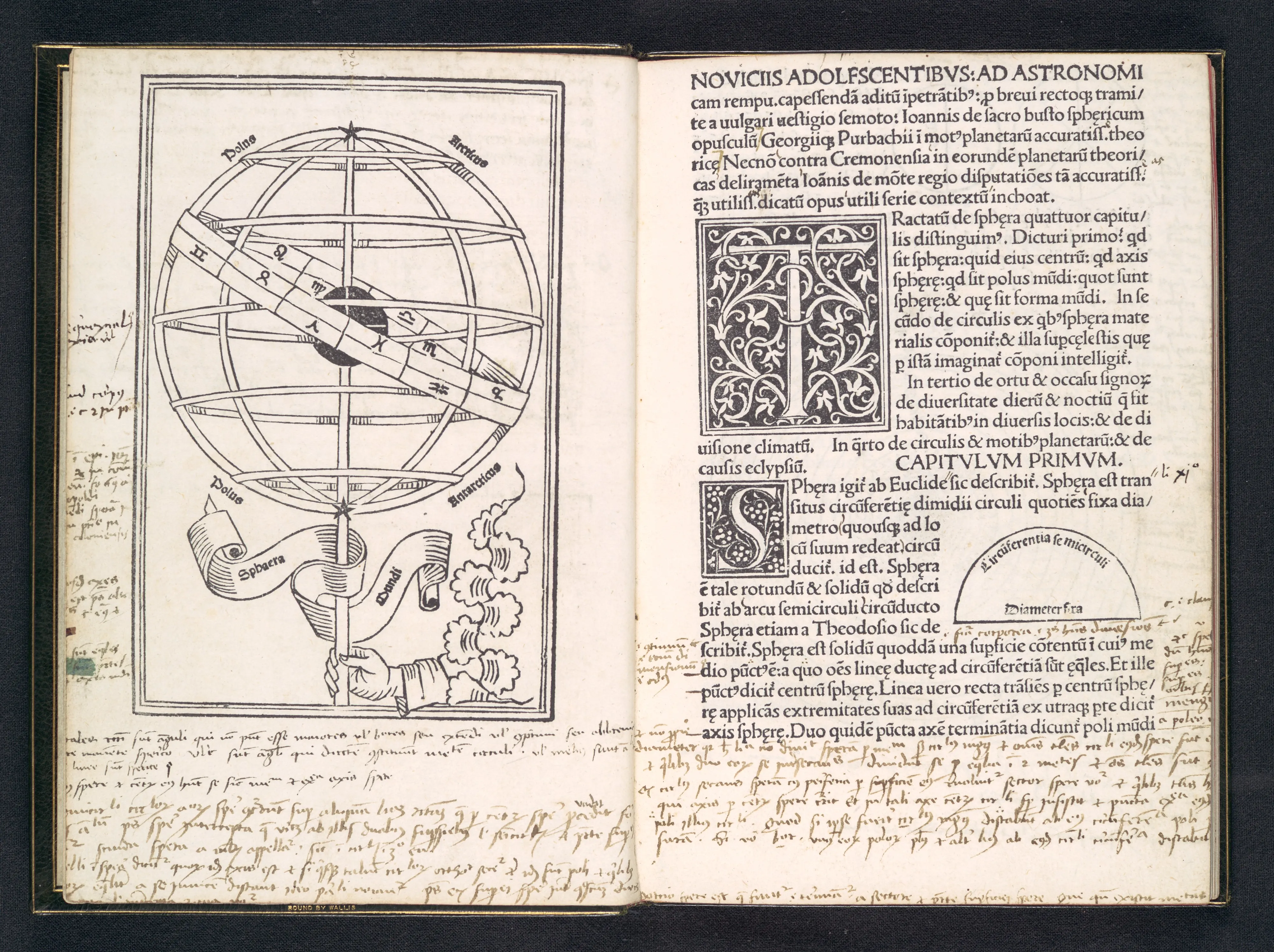
Five centuries later, Johannes de Sacrobosco, an astronomy professor at the University of Paris, composed Tractatus de Sphaera (circa 1230). This volume became the required astronomy textbook in every European university for four centuries. Sacrobosco proved the sphericity of the Earth using empirical proofs: ships disappearing hull-first over the horizon, different constellations visible as travelers move south, and lunar eclipses casting circular shadows on the moon.
In theological philosophy, Saint Thomas Aquinas opened his Summa Theologiae (circa 1265) by citing the roundness of the Earth as an uncontroversial truth:
SOURCE: Thomas Aquinas, Summa Theologiae, First Part, Question 1, Article 1
“The astronomer and the physicist both demonstrate the same conclusion: for example, that the earth is round: yet the astronomer does so through mathematics, while the physicist does so through matter.” Thomas Aquinas, Summa Theologiae 1.1.1
Even popular poetry took the spherical planet for granted. In Dante Alighieri’s Divine Comedy (circa 1314), Dante and Virgil descend through Hell to the center of the Earth. As they climb past Satan’s waist, gravity reverses, and Virgil turns upside down to climb toward the southern hemisphere.
The Human Turn
Why does the flat Earth myth refuse to die in modern consciousness?
The answer lies in our cultural need for a dark age. Modern society takes pride in an unbroken narrative of linear progress. To feel confident in our contemporary enlightenment, we require a backward period of superstitious fools stumbling through darkness until modern heroes rescued humanity.
We transformed medieval thinkers into caricatures who thought swords were blunt bludgeons, as disproved in our analysis of medieval metallurgy, or clumsy buffoons hoisted onto horses with cranes, as debunked in our study of knight mobility. Believing that medieval scholars thought the world was flat satisfies that same psychological impulse.
The historical reality is far richer. Medieval scholars lived in a universe governed by geometry, logic, and observation. They knew the world was round, studied its curved shadows, and measured celestial spheres under night skies.
The Artifact
The physical proof of medieval astronomical consensus is embodied in the visual material culture of the era:
The Metropolitan Museum of Art in New York preserves an incunable edition of Sacrobosco’s Sphaera Mundi, printed in Venice in 1485 by master printer Erhard Ratdolt. Seven years before Columbus set sail, Ratdolt illustrated the text with woodcut diagrams demonstrating the curvature of the ocean, complete with a ship sailing over a curved water surface where the mast remains visible long after the hull sinks beneath the horizon.
Throughout the Middle Ages, European monarchs held the Globus cruciger (the cross-bearing orb) during coronation ceremonies. Surviving regalia in Vienna and London show gold spheres topped with Christian crosses dating back to the fifth century, physically symbolizing imperial rule over the spherical Earth.
In parchment and gold, in university curricula and royal regalia, the medieval record is clear: no one fell off the edge of the world, because everyone knew there was no edge to find.
Primary Sources & Archaeological References
- [01]
- [02]
- [03]
- [04]
Related Dossiers
Medieval People Did Not Die at Thirty: The Life Expectancy Fallacy
Pop culture claims medieval people died of old age at thirty. Cemeteries and records prove adults routinely lived well into their sixties and seventies.
Medieval People Did Not Drink Beer Instead of Dirty Water
Medieval Europeans did not avoid water out of fear of poison. Medical manuscripts and civic pipe records prove clean water was prized and drunk daily.
Medieval Chastity Belts Were Nineteenth-Century Fakes
Museum metallurgical tests and archival studies revealed that supposed medieval chastity belts are Victorian forgeries inspired by a 1405 satirical joke.