The Library of Alexandria Did Not Burn in a Single Cataclysm
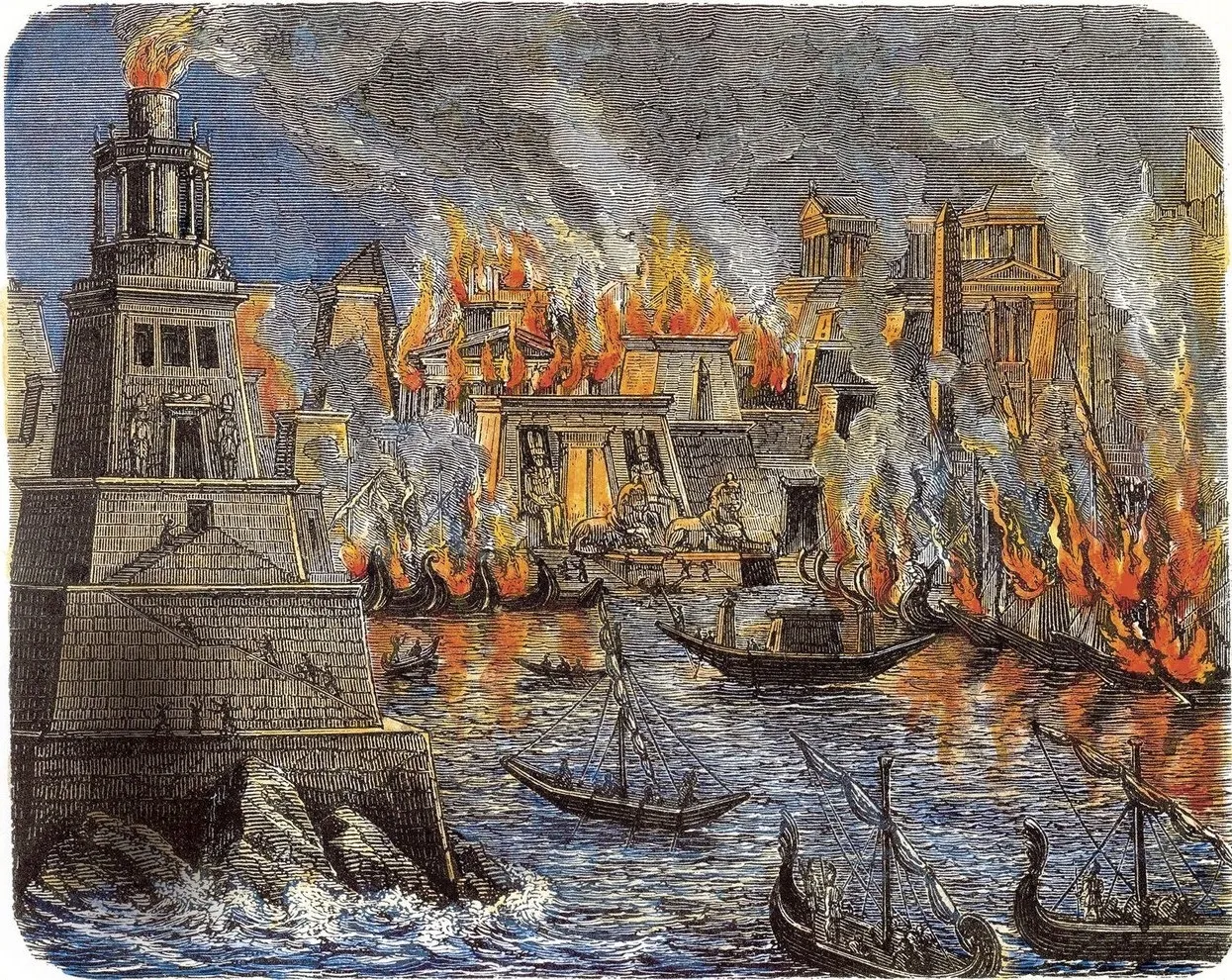
THE MOVIE VERSION
Cinema and popular lore depict the entire Great Library consumed in a single apocalyptic blaze, setting human civilization back a thousand years overnight.
THE RECORD
REF #027Ancient sources confirm the library never suffered a single fatal fire, but decayed over four centuries through budget cuts, warfare, and uncopied papyrus rot.
In modern popular culture, cinematic drama, and internet history memes, the destruction of the Great Library of Alexandria is treated as the greatest tragedy in human intellectual history. Movies like Agora and television documentaries portray a towering temple of wisdom suddenly engulfed in towering walls of flame. Thousands of screaming scholars clutch their robes as millions of priceless scrolls turn to ash in a single afternoon.
The internet laments that if Alexandria had not burned, humanity would have colonised the stars by the seventeenth century.
The story is cinematic, heartbreaking, and deeply satisfying.
It is also an absolute historical fabrication.
The Library of Alexandria was never destroyed in a single apocalyptic blaze. No single conqueror burned all the books of the ancient world. Ancient texts, imperial decrees, and archaeological excavations in Egypt demonstrate that the Great Library suffered a far more mundane fate: four centuries of bureaucratic neglect, imperial budget cuts, regional civil wars, and the natural decay of uncopied papyrus in Mediterranean moisture.
The Claim
The popular myth insists that ancient civilization stored all human knowledge in a single building in Alexandria, and that a single catastrophic fire wiped out classical science overnight.
Depending on who tells the story, the villain changes:
- Julius Caesar (48 BCE): Caesar is accused of setting fire to his own fleet in the Alexandrian harbor, causing flames that swept inland and consumed hundreds of thousands of scrolls.
- Patriarch Theophilus (391 CE): Christian mobs under the Bishop of Alexandria are portrayed as storming the library, tearing down classical philosophy, and burning ancient science to establish religious hegemony.
- Caliph Omar (642 CE): Arab conquerors are falsely accused of using thousands of Greek manuscripts as fuel to heat the city public bathhouses for six months.
This narrative suggests that classical society went from radiant enlightenment to intellectual darkness because someone threw a torch into a single repository.
Just as modern mythmakers falsely assumed that medieval people believed the Earth was flat, as disproved by primary university curriculums in our analysis of medieval cosmological science, or that classical statues were carved in pristine white marble, as revealed by pigment chemistry in our study of Greek and Roman polychromy, popular history prefers a dramatic fable over complex historical reality.
The Mechanism
How did the myth of a single catastrophic fire take root?
The legend is the product of ancient rhetorical exaggeration magnified by modern romantic storytelling:
First, Roman writers loved large, theatrical numbers. The philosopher Seneca, quoting the lost histories of Livy, claimed that forty thousand books burned during Caesar’s harbor conflict in 48 BCE. By the time the fourth-century historian Ammianus Marcellinus repeated the story, forty thousand had inflated to seventy thousand. Later Byzantine compilers inflated it further to seven hundred thousand.
Second, the Arabic bathhouse legend is a complete medieval fabrication. It does not appear in any contemporary Muslim, Christian, or Jewish chronicles for more than five hundred years after the Arab conquest of Egypt. It surfaced for the first time around 1200 CE in the writings of Abd al-Latif al-Baghdadi and Gregory Bar Hebraeus, written during the Crusades as a standard anti-conquest rhetorical trope.
Third, the organic reality of ancient books made single-day obliteration unnecessary. Ancient books were written on papyrus, a plant-based material manufactured in the Nile Delta. In the humid, salty maritime atmosphere of Alexandria, papyrus brittle fibers decayed within one to two centuries unless constantly copied by hand onto fresh rolls. When state funding dried up, ancient books died silently of mold and dry rot.
The Evidence
The primary textual evidence proves that the intellectual institution of Alexandria survived long after its supposed destructions:
When Julius Caesar fought the Alexandrian War in 48 BCE, as examined in our study of Caesar political career, he ordered Roman soldiers to burn Egyptian warships in the harbor. The Roman historian Cassius Dio explicitly records what caught fire: the flames did not consume the royal Mouseion inside the palace quarter, but rather dockside warehouses (apothekai) near the harbor that held commercial grain and bundles of blank or export papyrus.
Proof of the library survival is confirmed by the Greek geographer Strabo. Strabo visited Alexandria around 25 BCE, more than twenty years after Caesar supposed destruction of the library. Strabo describes walking through the Mouseion, admiring its covered colonnades, its public garden, and the great dining hall where scholars lived and debated on royal stipends. Strabo mentions no fire, no ruins, and no loss of scholarship.
The decline of Alexandrian scholarship was financial and political, not pyrotechnic:
- Roman Budget Austerity: Under the Ptolemaic kings, the library received unlimited royal subsidies to purchase every scroll entering the Mediterranean. Under Roman rule, Alexandria became a provincial tax asset. Roman emperors reduced stipends and diverted intellectual resources to new public libraries in Rome.
- Caracalla’s Purge (215 CE): Roman Emperor Caracalla stripped the Mouseion of its civic privileges, abolished membership subsidies, and expelled foreign scholars after the citizens insulted his lineage.
- Aurelian’s Civil War (272 CE): When Queen Zenobia of Palmyra seized Egypt, the Roman Emperor Aurelian laid siege to Alexandria. In the brutal urban street fighting, Aurelian destroyed the entire royal quarter (Bruchion) where the original library stood.
- The Serapeum Riots (391 CE): When Patriarch Theophilus destroyed the Serapeum temple complex under the anti-pagan decrees of Theodosius I, contemporary Christian historians Socrates Scholasticus and Sozomen described the demolition of pagan shrines and statues. Neither historian mentions burning books; the Serapeum library collections had largely dispersed decades earlier.
Ancient scholarship was not concentrated in a single fragile basket. Copies of classical texts existed in hundreds of municipal and private libraries across Rome, Athens, Antioch, Pergamon, and Constantinople. Texts were lost because readers stopped paying scribes to recopy them from deteriorating papyrus scrolls onto durable parchment codices.
The Human Turn
Why do we mourn the burning of Alexandria with such personal, visceral grief?
The myth serves an emotional purpose: it provides a scapegoat for human ignorance.
It is comforting to imagine that human history possesses a clear villain. If we can blame a single fire, an arrogant Roman general, or religious fanatics for destroying the secrets of the ancients, we relieve ourselves of the uncomfortable truth: human societies lose knowledge through simple boredom, indifference, and shifting cultural priorities.
Centuries of classical poetry, drama, and mathematics vanished not because soldiers set them on fire, but because generations of medieval readers simply chose not to copy them. When a civilization stops valuing an idea, no fire is required to erase it.
The Artifact
The physical reality of late antique scholarship in Alexandria was uncovered by modern archaeology at Kom el-Dikka:
Between 1960 and the early 2000s, the Polish Centre of Mediterranean Archaeology excavated an extensive urban complex in central Alexandria. Instead of finding ashes from a fourth-century fire, archaeologists uncovered twenty-two lecture halls and auditoria dating from the fifth and sixth centuries CE.
These auditoria featured semi-circular stone benches, elevated chairs for lecturing professors, and acoustic design that accommodated thousands of students simultaneously. Long after the supposed destruction of the Great Library, Alexandria remained the premier center of medical, philosophical, and grammatical instruction in the eastern Mediterranean.
Surviving papyrus fragments from Oxyrhynchus, preserved in the dry desert sands of Middle Egypt, show that private citizens continued copying Homer, Plato, and Euclid well into the Byzantine period.
The true history of ancient knowledge is not a single plume of smoke rising above the Mediterranean. It is a story of stone lecture halls that outlasted empires, and ink quietly fading on neglected sheets of reed.
Primary Sources & Archaeological References
- [01]
- [02]
- [03]
- [04]
Related Dossiers
Classical Marble Statues Were Painted Garishly
Multispectral imaging and Pliny the Elder prove ancient Greek and Roman sculptures were painted in saturated colors like cinnabar, azurite, and lead white.
Romans Did Not Salt the Earth at Carthage: The Myth of Scipio
Pop culture claims Scipio sowed Carthage with salt in 146 BCE. Ancient texts and archaeological record prove this nineteenth-century myth never happened.
Julius Caesar Never Said Et Tu Brute: The Greek Curse Record
Shakespeare invented Et tu Brute in 1599. Roman historians Suetonius and Plutarch prove Caesar died in silence or uttered a chilling Greek curse.