Medieval People Did Not Die at Thirty: The Life Expectancy Fallacy
THE MOVIE VERSION
Historical cinema and memes portray the Middle Ages as a world where turning thirty made you an elderly survivor on the verge of the grave.
THE RECORD
REF #025Demographic records and cemetery excavations prove that while infant mortality was tragic, medieval people who reached age twenty routinely lived to sixty or seventy.
In popular historical television, viral internet memes, and casual classroom lore, the Middle Ages are depicted as a brief, brutal nightmare where nobody reached gray hair. Schoolchildren are routinely taught that “average life expectancy was thirty,” leading to the absurd modern assumption that a thirty-year-old medieval peasant was a toothless elder hobbling toward death. Modern writers frequently treat a forty-year-old medieval king as an ancient patriarch whose bodily vigor was completely spent.
The caricature paints pre-industrial Europe as a realm populated exclusively by teenagers and twenty-somethings, where anyone celebrating a thirty-fifth birthday was an astonishing biological miracle.
It is a profound statistical misunderstanding.
Medieval people did not magically drop dead upon reaching thirty. In fact, if an English peasant, a French blacksmith, or an Italian weaver survived the mortal perils of early childhood, they could reasonably expect to live into their sixties, seventies, or even eighties. The myth of universal early death confuses a mathematical artifact of demographic averages with the reality of human biological aging.
The Claim
The belief that medieval humans withered away at age thirty arises from a single number: life expectancy at birth (e0).
Historical demographers calculating life expectancy for medieval populations frequently arrive at figures between thirty and thirty-five years. Modern commentators see this number and make an elementary mathematical error: they assume thirty was the normal age at which adults died. They imagine a bell curve centered on thirty-two, where human vitality simply expired in early middle age.
Popular culture reinforces this myth because it validates our modern sense of superiority. We like to imagine our ancestors as fragile, sickly primitives who could barely survive basic seasons. This chronological condescension mirrors the modern myth that medieval townsfolk drank only weak beer because all water was poisonous, as debunked in our forensic investigation of medieval water purity, that armored knights were so weak they had to be hoisted onto horses with cranes, as disproved in our examination of medieval knights physical conditioning, or that medieval thinkers believed the Earth was flat, as refuted in our study of medieval cosmological science.
When we look beneath modern narrative assumptions and examine actual parish rolls, legal inquisitions, and archaeological bone pits, the reality of medieval longevity looks remarkably familiar.
The Mechanism
To understand medieval lifespan, one must understand how high infant and child mortality distorts the arithmetic mean.
In the pre-antibiotic world, childbirth and infancy were extraordinarily perilous. Between 20 and 30 percent of infants died before their first birthday, claimed by neonatal tetanus, respiratory infections, gastrointestinal illness, and poor winter heating. Another 15 to 20 percent succumbed before reaching puberty. Overall, nearly half of all children born in the fourteenth century did not survive to adulthood.
Consider a simple mathematical illustration:
- Imagine a medieval village family with four children.
- Two infants die at age one from seasonal influenza.
- One daughter survives to marry, raises her family, and dies at age sixty-five.
- One son works the manor lands and lives to age seventy.
If you calculate the statistical average lifespan of these four siblings: (1 + 1 + 65 + 70) divided by 4 equals 34.25 years.
A statistical summary reports that the average life expectancy for this household was thirty-four. Yet not a single person in that family actually died in their thirties. Two perished in the cradle, and the two who survived childhood lived full lives into old age.
Demographers distinguish between life expectancy at birth (e0) and conditional life expectancy at age twenty (e20). Once an individual passed through childhood diseases and acquired natural immunity, their biological trajectory was robust. Medieval adult bodies aged at the same fundamental biological rate as modern bodies.
The Evidence
The historical and bioarchaeological record provides overwhelming empirical proof that medieval societies were filled with senior citizens:
In her demographic study of Westminster Abbey, Living and Dying in England 1100-1540, Oxford historian Barbara Harvey analyzed four centuries of continuous monastic records. Harvey tracked hundreds of monks who entered the community around age twenty. For monks who reached age twenty in the fifteenth century, their average remaining life expectancy was an additional 40 to 45 years, meaning the typical monk lived to age sixty or sixty-five.
Landholding documents reveal the same longevity among the laity. In the Inquisitions Post Mortem (IPM), English royal officials conducted detailed legal hearings upon the death of landowning tenants to determine feudal heirs. Demographic analyses of thousands of IPM records from 1250 to 1348 demonstrate that adult males who survived past twenty lived an average of 42 additional years, dying in their early sixties.
Bioarchaeological excavations of medieval parish cemeteries confirm these historical texts. At the parish church of St. Peter in Barton-upon-Humber, English Heritage excavated more than 2,800 well-preserved medieval skeletons. Using dental wear analysis, cranial suture closure, and pubic symphysis morphology, osteologists determined that individuals aged 50 and older represented between 20 and 30 percent of adult burials across all social classes.
Historical biographies are filled with famous figures who lived long lives:
- Eleanor of Aquitaine governed duchies, rode on crusade, and died peacefully in 1204 at age eighty-two.
- King Edward I of England remained a formidable commander until his death in 1307 at age sixty-seven.
- William Marshal, celebrated as the greatest tournament knight, led cavalry charges at the Battle of Lincoln at seventy, dying at seventy-two.
- Geoffrey Chaucer, author of The Canterbury Tales, lived to approximately sixty.
- Hildegard of Bingen, the celebrated polymath, composed visionary music until her death at eighty-one.
Medieval literature recognized old age as a common phase of existence. In scholastic philosophy, human life was divided into distinct ages (aetates). The stage of senectus (mature old age) was defined as beginning at sixty, followed by senium at seventy or eighty.
The Human Turn
Why does the thirty-year life expectancy myth persist with such tenacity?
The myth serves a comforting modern psychological need: it creates an exaggerated contrast between our sanitized, high-tech world and the historical past. By reducing our ancestors to short-lived figures who barely had time to think, we flatter ourselves into believing that modern civilization alone conquered the human condition.
We view medieval people through the lens of pure deprivation, forgetting that the human body is an exceptionally resilient biological system. While medieval communities lacked antibiotics and vaccines, they built tight-knit social networks and maintained legal arrangements to care for aging parents.
Manorial records show that aging peasants routinely drafted formal retirement contracts (maintenance agreements) with their children, transferring land rights in exchange for a warm room, a guaranteed daily ration of grain, and firewood. Those contracts were written for men and women in their sixties and seventies, planning for years of peaceful domestic retirement.
The Artifact
The visual evidence of medieval longevity survives in fifteenth-century printmaking and funerary monuments:
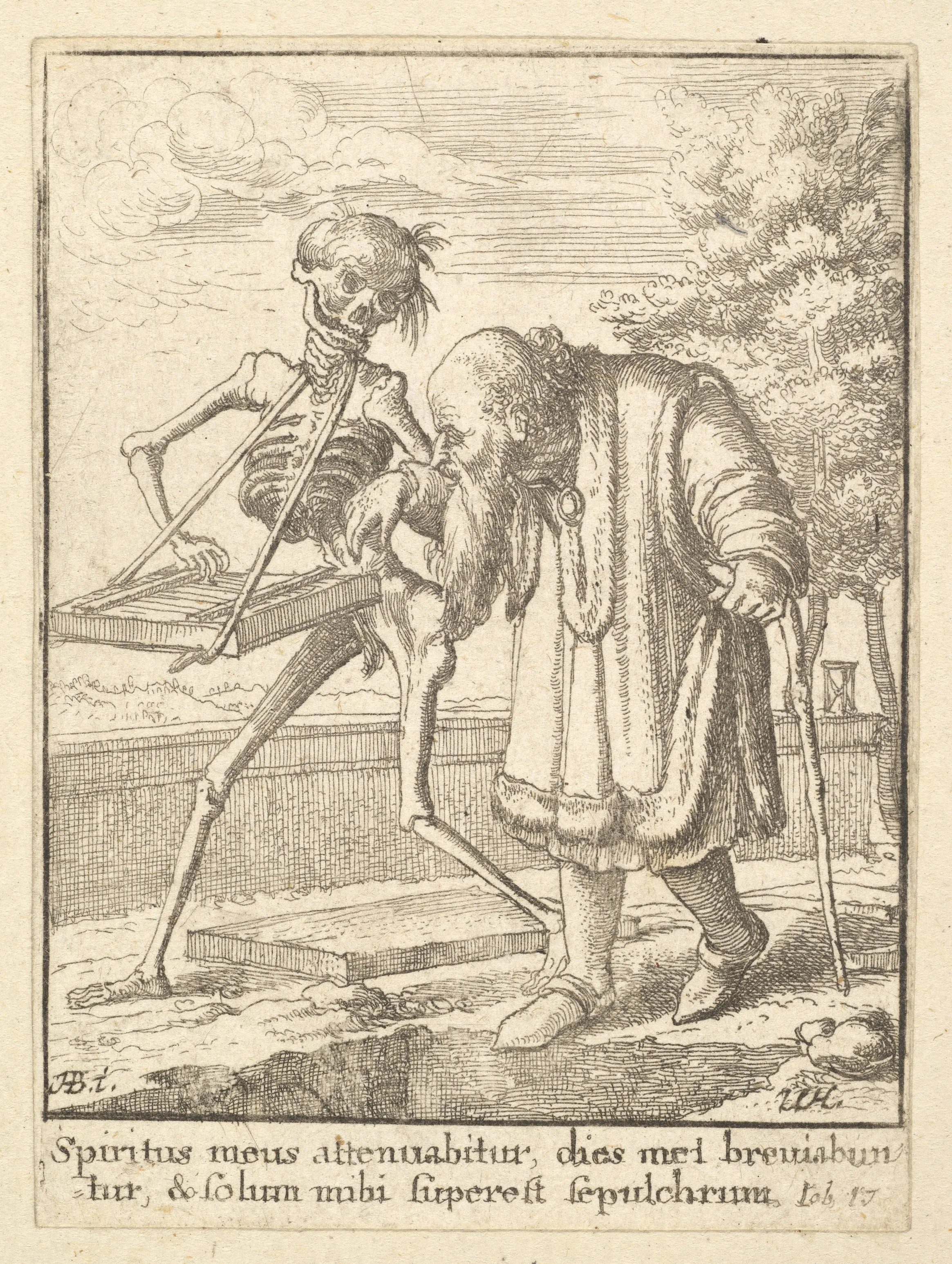
In the Department of Drawings and Prints at The Metropolitan Museum of Art, visitors can study the woodcuts of the Dance of Death (Danse Macabre), designed by Hans Holbein the Younger and engraved by Wenceslaus Hollar.
In the print titled The Old Man, Death does not strike down a youthful laborer in his thirties. Instead, Death gently leads an elderly, stooped grandfather with long white hair, a flowing beard, and a walking stick toward an open grave, playing a dulcimer to guide his weary steps.
Alongside tomb effigies across European cathedrals that depict aged dowagers and graying knights with deliberate realism, these prints prove that medieval culture understood the full span of human mortality. Our ancestors were not doomed to perish in youth; they built enduring communities and watched their grandchildren grow up under the roofs of medieval Europe.
Primary Sources & Archaeological References
- [01]
- [02]
- [03]
- [04]
Related Dossiers
Medieval People Did Not Drink Beer Instead of Dirty Water
Medieval Europeans did not avoid water out of fear of poison. Medical manuscripts and civic pipe records prove clean water was prized and drunk daily.
Medieval People Did Not Believe the Earth Was Flat: The 1828 Hoax
Every medieval scholar knew the Earth was spherical. The myth that Columbus had to convince skeptics the world was round was invented by Washington Irving.
Medieval Chastity Belts Were Nineteenth-Century Fakes
Museum metallurgical tests and archival studies revealed that supposed medieval chastity belts are Victorian forgeries inspired by a 1405 satirical joke.