Romans Did Not Salt the Earth at Carthage: The Myth of Scipio
THE MOVIE VERSION
School textbooks and cinema portray Scipio Aemilianus ordering legionaries to plow salt into Carthaginian soil so nothing would grow for eternity.
THE RECORD
REF #026Zero ancient sources mention salt at Carthage. The story was invented in 1863 by French historians and popularized by twentieth-century textbooks.
In high school history lectures, popular historical documentaries, and common trivia games, the fall of Carthage in 146 BCE is crowned by a singular act of vengeful destruction. According to popular memory, Roman consul Scipio Aemilianus did not merely sack the city and raze its walls. He supposedly ordered Roman legions to plow furrows across the ruins and sow the earth with thousands of bushels of salt, cursing the North African ground so that not a single blade of grass could ever sprout again.
The image is haunting, visceral, and theatrical.
It is also complete historical fiction.
No Roman general ever salted the soil of Carthage. Ancient Greek and Roman historians who chronicled the Third Punic War in meticulous detail never wrote a single word about salt. The legend of Roman salting does not appear in classical antiquity, the Middle Ages, or the Renaissance. It was invented in the nineteenth century by romantic French writers, copied into twentieth-century textbooks, and accepted as gospel by generations of readers.
The Claim
The standard textbook myth asserts that after seventeen days of continuous urban fire, Scipio Aemilianus performed a formal ritual of agricultural desolation.
Romans are depicted dragging iron plows through the rubble of temples and residential quarters, scattering sea salt across the vast Tunisian plains. This ritual was supposedly designed to render the breadbasket of the western Mediterranean permanently barren. The phrase “salting the earth” entered modern political vocabulary as a metaphor for ruthless, scorched-earth obliteration.
Modern readers readily believe the tale because Rome had a well-deserved reputation for merciless military pragmatism. As demonstrated in our study of Roman legionary tactics and the terrifying psychological inscriptions carved onto Roman slinger lead bullets, the Roman war machine waged warfare with brutal efficiency.
Yet salting Carthage makes zero sense militarily, economically, or culturally. Salt was an expensive, prized commodity in the ancient Mediterranean, subject to state monopolies and used as military compensation. Sowing thousands of hectares of fertile farmland would have required tens of thousands of tons of salt, demanding maritime transport fleets that did not exist.
More importantly, Rome desperately wanted North African grain. Destroying the fertility of the Medjerda Valley would have been an act of agricultural suicide for an expanding empire.
The Mechanism
How did an entirely fabricated detail become an undisputed staple of ancient history?
The historiographical origins of the myth were uncovered in 1986 by historian R. T. Ridley in his study “To Be Taken with a Pinch of Salt: The Destruction of Carthage”, published in Classical Philology. Ridley combed through ancient classical literature, Byzantine encyclopedias, and modern scholarship to locate the first mention of the salting story.
Ridley established that the myth arose from an uncritical conflation of biblical imagery with Roman history:
- The Biblical Trope: In the Book of Judges (9:45), the warlord Abimelech destroys the rebellious city of Shechem: “He took the city, and slew the people that was therein, and beat down the city, and sowed it with salt.”
- Nineteenth-Century Conflation: In 1863, French historian Félix Lacroix published an article on Carthage in which he casually transferred the Shechem motif onto Scipio’s sack of Carthage.
- Textbook Institutionalization: In 1930, British classicist B. L. Hallward wrote the chapter on the Third Punic War for the prestigious Cambridge Ancient History (Volume VIII), where he stated without any source citation that Carthage was plowed and salted.
Because the Cambridge Ancient History was the undisputed standard authority for twentieth-century scholars, hundreds of popular history books, university survey courses, and school textbooks repeated Hallward’s unsourced claim as verified fact. Within decades, an invented nineteenth-century flourish became accepted ancient history.
The Evidence
The documentary and archaeological records thoroughly refute the salting myth from every angle:
First, we possess detailed accounts of the fall of Carthage written by ancient historians who had access to eyewitnesses. The Greek historian Polybius was a personal friend and military advisor to Scipio Aemilianus, standing beside him on the walls as the city burned. Polybius preserves Scipio’s genuine reaction: Scipio wept as he watched the flames, quoting verses from Homer’s Iliad regarding the inevitable fall of sacred Troy, fearing that Rome might one day suffer the same fate.
Second, the Roman historian Appian of Alexandria wrote a comprehensive chapter-by-chapter chronicle of the siege in his Punica (Chapters 127 to 135). Appian records the systematic demolishing of the walls, the burning of the Byrsa citadel, the plundering of gold and bronze, and the ritual religious curses (devotio and evocatio) placed upon the ruined site by the Roman Senate. Appian mentions plows, fires, and curses. He does not mention a single grain of salt.
Neither does Cicero, Livy, Strabo, Plutarch, Diodorus Siculus, Florus, or the Byzantine chronicler Zonaras. The silence across every classical authority is absolute.
Third, Roman political and archaeological history directly contradicts any attempt to ruin the land. Only twenty-four years after the fall of Carthage, in 122 BCE, Roman tribune Gaius Gracchus passed the Lex Rubria, leading thousands of Roman settlers to found an agricultural colony named Colonia Iunonia on the exact site of Carthage. Gracchus surveyed sixty thousand land allotments in the surrounding territory specifically because the soil was renowned for producing high agricultural crop yields.
When Julius Caesar launched plans to refound Carthage before his assassination in 44 BCE, as detailed in our analysis of Caesar last moments, and Augustus fulfilled the plan in 29 BCE, Colonia Julia Carthago rapidly grew into the second largest city in the western Roman Empire. It served as the empire primary granary, feeding hundreds of thousands of Roman citizens in Italy with African wheat.
The Human Turn
Why does the myth of salting Carthage remain so compelling despite eighty years of definitive academic debunking?
The myth endures because it satisfies our appetite for poetic finality. In storytelling, Rome and Carthage represent the monumental clash of ancient titans. The three Punic Wars spanned more than a century of cataclysmic struggle, from Hannibal crossing the Alps to the final slaughter on the Byrsa. A standard siege ending in burning and plunder feels inadequate for such monumental drama. We demand an apocalyptic gesture that closes the book on Phoenician civilization forever.
By believing that Scipio salted the earth, we transform a pragmatic, brutal imperial conquest into a biblical morality play.
The historical reality is far more chilling than cinematic melodrama. Rome did not need to ruin the soil to destroy Carthage. The Senate slaughtered tens of thousands of citizens, sold fifty thousand survivors into slavery, melted Punic bronzes into Roman bullion, and then farmed the fertile African soil to enrich the Roman aristocracy. Rome did not hate the earth; Rome coveted it.
The Artifact
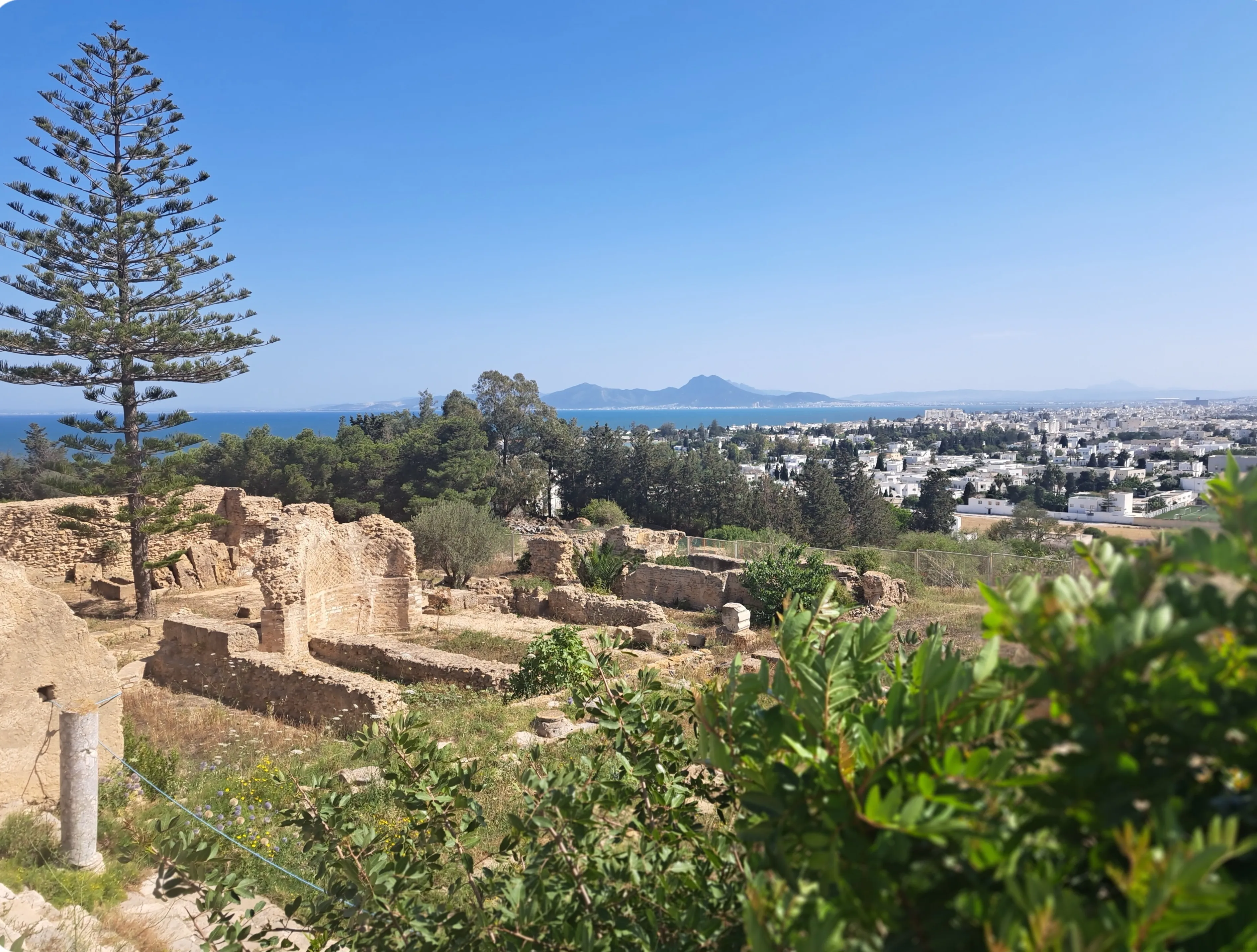
The physical legacy of Punic and Roman Carthage survives atop the Byrsa Hill in modern Tunisia:
At the Carthage National Museum and the surrounding archaeological park, visitors can walk through the excavated Punic residential quarter on the southern slope of the Byrsa. Known as the Hannibal District, these multi-story houses retain intact stucco cisterns, terra-cotta drainage pipes, and red mortar mosaic floors (opus signinum) dating to the early second century BCE.
Directly overlying these burned Punic strata are the immense limestone foundations of the Roman forum, basilica, and imperial temples constructed under Augustus.
Archaeological soil cores taken across the Carthage peninsula show uninterrupted pollen sequences for olive trees, wheat, barley, and vines throughout the late second and first centuries BCE. There is no chemical residue of sodium chloride toxicity, no sterilizing layer, and no interruption in agricultural cultivation.
These stone foundations and ancient pollen grains tell the true story of classical antiquity: an empire that destroyed an ancient rival not to create a barren desert, but to seize its wealth and plant Roman roots in its soil.
Primary Sources & Archaeological References
- [01]
- [02]
- [03]
- [04]
Related Dossiers
Julius Caesar Never Said Et Tu Brute: The Greek Curse Record
Shakespeare invented Et tu Brute in 1599. Roman historians Suetonius and Plutarch prove Caesar died in silence or uttered a chilling Greek curse.
Nero Did Not Fiddle While Rome Burned: The Antium Relief Record
Tacitus proves Nero was thirty miles away in Antium when Rome caught fire. He rushed back to build refugee shelters and slash grain prices, not play violin.
Roman Vomitoriums Were Not for Puking: The Exit Hall Myth
Roman vomitoria were not decadent banquet regurgitation rooms. Classical texts and amphitheater engineering prove they were crowd evacuation tunnels.