Medieval Swords Were Not Heavy Iron Bludgeons
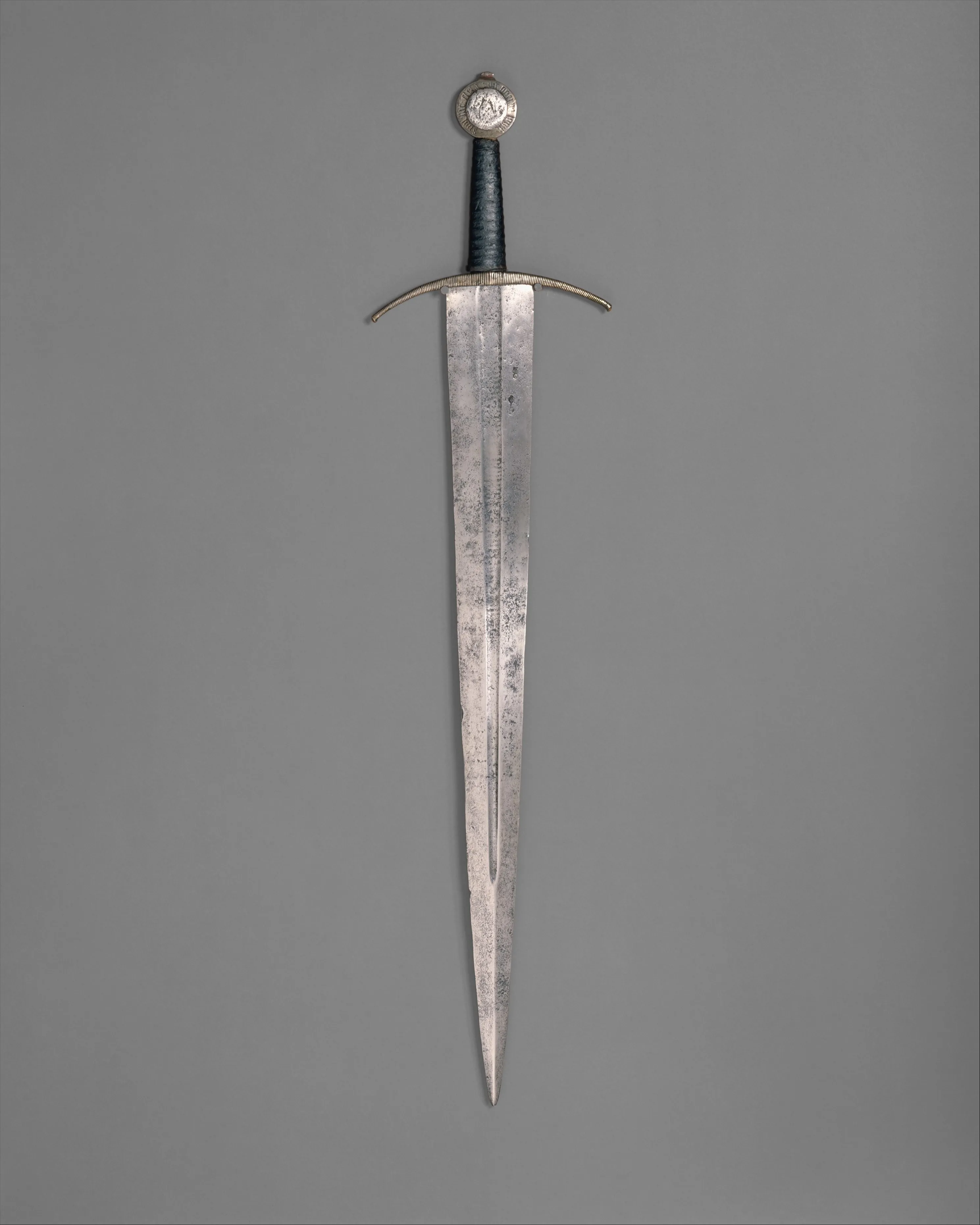
THE MOVIE VERSION
Popular fantasy and period films depict medieval swords as massive ten to fifteen pound iron clubs swung with labored two-handed heaves to smash armor.
THE RECORD
REF #016Museum measurements of thousands of surviving blades prove one-handed knightly swords weighed two to three pounds, engineered with distal taper for agile precision.
Popular culture has long treated the medieval sword as an unwieldy slab of crude iron. In Hollywood battle scenes, video games, and fantasy novels, knights struggle to lift massive double-edged blades, swinging weapons that appear to weigh ten to fifteen pounds with clumsy, lumbering motions. Characters bludgeon through metal helmets and split iron shields as though swinging sledgehammers. This portrayal reinforces the Victorian stereotype of medieval warfare as a brutish slugging match between armored barbarians. Yet when one examines surviving historical blades in major European armories, the reality is astonishingly different. Surviving medieval arming swords and longswords weighed between two and three and a half pounds. They were finely tuned instruments of kinetic engineering, designed for rapid fencing, balance, and calculated thrusting.
The Claim
The belief that medieval European swords were brutally heavy originated during the nineteenth century. Victorian antiquarians, enamored by romantic ideas of superhuman chivalric ancestors, routinely exaggerated the physical demands of medieval combat. Heavy Victorian parade replicas and theatrical stage props, often cast from thick solid iron without historical tapering, reinforced the assumption that genuine battle swords were cumbersome bludgeons.
Modern media inherited and amplified this misconception. Video games regularly assign swords colossal weights and slow recovery frames, while action cinema depicts knights winding up for ponderous overhead swings. Just as popular movies falsely portray medieval knights as helpless turtles who needed cranes to mount horses, a myth disproved by metabolic biomechanics in our study of knight armor agility, popular entertainment mistakes physical thickness for structural combat efficiency.
In real combat, an excessively heavy sword was fatal to its user. A knight fighting on foot or horseback faced opponents equipped with fast spears, maces, and daggers. A warrior swinging a ten-pound iron bar would suffer rapid muscle fatigue within ninety seconds, leaving his guard wide open to a quick thrust into the visor or armpit.
The Mechanism
The remarkable agility of historical swords was made possible by advanced bladesmithing techniques:
First, historical swords utilized both profile taper and distal taper:
- Profile Taper: The blade narrowed in width from the crossguard toward the point.
- Distal Taper: The blade became progressively thinner along its spine. Near the hilt, a knightly blade was typically five to six millimeters thick to withstand bending moments during parries. Toward the tip, skilled smiths forged the steel down to less than two millimeters. Distal taper removed excess steel from the forward half of the blade, drastically reducing rotational inertia.
Second, bladesmiths incorporated fullers, longitudinal grooves forged into the flat faces of the blade. Contrary to the popular myth that fullers were “blood grooves” meant to break flesh suction, fullers functioned as architectural I-beams. By removing mass from the center of the blade while preserving thick outer ridges, a fuller reduced overall weight by twenty to thirty percent without sacrificing structural rigidity.
Third, pommel counterweights shifted the center of gravity. A solid iron or bronze pommel welded to the tang placed the balance point roughly eight to twelve centimeters ahead of the crossguard. This geometry positioned the rotational pivot point inside the fencer’s palm, making the sword feel light in hand and allowing rapid changes of trajectory.
Just as Roman legionaries discarded wide slashing motions in favor of disciplined forward thrusts, as examined in our study of Roman gladius mechanics, medieval swordsmiths engineered weapons for speed and precision.
The Evidence
The definitive physical proof of medieval sword mechanics comes from systematic measurements conducted across thousands of preserved specimens in European museums:
The British arms historian Ewart Oakeshott dedicated decades to cataloging surviving European swords from the tenth through sixteenth centuries. In foundational works including The Sword in the Age of Chivalry and Records of the Medieval Sword, Oakeshott established an empirical typology based on blade geometry, pommel forms, and exact physical measurements:
- One-Handed Arming Swords (Types X through XIV): The quintessential knightly sidearm of the High Middle Ages. Museum records show typical weights between nine hundred and twelve hundred grams (two to two point six pounds). For example, the famous thirteenth-century Type XIV sword in the Metropolitan Museum of Art (Accession 32.75.225) balances effortlessly at just over two pounds.
- Longswords and Bastard Swords (Types XVa through XVIIIb): Two-handed blades designed for unarmored judicial duels and late medieval battlefield harness. Despite overall lengths between one hundred and one hundred and twenty centimeters, surviving longswords average between one point two and one point six kilograms (two point six to three point five pounds).
- The Wallace Collection A.460: A celebrated late fourteenth-century Type XV longsword in London. With a rigid diamond cross-section designed to pierce gaps in plate armor, the sword measures ninety-five centimeters in overall length yet weighs exactly one thousand three hundred and sixty grams (three pounds).
- Massive Two-Handers (Zweihänder): Renaissance greatswords carried by German Landsknechts to disrupt pike formations measure up to one hundred and seventy centimeters long. Even these massive weapons weigh between two point five and three point five kilograms (five point five to seven point seven pounds), never approaching the ten to twenty-pound monsters imagined in popular fiction.
Archaeological finds from the River Thames, the Castillon hoard, and the Alexandria arsenal confirm these numbers across hundreds of verified battle specimens.
The Human Turn
Restoring the true weight of historical swords transforms our understanding of medieval martial arts. Surviving combat manuals (Fechtbücher) written by master swordsmen like Johannes Liechtenauer in fourteenth-century Germany and Fiore dei Liberi in fifteenth-century Italy describe combat systems characterized by speed, winding, grappling, and levered control.
These manuals show swordsmen performing lightning-fast parries, point shifts, and half-swording techniques, where a fighter grasped the mid-blade with a gauntleted hand to drive the point into visor slits. Such techniques are physically impossible with a heavy bludgeon. They require a balanced, responsive weapon that acts as an extension of the forearms.
Just as Viking raiders relied on light, thin-bladed bearded axes rather than fantasy double-bladed fantasy axes, as analyzed in our investigation of Viking battle axes, medieval knights wielded tools of refined mechanical engineering. Knights were not crude brawlers relying on brute muscle. They were trained athletes practicing a sophisticated martial science.
The Artifact
The material reality of medieval sword design is epitomized by the Type XVI knightly sword preserved at the Metropolitan Museum of Art under accession number 32.75.225.
Forged in Western Europe around 1400, the sword features an eighty-centimeter blade with a pronounced central fuller extending down the upper half, transitioning into a reinforced diamond-section point designed for thrusting between iron joints. The grip is fitted with a wheel pommel and an arched crossguard.
When placed upon modern laboratory scales, the sword weighs just one kilogram (two point two pounds). The blade possesses dramatic distal taper, thinning from five millimeters at the hilt to barely one point five millimeters near the tip.
Held in hand, the weapon moves with fluid ease. It does not drag the wrist downward or require strenuous effort to redirect. It remains a physical testament to the skill of the medieval armorer, an artisan who understood physics and crafted steel not to be an awkward iron club, but a deadly, balanced extension of human will.
Primary Sources & Archaeological References
- [01]
- [02]
- [03]
- [04]
Related Dossiers
Flaming Arrows Were Useless in Open Field Battles
Ammianus Marcellinus and ballistics tests show fire arrows blew out at high speeds and lacked penetration, restricting incendiary darts strictly to sieges.
Roman Legionaries Stabbed Instead of Slashing
Vegetius and battlefield archaeology prove the Roman army drilled soldiers to thrust, noting a two-inch stab kills while wild cuts leave the flank exposed.
Vikings Did Not Swing Double-Bladed Battle Axes
Surviving Norse axes from Petersen Type A through M have single edges weighing under two pounds, balancing speed and cutting power over fantasy bulk.