Vikings Did Not Swing Double-Bladed Battle Axes
THE MOVIE VERSION
Fantasy films depict Viking warriors swinging massive double-bladed battle axes that crush armor with sheer weight.
THE RECORD
REF #003Archaeology has recovered thousands of Viking axes and not one double-bladed combat head exists in the record.
Every excavated Viking Age axe head in Northern Europe is single-bladed. Across more than a century of professional archaeological digs in Scandinavia, Britain, Ireland, and the Baltic, researchers have examined thousands of iron axe heads from burials, riverbeds, and settlement layers. Not a single authentic specimen possesses two opposing cutting edges. The massive double-bladed battle axe of modern video games and fantasy cinema is an imaginary weapon that contradicts every principle of Norse combat metallurgy.
The Claim
A double-bladed battle axe was an unusable liability on a historical battlefield. In modern film depictions, towering Norsemen swing heavy iron axes featuring identical flared blades protruding from both sides of the haft. These cinematic props look terrifying, but they would have exhausted or maimed anyone foolish enough to carry them into combat.
Viking warriors relied on speed, precision, and endurance. Their combat axes were light tools developed from domestic wood-chopping implements. In his masterwork De Norske Vikingesverd, published in Kristiania in 1919, Norwegian archaeologist Jan Petersen established the standard classification of Viking Age edged weapons. Surveying hundreds of finds, Petersen cataloged axe heads across thirteen distinct classes, labeled Type A through Type M.
SOURCE: Petersen, De Norske Vikingesverd (1919), pp. 36-47
Every single axe type in Petersen’s taxonomy features a single cutting edge backed by a flat poll or hammer surface. The largest two-handed broadaxe of the Viking Age, the Petersen Type M commonly called the Dane axe, was forged thin to keep its mass remarkably low. Even when Norse chroniclers recorded the devastating power of two-handed axes at decisive clashes like Stamford Bridge in 1066, they described single-bladed weapons wielded by disciplined shock troops.
“Tostig went forward into the battle… and fought most desperately. Many men fell on both sides; for the English hit hard with their two-handed axes.” Snorri Sturluson, Heimskringla: Saga of Harald Hardrada 92 (trans. Samuel Laing)
The English housecarls and Norse warriors swinging these two-handed axes did not carry double-headed fantasy cleavers. They swung wide, razor-thin single edges mounted to four-foot ash shafts.
The Mechanism
The physics of edged combat explains why double-bladed axes never existed in the Viking armory. The effectiveness of an axe lies in the concentration of kinetic energy. Unlike a sword, which distributes weight evenly along its blade to allow parrying, an axe concentrates its mass into the head, acting as a force multiplier at the end of a wooden lever.
Adding a second cutting edge to the rear of the head destroys this mechanical advantage in three ways:
First, a rear blade adds useless dead weight. A functional combat axe head must weigh between 300 and 900 grams, roughly eleven ounces to two pounds. An axe head exceeding three pounds tires the forearms, slowing weapon recovery after a swing. In hand-to-hand fighting, a slow recovery invites an immediate spear thrust.
Second, a second blade creates a lethal hazard for the user. When a warrior swings an axe, the weapon frequently deflects off an opponent’s iron-rimmed shield boss or oak planks. If the axe head rebounds backward toward the user’s face or chest, a flat hammer poll harmlessly glances off armor. A sharp rear blade, however, would slice into the wielder’s shoulder, neck, or forearm on the rebound.
Third, a flat poll provides tactical utility that an extra blade destroys. A warrior could use the blunt hammer end to fracture shield rims, crush helmets, or hook an opponent’s shield without blunting the primary cutting edge. A thin, single-bladed head allowed blacksmiths to taper the iron down to just two millimeters behind the steel edge, producing a weapon capable of slicing through heavy wool and split leather while biting deeply into bone.
The Evidence
The archaeological record demonstrates the dominance of single-bladed axes across the entire Norse world. In excavations conducted between 1962 and 1981 at Wood Quay and the High Street in Dublin, archaeologist Andrew Halpin documented dozens of Viking Age combat axes. Every head recovered from the tenth and eleventh-century deposits conformed strictly to single-edged Petersen types.
SOURCE: Halpin, Weapons and Warfare in Viking and Medieval Dublin (2008)
The most celebrated surviving Viking axe in the world confirms this design philosophy. In 1868, at Bjerringhøj near Mammen in Jutland, Denmark, a chamber grave belonging to a wealthy magnate was excavated from a burial mound. Dendrochronological dating of the oak chamber timber confirmed that the burial took place in the winter of 970 to 971 CE.
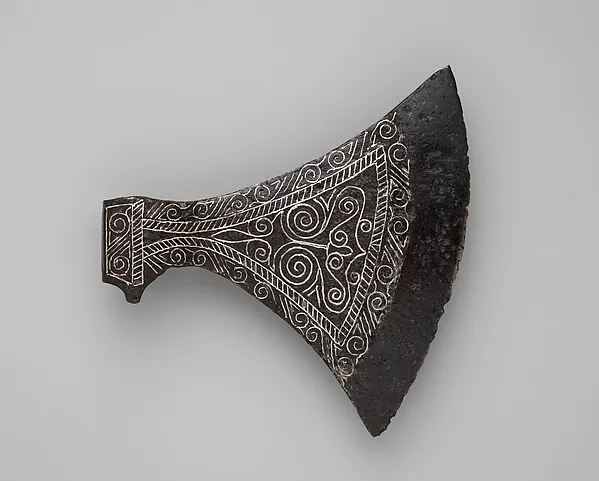
Inside the grave lay the famous Mammen axe, cataloged as C133 at the National Museum of Denmark in Copenhagen. Forged from iron and elaborately inlaid with silver wire, the axe head depicts a winding bird motif and foliate tendrils. It is an elite status weapon created for ceremonial display and lethal action.
SOURCE: National Museum of Denmark, Inventory C133
The Mammen axe is entirely single-bladed. Its cutting edge measures roughly ten centimeters, and its total head weight is under 500 grams, barely one pound. The back of the head forms a rectangular, flat poll. It is light, agile, and deadly. Even an emperor or chieftain who could afford the finest metallurgy in Scandinavia carried a single-bladed weapon.
Where does the double-bladed axe come from? The double-edged axe, known in ancient Greek as the labrys, belongs to Bronze Age Minoan religion on Crete, where it served as a ceremonial religious symbol rather than a battlefield weapon. In modern times, the double-bitted axe was invented in nineteenth-century North America as a specialized forestry tool. Lumberjacks ground one edge thin for felling timber and kept the opposite edge thick for knotty wood. Late Victorian illustrators merged this modern timber tool with romantic Norse mythology, creating an enduring fantasy stereotype.
This pattern of romantic distortion matches the invention of Viking horned helmets, which also sprang from nineteenth-century artistic invention. Similar misconceptions affect Roman weaponry, where popular media overlooks how lead ammunition wielded by Roman slingers delivered concussive kinetic energy that matched edged weapons. Historical military gear was governed by ruthless practicality, not theatrical visual flair.
The Human Turn
For the typical Norse farmer who manned the rowing benches of a longship, the axe was not a costume piece. It was an extension of his daily labor. Before he set foot on a ship, he had spent his youth clearing birch forests, splitting firewood, and shaping ship planks with single-bladed axes.
When called to the levy, the warrior carried the same tool into combat. A small hand axe, tucked into a leather belt, served to fell trees for camps, butcher meat, repair oars, and defend the shield wall. The familiarity gained through thousands of hours of timber cutting made the axe far more intuitive in a novice’s hands than an expensive sword.
Wealthier housecarls who trained with the two-handed Petersen Type M broadaxe formed the elite core of Anglo-Scandinavian armies. They were shock fighters who stepped forward from the shield wall to deliver sweeping cleaves that could sever horse limbs and cleave maille. Yet even these elite professionals relied on lightweight heads mounted to supple ash wood, relying on momentum and leverage rather than dead weight.
The Artifact
A genuine Viking axe head, such as the eleventh-century Scandinavian axe preserved at The Metropolitan Museum of Art under accession number 2023.580.5, reveals the true craftsmanship of the northern armorer. Its single edge curves gracefully toward the eye, while the neck is decorated with delicate silver inlays that catch the light without adding clumsy mass.
This physical object corrects generations of fantasy fiction. The men of the Viking Age did not swing cartoonish double-bladed cleavers. They fought with refined, economical instruments that balanced cutting geometry against human endurance. In the brutal economy of early medieval warfare, efficiency was the only thing that kept a warrior alive.
Primary Sources & Archaeological References
- [01]
- [02]
- [03]
- [04]
Related Dossiers
Roman Legionaries Stabbed Instead of Slashing
Vegetius and battlefield archaeology prove the Roman army drilled soldiers to thrust, noting a two-inch stab kills while wild cuts leave the flank exposed.
Viking Berserkers Did Not Fight on Toxic Mushrooms
Toxicological research and Old Norse sagas refute the 1784 mushroom theory, revealing berserk fury was a ritualized military trance, not drug psychosis.
The Viking Blood Eagle Was a Poetic Fiction
Old Norse philology and anatomy show the blood eagle ritual arose from misunderstood skaldic metaphors for carrion birds feeding on dead soldiers.