Medieval Knights Were Not Clumsy Turtles in Armor
THE MOVIE VERSION
Cinema depicts plate-armored knights as helpless, rigid statues who required cranes to mount horses and could not stand if knocked down.
THE RECORD
REF #006A complete field harness weighed 20 to 25 kilograms distributed across the skeleton, permitting sprinting, vaulting, and agile grappling.
A medieval knight in full plate armor was not an immobilized metal statue. Weight records compiled by the Royal Armouries in Leeds and biomechanical experiments published by Graham Askew in 2012 confirm that a fifteenth-century field harness weighed between twenty and twenty-five kilograms, roughly forty-five to fifty-five pounds. This mass was distributed evenly across the human skeletal system, allowing trained men-at-arms to sprint, jump, and vault onto warhorses without assistance.
The Claim
A knight knocked from his horse was not a stranded beetle. Popular films, television comedies, and historical fiction routinely present armored warriors who stumble clumsily, require cranes or block-and-tackle rigs to be hoisted into saddles, and lie helpless on the ground once felled. In the brutal reality of late medieval warfare, an armor system that hindered basic agility would have been suicidal.
Plate armor was custom-tailored military equipment engineered by master armorers in workshops across Milan, Nuremberg, and Augsburg. Blacksmiths fitted individual steel plates to the contours of the wearer’s anatomy using sliding rivets and internal leather straps. This construction placed weight directly onto load-bearing bones rather than hanging from the shoulders.
SOURCE: Le Livre des faits de Boucicaut (c. 1409)
Primary fifteenth-century records document the remarkable physical flexibility demanded of elite men-at-arms. In the contemporary biography of Jean II Le Maingre, known as Marshal Boucicaut, chroniclers recorded the intense daily training regimen of the famous French knight.
“He would turn somersaults armed in all his pieces except the helmet… and would vault onto a courser armed in all his pieces without putting a foot in the stirrup.” Le Livre des faits du bon messire Jehan le Maingre (c. 1409)
Boucicaut performed handstands, scaled the underside of tall wooden ladders using his arm strength alone, and practiced sprint intervals while encased in steel. These exercises were not theatrical parlor tricks. They were baseline survival conditioning for mounted and dismounted shock combat.
The Mechanism
The mobility of plate armor depended entirely on mass distribution and articulation. A standard modern infantryman in the United States military carries a combat load between thirty and forty-five kilograms, consisting of ceramic body armor, ammunition, hydration systems, and tactical electronics. The vast majority of that modern weight hangs from the shoulders and lower back, producing severe spinal compression.
A medieval plate harness operated on an entirely different biomechanical principle. The breastplate and backplate rested on the pelvic girdle through a fitted leather arming doublet (pourpoint) that cinched tightly above the hip bones. The arm and leg defenses (cuisses, greaves, and vambraces) were strapped directly to the limbs, meaning each muscle group moved only the fraction of steel covering that specific limb segment.
To preserve natural joint kinematics, armorers developed rotating and sliding laminations. Knee defenses (poleyns) and elbow cops (couters) utilized overlapping lames connected by slotted rivets. When a knight bent his leg to run or mount a horse, the steel lames slid smoothly over one another, maintaining continuous blade protection without restricting the biological angle of flexion.
The true physiological bottleneck of armor was not mobility, but thermoregulation and oxygen consumption. In 2012, biomechanist Graham Askew of the University of Leeds led a clinical study measuring the metabolic cost of movement in reproduction fifteenth-century armor. Askew placed experienced historical martial artists on motor-driven treadmills equipped with oxygen consumption respirometers.
The study revealed that walking in full harness required 2.1 to 2.3 times more metabolic energy than unarmored walking, while running required 1.9 times more energy. The primary restriction stemmed from the cuirass compressing the thoracic cavity, which reduced lung tidal volume and forced fighters into rapid shallow breathing. Armor did not stop a knight from running; it shortened the duration of his sprint before lactic acidosis forced him to slow his pace.
The Evidence
Physical confirmation of armor lightness exists in museum collections worldwide. The Wallace Collection in London, the Royal Armouries in Leeds, and The Metropolitan Museum of Art in New York preserve hundreds of authentic fifteenth and sixteenth-century field harnesses.
SOURCE: Royal Armouries Leeds, Field Harness Catalogue Records
When museum curators weigh complete, battle-ready field armors from the late Gothic and Maximilian eras, the results consistently fall between twenty and twenty-eight kilograms. Specialized jousting armor (Stechzeug), engineered for sporting contests at the tilt, did weigh up to forty kilograms. However, tilt armor was rigid sports gear designed solely for riding straight lines with a heavy lance, not battlefield combat. Popular cinema has conflated static sporting armor with active campaign harnesses.
In 2016, Swiss martial arts researcher Daniel Jaquet conducted a series of controlled experiments replicating the exact obstacle course described in Boucicaut’s biography. Wearing a museum-accurate twenty-five-kilogram steel harness, test subjects successfully vaulted onto horses, jumped hurdles, climbed vertical wooden beams, and completed backward rolls across gym mats.
SOURCE: Jaquet and Bartomeu, Journal of Medieval Military History (2016)
The high-speed camera footage verified that a fallen knight could roll onto his stomach, bring his knees under his hips, and spring to his feet in under two seconds. If a knight was killed on the ground at Agincourt in 1415, he died from heat exhaustion, suffocation in muddy clay, or being swarmed by archers armed with daggers, not because steel made him unable to rise.
Similar distortions cloud other pre-modern battlefield technologies. Popular culture imagines Viking warriors swinging clumsy double-bladed axes or wearing theater-inspired horned helmets, when real archaeological finds show light, single-bladed tools and smooth iron domes. From medieval plate to Roman gladius swords, weapon systems were shaped by cold biomechanics rather than heavy fiction.
The Human Turn
Behind the engineering of the plate harness lay lifelong physical conditioning. The men who wore these suits were not casual soldiers. Sons of noble families began training as pages at age seven and squires at age fourteen. They practiced wrestling, mounted horsemanship, and swordplay daily, developing dense bone mineral density and thick tendon attachments capable of supporting external loads.
Inside the harness, combat was an intensely claustrophobic sensory experience. Padded linen arming garments absorbed sweat, quickly becoming soaked in moisture. The enclosed helmet (armet or sallet) limited peripheral vision to a narrow slit (ocularium), forcing the knight to rely on auditory cues and constant neck rotation. Breathing hot, exhaled carbon dioxide inside the visor triggered rapid heart rates.
To survive in this microclimate, knights developed exceptional tactical discipline. They learned to raise their visors during lulls in combat to take in fresh air, lowering the face plate only when charging enemy lines. Combatants paced their physical exertion, knowing that an uncontrolled adrenaline surge would exhaust their glycogen stores in ten minutes of intense hand-to-hand fighting.
The Artifact
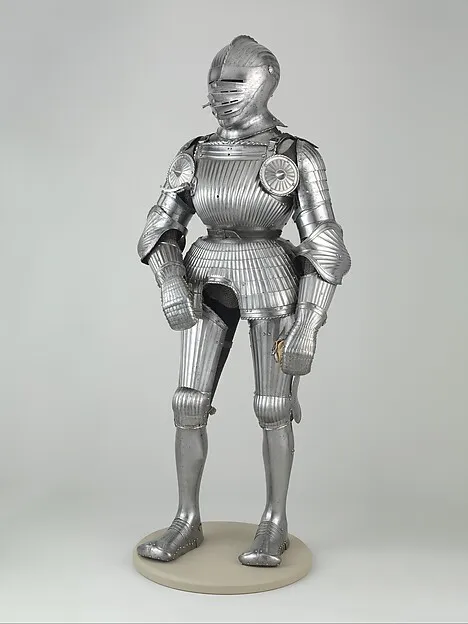
A surviving field harness, such as the German steel armor preserved at The Metropolitan Museum of Art under accession number 04.3.289, displays the pinnacle of pre-industrial functional design. The metal surfaces are clean, smooth, and contoured like an exoskeleton, with fluted ridges that channel striking energy away from vulnerable seams.
This armor is not a clumsy cage. It is a masterpiece of kinetic protection forged to keep a human heart beating amid the chaos of poleaxes, warhammers, and bodkin arrows. When we look past cinematic tropes, the knight emerges as an elite, highly agile athlete operating a sophisticated system of personal defense.
Primary Sources & Archaeological References
- [01]
- [02]
- [03]
- [04]
Related Dossiers
Medieval People Did Not Die at Thirty: The Life Expectancy Fallacy
Pop culture claims medieval people died of old age at thirty. Cemeteries and records prove adults routinely lived well into their sixties and seventies.
Medieval People Did Not Believe the Earth Was Flat: The 1828 Hoax
Every medieval scholar knew the Earth was spherical. The myth that Columbus had to convince skeptics the world was round was invented by Washington Irving.
Medieval People Did Not Drink Beer Instead of Dirty Water
Medieval Europeans did not avoid water out of fear of poison. Medical manuscripts and civic pipe records prove clean water was prized and drunk daily.