Viking Berserkers Did Not Fight on Toxic Mushrooms
THE MOVIE VERSION
Popular historical fiction portrays Viking berserkers ingesting red hallucinogenic fly agaric mushrooms to induce blind cannibalistic battle rages.
THE RECORD
REF #017Old Norse sagas describe berserkers entering ritualized psychological warrior cult trances, while pharmacology proves fly agaric causes motor paralysis, vomiting, and sedation.
Popular culture depicts the Viking berserker as an uncontrollable madman intoxicated on hallucinogenic fungi. In modern television dramas, graphic novels, and historical podcasts, Norse shock troops devour dried red-and-white fly agaric mushrooms (Amanita muscaria) prior to naval landings. Under the supposed influence of fungal alkaloids, they strip off armor, howl like wolves, gnaw on wooden shields, and slaughter enemies without feeling pain. The image of the drug-fueled Viking is ubiquitous. Yet when scrutinized through Old Norse literary analysis and modern neuropharmacology, the mushroom narrative collapses entirely. The idea was invented by an eighteenth-century Swedish clergyman who had never examined a medieval manuscript. In the historical Viking Age, berserk fury (berserkergang) was a sophisticated somatic trance cultivated by elite warrior cults, not drug-induced food poisoning.
The Claim
The belief that berserkers fought under the influence of psychoactive mushrooms traces back to a single source: Swedish professor and naturalist Samuel Odmann. In 1784, Odmann published an essay in the proceedings of the Royal Swedish Academy of Sciences titled An Attempt to Explain the Ancient Nordic Berserkers through Natural History.
Odmann had read contemporary anthropological accounts of Siberian shamans, specifically the Koryak and Kamchadal peoples, who ingested Amanita muscaria during religious rituals. Without a shred of supporting evidence from medieval Icelandic sagas, skaldic verse, or archaeological excavation, Odmann theorized that Viking warriors must have used the same mushroom to stimulate battlefield frenzy.
Because nineteenth-century romantic writers were eager to depict medieval Scandinavians as savage primitives, Odmann’s conjecture was repeated in European historical surveys and eventually adopted as conventional wisdom. Just as Victorian opera costumers attached cow horns to Viking stage caps, establishing the myth analyzed in our study of horned Viking helmets, popular historians embraced the toxic toadstool because it provided an exotic chemical explanation for terrifying military behavior.
Yet medieval Old Norse sources never once mention mushrooms, fungi, or plant concoctions in connection with berserkers. Across thousands of pages of family sagas, kingly chronicles, and mythological lays, the word berserkergang is treated as a spiritual transformation, never an herb-induced intoxication.
The Mechanism
The biological effects of Amanita muscaria demonstrate why no military force would knowingly feed it to front-line warriors:
The active compounds in fly agaric are ibotenic acid and muscimol. Muscimol functions as a potent agonist of GABA-A receptors in the human brain, acting as a profound central nervous system depressant and sedative.
When ingested, Amanita muscaria triggers severe physiological distress within thirty to ninety minutes:
- Motor Ataxia: The consumer experiences cerebellar dysfunction, loss of fine motor coordination, dizziness, and muscular twitching.
- Gastrointestinal Trauma: Ibotenic acid causes acute nausea, intense stomach cramps, profuse sweating, and violent vomiting.
- Lethargy and Stupor: The primary subjective state is a twilight sleep characterized by sluggishness, auditory hallucinations, and mental dissociation, often followed by a deep coma-like stupor lasting several hours.
On a medieval battlefield, where survival depended on rapid footwork, parrying with shield bosses, and maintaining cohesive shield walls, as examined in our analysis of Viking single-bladed axes, an intoxicated warrior suffering from blurred vision and nausea would be cut down immediately. A man staggering into combat under the influence of muscimol would vomit on his shoes rather than lead an assault.
The Evidence
Old Norse literature provides clear descriptions of what berserkers actually were: an elite royal bodyguard and totemic warrior society dedicated to Odin:
In chapter six of the Ynglinga saga, preserved in Snorri Sturluson’s thirteenth-century history Heimskringla, Snorri described the personal warriors of Odin:
SOURCE: Snorri Sturluson, Heimskringla: Ynglinga Saga, Chapter 6
“Odin’s men rushed forwards without armor, were as mad as dogs or wolves, bit their shields, and were strong as bears or wild bulls, and killed people at a blow, but neither fire nor iron told upon them. These were called Berserkers.” Snorri Sturluson, Ynglinga Saga 6 (trans. Samuel Laing)
The ninth-century court skald Thorbjorn Hornklofi celebrated the berserkers who fought for King Harald Fairhair at the Battle of Hafrsfjord around 872 AD in his poem Haraldskvaedi:
SOURCE: Thorbjorn Hornklofi, Haraldskvaedi (Hrafnsmal) 20-21
“They are called wolf-skins (ulfhednar) who bear bloody shields in battle; they redden spears when they join combat; there they sit together at work.” Thorbjorn Hornklofi, Haraldskvaedi 20-21 (ed. R. D. Fulk)
The sources portray berserkers (bare-shirts or bear-shirts) and ulfhednar (wolf-skins) as religious retainers who underwent rigorous psychological conditioning. Through sensory deprivation, rhythmic chanting, hyperventilation, and mimetic zoomorphism, mimicking the movements of bears and wolves, these warriors learned to induce self-directed dissociative states. Autohypnotic adrenaline surges released high concentrations of epinephrine and norepinephrine, temporarily suppressing fear, raising pain thresholds, and heightening vascular blood pressure.
When the frenzy broke, the sagas consistently record that warriors experienced severe physiological exhaustion and physical depression lasting several days, a classic post-adrenaline crash well documented in modern sports psychology and combat stress studies.
Just as the poetic imagery of the blood eagle was later misunderstood as an anatomical execution method, as explored in our study of the blood eagle in skaldic verse, the ritual animal mimicry of berserkers was reduced by modern observers to vulgar intoxication.
The Human Turn
Recognizing berserkergang as an autohypnotic martial technique restores agency to the Norse warrior. Early medieval warfare was terrifying. Hand-to-hand combat involved bone-crushing blunt trauma, severed limbs, and visceral carnage. Developing psychological rituals that allowed soldiers to bypass paralyzing survival instincts was a rational response to brutal warfare.
In Scandinavian society, berserkers were revered during wartime but feared during peace. Sagas repeatedly depict berserkers as troublesome household champions who provoked duels (holmganga) to claim land and brides. When King Harald Bluetooth centralized authority in Denmark, he outlawed berserker bands. By 1015, the law codes of Jarl Eirik Hakonarson in Norway formally banned berserkergang, punishing anyone who entered the frenzy with outlawry. A society does not outlaw mushroom consumption. It outlaws an elite caste of institutionalized killers whose state-sanctioned violence threatened political stability.
The Artifact
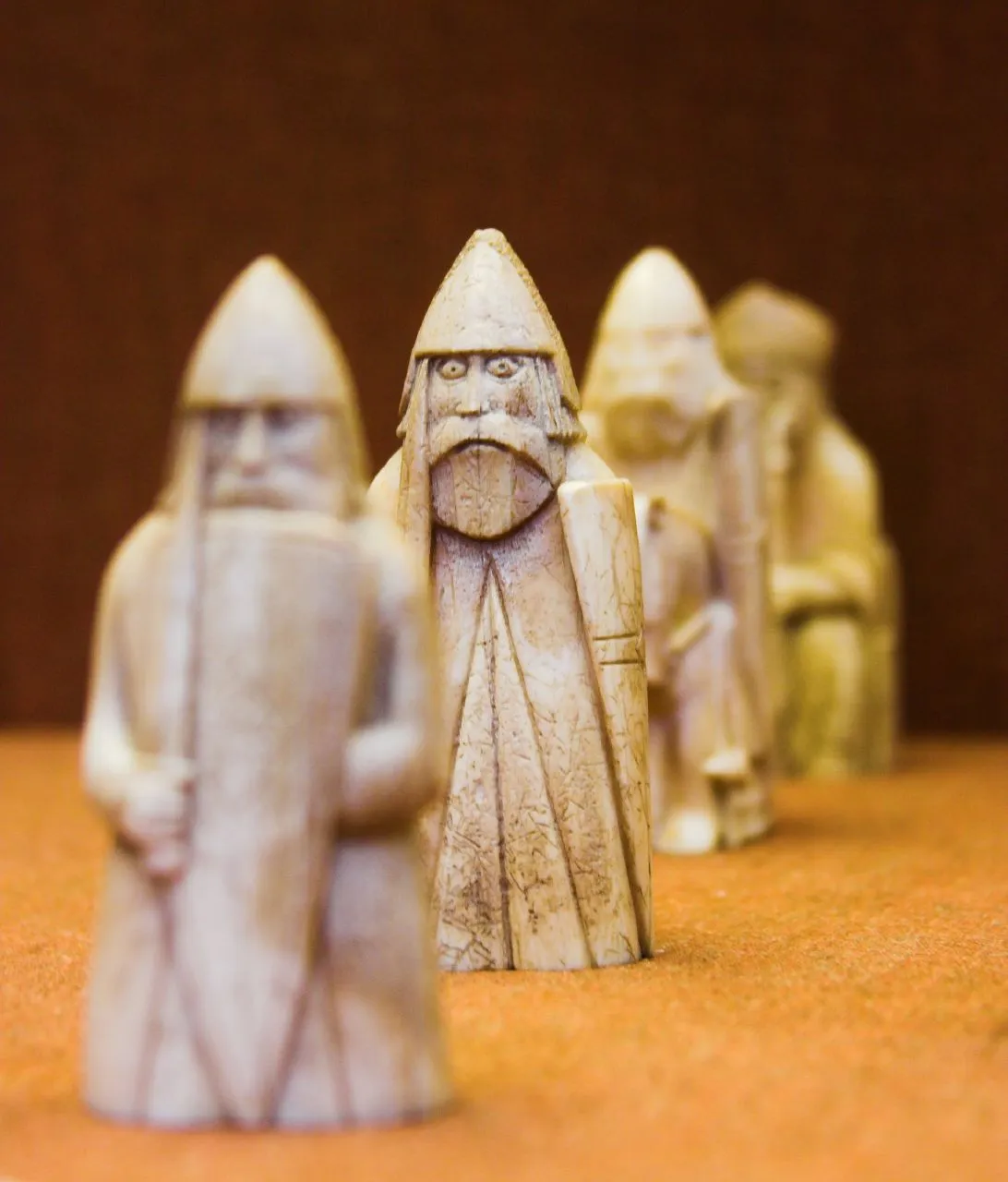
The visual reality of the berserker is captured in the walrus ivory chess pieces unearthed on the Isle of Lewis in the Outer Hebrides in 1831, currently preserved in the British Museum and the National Museum of Scotland.
Dating to roughly 1150 AD, the Lewis Chessmen include several warders representing foot soldiers. One specific specimen, cataloged under registration number 1859,0725.101, depicts a standing warrior biting the upper rim of his kite shield with bulging, wide-open eyes and a clenched jaw.
The carving exhibits no symptoms of drug-induced stupor or chemical delirium. The warder stands upright in full helmet and wool tunic, maintaining a tight, vigilant defensive posture behind his shield. The shield-biting represents the deliberate somatic ritual described by skalds: an intentional physical anchor used to induce focused battle rage while holding the line.
The Lewis warder preserves the true face of the berserker. He was not a toxic mushroom addict staggering into the arrows. He was a disciplined specialist of ancient psychological warfare, channeling totemic fury through cold, calculated will.
Primary Sources & Archaeological References
- [01]
- [02]
- [03]
- [04]
Related Dossiers
The Viking Blood Eagle Was a Poetic Fiction
Old Norse philology and anatomy show the blood eagle ritual arose from misunderstood skaldic metaphors for carrion birds feeding on dead soldiers.
Vikings Never Wore Horned Helmets: The Real Iron Record
The 10th-century Gjermundbu find shows Viking helmets were smooth iron domes with spectacle eye guards, while horned headgear was an opera invention.
Vikings Did Not Swing Double-Bladed Battle Axes
Surviving Norse axes from Petersen Type A through M have single edges weighing under two pounds, balancing speed and cutting power over fantasy bulk.