Roman Slingers Wrote Death Notes on Lead Bullets
THE MOVIE VERSION
Period dramas treat ancient missile combat as archery duels while ignoring the terrifying lethality of slingers.
THE RECORD
REF #004Roman slingers hurled heavy cast-lead bullets stamped with psychological taunts that shattered bone beneath unbroken skin.
Roman lead sling bullets were deadly weapons that carried custom text. Archaeologists have recovered thousands of cast-lead projectiles, called glandes plumbeae, from siege sites across the Mediterranean basin. Over eighty inscribed examples cataloged under entry 6721 in Volume Eleven of the Corpus Inscriptionum Latinarum prove that soldiers carved biting political taunts, commander names, and obscene physiological threats directly into bullet molds before casting molten metal into lethal ammunition.
The Claim
Ancient ranged warfare was not dominated by archers. In cinema and television, ranged combat consists almost exclusively of arrows raining down on Roman testudo formations. In historical Roman siegecraft and skirmish lines, the lead sling bullet was a far more lethal projectile. A slinger wielding a leather cord could launch a dense lead acorn at velocities exceeding one hundred miles per hour, delivering kinetic energy comparable to a modern pistol round.
Roman legionaries and specialized auxiliaries, notably Balearic slingers (funditores), did not merely throw plain rocks. They manufactured standardized, aerodynamic lead weights. The Latin term glans meant acorn, describing the biconical, pointed shape that minimized drag in flight. Before casting, soldiers carved mirror-image inscriptions into two-part stone or terracotta molds. When the bullet solidified, raised Latin letters stood out from the lead surface, turning military ammunition into psychological propaganda.
SOURCE: CIL XI 6721 (Inscriptiones Perusinae)
The most famous collection of inscribed bullets dates to the brutal winter siege of Perusia (modern Perugia, Italy) in 41 to 40 BCE. During this Roman civil war clash, Octavian (the future Emperor Augustus) besieged the Antonian forces led by Mark Antony’s brother, Lucius Antonius, and Antony’s formidable wife, Fulvia. The excavation of Perusia recovered dozens of bullets traded between the trenches.
The inscriptions were crude, personal, and violent. Bullets cast by Octavian’s slingers mocked the physical appearance of Lucius Antonius: L. ANTONI CALVE, reading “Lucius Antonius, bald guy.” Other bullets hurled into the starving city targeted Fulvia’s private anatomy, or bore sarcastic tactical greetings like ACCIPE, meaning “Take this.” Inside the walls, besieged Antonian slingers retaliated by casting bullets inscribed OCTAVI SEDEM LAXA, a vulgar anatomical insult directed at the young Caesar.
The Mechanism
The lethality of a lead sling bullet depended on material density and flight velocity. Lead (plumbum) has a density of 11.3 grams per cubic centimeter, roughly four times the density of standard river stone. Because of this high mass-to-volume ratio, an armorer could produce an aerodynamic projectile weighing between thirty and sixty grams, about one to two ounces, that measured barely three centimeters in length.
This compact profile offered minimal air resistance compared to an arrow or a rock. When swung in a braided sling of wool, flax, or leather, the missile was released at an arc. Ballistic tests conducted by experimental archaeologists, including John Reid during the Burnswark Project in Scotland, confirm that Roman lead bullets achieved muzzle velocities between thirty and fifty meters per second, roughly seventy to one hundred and ten miles per hour.
At these speeds, the bullet was virtually invisible in flight. Unlike arrows, which warriors could see arching through the air, a lead glans moved too quickly to track. The impact packed immense concussive energy. When a bullet struck a soldier wearing a bronze helmet, it did not need to pierce the metal to incapacitate the target. The shock passed directly into the bone, causing intracranial bleeding and fractures.
SOURCE: Vegetius, Epitoma Rei Militaris 1.16
The late Roman military theorist Flavius Vegetius Renatus emphasized this concussive power in his treatise Epitoma Rei Militaris. Vegetius noted that sling projectiles inflicted injuries that were harder to treat than arrow wounds because lead bullets fractured bones without necessarily tearing outer clothing or armor plate.
“Recruits should be thoroughly trained in the use of the sling, and casting stones… [They] hit not only marks, but even the heads of their enemies, with such surprising exactness that they seem to have used leaden bullets.” Vegetius, The Military Institutions of the Romans 1.16 (trans. John Clarke)
When a bullet struck unprotected limbs or soft tissue, it behaved like a modern gunshot. The dense lead ball plunged deep into muscular tissue, dragging dirt and clothing into the tract.
The Evidence
Medical confirmation of sling bullet trauma appears in the encyclopedic medical manual De Medicina, written by the Roman encyclopedist Aulus Cornelius Celsus in the first century CE. In Book Seven, Celsus provides detailed surgical instructions for treating battlefield trauma, dedicating an entire section to extracting lead missiles from human flesh.
SOURCE: Celsus, De Medicina 7.5.4
Celsus noted that lead bullets presented unique surgical complications. Because the lead was soft and rounded, standard extraction hooks frequently slipped. If a bullet had lodged itself against a bone or passed through muscle fascia, the surgeon was forced to dilate the wound with a scalpel before gripping the missile with heavy extraction forceps (volsellae).
“The third kind of missile which has at times to be extracted is a lead bullet, or a stone, or something similar, which has penetrated through the skin and become fixed within… In all such cases the wound should be laid open… and what is inside extracted by forceps.” Celsus, De Medicina 7.5.4 (trans. W.G. Spencer)
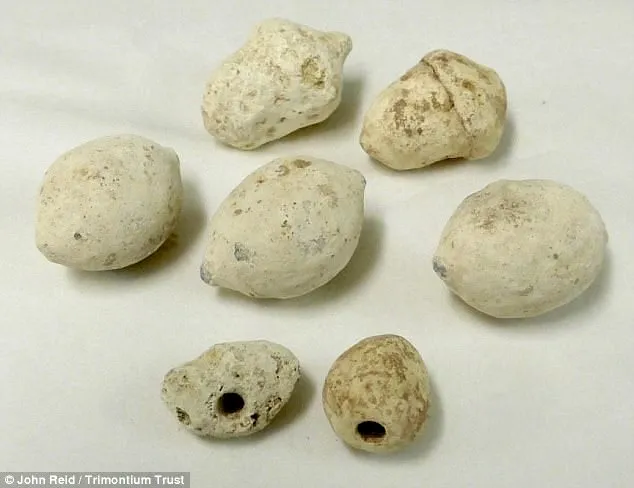
Archaeological digs continue to recover sling bullets with specialized tactical modifications. At Burnswark Hill in Scotland, the site of a second-century Roman assault on an indigenous Scottish hillfort, excavators recovered lemon-shaped lead bullets cast with a small four-millimeter hole drilled into the lateral rim. Ballistic firing trials confirmed that this aperture converted the projectile into an acoustic weapon. As it traveled through the air, air rushing over the hole created a terrifying high-pitched whistle, functioning as psychological terror against warriors trapped behind earthen ramparts.
This focus on material efficiency highlights a universal rule of ancient arms. Real military equipment was defined by physics rather than spectacle. Just as Roman military doctrine favored lead bullets over theatrical archery duels, ancient combatants never used awkward fantasy weapons like Viking double-bladed axes. Instead, battlefield systems were engineered for maximum kinetic effect and rapid production. Even the physical conditioning of Roman arena combatants was shaped by practical bioenergetics, as shown by bone evidence in our study on gladiator diets.
The Human Turn
The inscriptions on sling bullets offer an unfiltered window into the raw psychology of ancient soldiers. While classical literature was composed by aristocratic historians writing long after the fact, the letters cast into glandes were created by ordinary trench soldiers in the midst of siege warfare.
Standing behind earthen palisades, short of rations and surrounded by dysentery, slingers carved their dark humor into soapstone molds over campfire embers. They named their military formations, stamping LEG XI for the Eleventh Legion, or dedicated the shot to Roman gods, inscribing IOM for Jupiter Optimus Maximus.
Other inscriptions spoke directly to the enemy across the line. Words like TIBI, meaning “For you,” or FERI, meaning “Strike,” addressed the anonymous man on the receiving end. The graffiti shows that ancient soldiers used obscenity and humor as coping mechanisms in the face of violent death. When a slinger swung his leather cords, he was delivering a personal message cast in lead.
The Artifact
A surviving Roman sling bullet, pitted by corrosion and weighing barely forty grams, looks unimpressive beside a parade helmet or an ornate sword. Held in the palm, however, its lethal density is unmistakable. The lead is cool, heavy, and sculpted with aerodynamic precision.
These small gray acorns transform our understanding of ancient ranged warfare. They reveal that ancient battlefields were loud, concussive, and terrifyingly fast. Behind the marble statues of Roman commanders were ordinary men armed with leather cords and molten lead, carving crude words into small missiles that shattered bone and decided the fate of empires.
Primary Sources & Archaeological References
- [01]
- [02]
- [03]
- [04]
Related Dossiers
Roman Legionaries Stabbed Instead of Slashing
Vegetius and battlefield archaeology prove the Roman army drilled soldiers to thrust, noting a two-inch stab kills while wild cuts leave the flank exposed.
Romans Did Not Salt the Earth at Carthage: The Myth of Scipio
Pop culture claims Scipio sowed Carthage with salt in 146 BCE. Ancient texts and archaeological record prove this nineteenth-century myth never happened.
Julius Caesar Never Said Et Tu Brute: The Greek Curse Record
Shakespeare invented Et tu Brute in 1599. Roman historians Suetonius and Plutarch prove Caesar died in silence or uttered a chilling Greek curse.