Vikings Never Wore Horned Helmets: The Real Iron Record
THE MOVIE VERSION
Popular films and television show Norse warriors charging into combat wearing prominent horned helmets.
THE RECORD
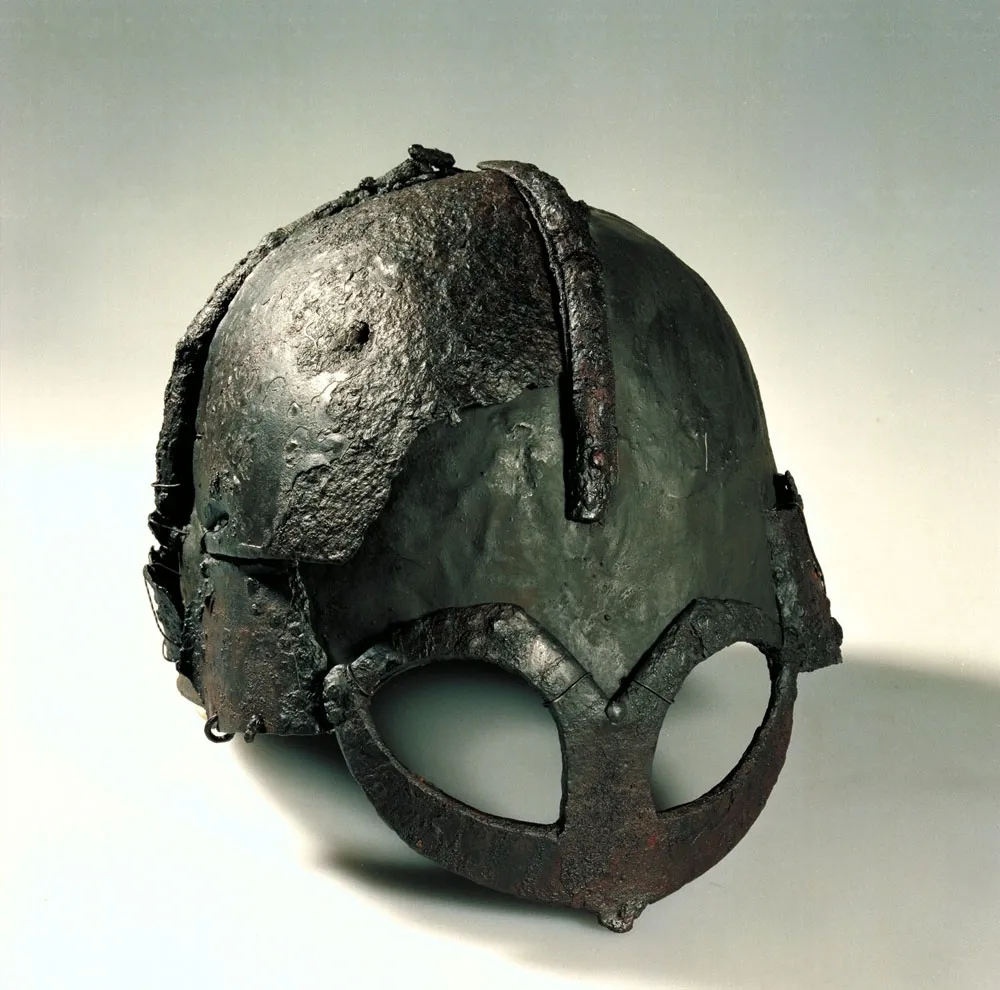
REF #002Every excavated Viking helmet is a smooth rounded iron cap designed to deflect weapon strikes away from the head.
No archaeological excavation has ever recovered a horned helmet from a Viking Age burial site. The single surviving, reconstructible Viking helmet known to science, excavated at the Gjermundbu farm in Norway in March 1943 and cataloged as C27317 at the Museum of Cultural History in Oslo, is a rounded iron skull cap fitted with a smooth spectacle face guard. The horned helmet that dominates popular culture is a nineteenth-century theatrical fabrication that distorts the lethal realities of early medieval combat.
The Claim
A horned helmet in a medieval shield wall was a fatal design flaw. Popular cinema and television present Norse warriors wearing prominent horns mounted to iron headgear. In actual hand-to-hand fighting, outward projections converted glancing blows into catastrophic neck trauma. An enemy axe striking a horn acted as a lever, snapping the wearer’s cervical vertebrae or ripping the helmet off the head.
Viking Age blacksmiths understood defensive geometry, designing helmets to deflect incoming energy away from the cranium. Across three centuries of Norse seafaring from 793 to 1066 CE, Scandinavian warriors wore smooth, conical or rounded helmets of low-carbon iron. These pieces provided glancing surfaces against downward cuts from spears, swords, and axes.
SOURCE: Grieg, Gjermundbufunnet (1947), inventory C27317
Written records from the period reinforce the absence of horns. Snorri Sturluson, writing in thirteenth-century Iceland using older skaldic poetry, described royal military equipment in detail. When King Olaf Haraldsson prepared for the Battle of Stiklestad in 1030 CE, his gear was recorded without theatrical embellishments.
“King Olaf was armed thus: he had a gold-mounted helmet on his head, a white shield with a gilded cross, in one hand a spear… and he was girded with a sword.” Snorri Sturluson, Heimskringla: Saga of St. Olaf 213 (trans. Samuel Laing)
The king wore a gilded iron dome. Neither Snorri nor any contemporary skald mentioned horns or animal appendages protruding from Scandinavian battle helmets.
The Mechanism
The physics of personal armor explains why horns were never used in historical warfare. An effective helmet must fulfill two mechanical functions: prevent blade penetration and redirect kinetic force. When a four-pound sword or a broadaxe strikes an iron plate, the curved dome causes the impact point to slide along the slope, diffusing energy across time and surface area.
Protruding horns destroy this deflection mechanism entirely. If an adversary delivers a cut that strikes a curved horn, the point of impact catches firmly against the bracket. The impact cannot slide away. Instead, the total force of the strike transfers instantly through the helmet bowl into the suspension harness, the chinstrap, and the cervical vertebrae of the spine. The resulting rotational torque causes rapid spinal fracture or traumatic head torsion, incapacitating the warrior instantly.
Furthermore, a horn creates a dangerous grappling handle. Medieval shield-wall combat was dense and chaotic. Warriors pressed shield rim to shield boss at distances of twelve inches. In this cramped space, an opponent could easily seize a projecting horn with a hand or the hook of an axe, pulling the wearer down into waiting spears.
Norse armorers avoided these hazards by forging spherical skull caps with low profiles. They added smooth nasal bars or full spectacle ocular guards to protect the eyes and nose without providing leverage points for enemy weapons. The neck was protected by an aventail of flexible iron maille suspended from small holes drilled along the helmet rim, preserving rotational mobility of the head.
The Evidence
The physical evidence for Viking Age helmets is remarkably scarce, proving that iron headgear was never universal. While thousands of swords and axe heads have been excavated from Scandinavian graves, only one complete Viking Age helmet exists: the Gjermundbu find.
The Gjermundbu find was uncovered on March 29, 1943, by Gunnar Gjermundbo during excavation on a burial mound at Haugsbygd in Ringerike, Buskerud county, Norway. Archaeologist Sigurd Grieg surveyed the cremation grave, designated Gjermundbu I, dated to roughly 970 CE. The grave goods included a maille shirt, two swords, two battle axes, two spears, and nine shattered fragments of an iron helmet.
SOURCE: Museum of Cultural History Oslo, Accession C27317
Conservators at the Universitetets Oldsaksamling in Oslo painstakingly reassembled the pieces. The resulting helmet consists of four iron plates riveted to two crossing iron reinforcing bands, topped by a small iron spike. The front plate features the famous spectacle ocular mask, which guarded the eyes and bridge of the nose. Along the lower margin, iron rings secured a maille curtain to protect the throat. The entire outer surface is smooth iron. There are no brackets, rivets, holes, or welds for horns.
Real horned bronze helmets do exist in Scandinavian soil, but they date to the Nordic Bronze Age, nearly two thousand years before the first Viking raid. In September 1942, peat cutters working at Brøns Mose near Veksø on Zealand, Denmark, excavated two bronze helmets featuring curved, twisted horns.
SOURCE: National Museum of Denmark, Inventory B13550
Radiocarbon dating of birch tar preserved inside the horn sockets dated the Veksø helmets to roughly 900 BCE. They were ritual objects used in religious ceremonies, deposited in a peat bog millennia before the Scandinavian Iron Age began. Norse raiders never saw them.
The modern myth was created in nineteenth-century Germany. In August 1876, costume designer Carl Emil Doepler created the wardrobe for the premiere of Richard Wagner’s opera cycle, Der Ring des Nibelungen, at the Bayreuth Festival. Drawing on romantic nationalism, Doepler fitted the opera’s antagonists with horned helmets to evoke primitive Germanic savagery. The visual trope was copied by painters, theater companies, and twentieth-century filmmakers, embedding an opera costume into popular historical consciousness.
This process of exaggeration mirrors other military myths. Victorian artists placed stage horns on Viking helms, turned light Norse tools into clumsy double-bladed axes, and imagined Roman arena combatants with fitness-model physiques rather than the starch-fed frames documented in our study on gladiator diets. Real archaeology consistently favors functional simplicity over theatrical excess.
The Human Turn
For the average Norse freeholder joining an overseas raid, high-grade iron armor was an unattainable luxury. Forging maille required months of drawing wire and riveting thousands of individual rings. Making a multi-plate helmet with eye guards required specialized smiths and imported bloomery iron.
The vast majority of warriors in a Viking levy went into battle wearing thick wool tunics, leather caps, and carrying a round wooden shield painted with simple pigments. The shield was their primary helmet. When arrows and throwing axes rained down on an advancing crew, warriors raised their shields above their heads, overlapping the lime-wood planks to form a portable roof.
Those few chieftains who possessed iron helmets like the one at Gjermundbu treated them as precious heirlooms. They cleaned the surface with animal fat to prevent rust and wore padded wool caps beneath the metal to cushion concussive blows. When the Gjermundbu chief died around 970 CE, his mourners did not bury his helmet intact. They deliberately pierced it and crushed it during the cremation ritual, killing the object so its spirit could accompany the warrior into the next world.
The Artifact
The battered iron fragments of the Gjermundbu helmet present a stark contrast to the horned caricatures of modern fiction. In the display case at the Historical Museum in Oslo, the helmet sits as a dark, functional shell: pitted by fire, scarred by iron tools, and shaped by the unforgiving realities of early medieval violence.
Removing the theatrical horns does not diminish the Norse warrior. It restores him to his real historical context. These men were practical seafarers and fighters who navigated stormy northern waters in open boats and met their adversaries behind walls of painted lime wood. Their equipment was refined by experience, unburdened by decorative nonsense, and built entirely to survive.
Primary Sources & Archaeological References
- [01]
- [02]
- [03]
- [04]
Related Dossiers
Viking Berserkers Did Not Fight on Toxic Mushrooms
Toxicological research and Old Norse sagas refute the 1784 mushroom theory, revealing berserk fury was a ritualized military trance, not drug psychosis.
The Viking Blood Eagle Was a Poetic Fiction
Old Norse philology and anatomy show the blood eagle ritual arose from misunderstood skaldic metaphors for carrion birds feeding on dead soldiers.
Nero Did Not Fiddle While Rome Burned: The Antium Relief Record
Tacitus proves Nero was thirty miles away in Antium when Rome caught fire. He rushed back to build refugee shelters and slash grain prices, not play violin.