The Viking Blood Eagle Was a Poetic Fiction
THE MOVIE VERSION
Television dramas depict the blood eagle as a common execution where victims survived having their ribs cleaved open and lungs pulled out.
THE RECORD
REF #008Old Norse philology shows the ritual began as a poetic metaphor for carrion birds feeding on corpses, later taken literally by saga writers.
No contemporary ninth-century text records the blood eagle as a physical method of execution. In a landmark philological study published in The English Historical Review in 1984, medievalist Roberta Frank proved that the notorious ritual arose from twelfth and thirteenth-century Christian saga writers misinterpreting complex Old Norse skaldic poetry. What began as a traditional poetic metaphor describing birds of prey feeding on the backs of fallen warriors became transformed into a surgical horror story.
The Claim
A human being cannot survive having their ribcage opened like bird wings. Popular television dramas and historical novels portray the blood eagle as a ceremonial execution reserved for hated enemies. In cinematic accounts, a living victim is restrained facedown while an executioner slices along the spine, severs the rib heads from the vertebrae with an axe, spreads the ribs outward, and pulls the lungs onto the back while the victim remains conscious.
Modern anatomical science and historical philology dismantle this theatrical narrative. In 2022, an interdisciplinary team led by Luke John Murphy published an anatomical analysis in the medieval studies journal Speculum. The researchers modeled the physiological trauma of the procedure. They confirmed that transecting the intercostal arteries and opening the pleural cavities triggers instantaneous bilateral pneumothorax and massive arterial hemorrhage. A subject subjected to this butchery loses blood pressure within seconds, rendering prolonged torture physically impossible.
SOURCE: Frank, English Historical Review 99(391), 1984
The historical root of the myth lies not in pagan surgical practice, but in grammar. Early skaldic poets composed verses using dense metaphors known as kennings. In Viking Age poetry, carrion birds feeding on dead soldiers were regularly referred to as eagles carving or clawing the backs of the slain.
“And Ivar, who sat at York, had Ella’s back cut with an eagle.” Sigvatr Þórðarson, Knútsdrápa (c. 1038, trans. Roberta Frank)
When eleventh-century skald Sigvatr Þórðarson composed this line about King Ælla of Northumbria, he used conventional skaldic imagery: Ivar the Boneless defeated Ælla at York in 867 CE and left his corpse on the battlefield for carrion birds. Two hundred years later, prose authors who no longer understood archaic skaldic syntax read the verse literally, inventing a ritual butchery that early poets never imagined.
The Mechanism
The evolution of the blood eagle demonstrates how literary folklore compounds over centuries. Early Old Norse was a condensed, alliterative poetic language with flexible word order. In skaldic verse, the subject, object, and verb could be separated by interjections, creating multi-layered riddles designed to be deciphered by aristocratic listeners.
In traditional Germanic battle poetry, carrion animals formed a fixed literary trope known to scholars as the “Beasts of Battle”: the raven, the wolf, and the eagle. Describing an enemy warrior as providing meat for eagles, or having his back marked by an eagle’s talons, was a standard formula signifying military defeat and unburied death.
By the thirteenth century, Scandinavian society had converted to Christianity. Scribes working in monastic scriptoriums in Iceland and Norway gathered old oral stanzas and wove them into long prose sagas. These medieval authors viewed their pagan ancestors through a lens of exotic barbarism. When scribes encountered ambiguous stanzas about eagles on backs, they attempted to explain the obscure phrasing by constructing elaborate narrative backstories.
Each successive retelling added graphic physiological details. In the Saga of the Orkneyingers, written around 1200 CE, the ritual is described simply as cutting an eagle on the back with a sword. By the time the Tale of Ragnar’s Sons was penned in the late thirteenth century, the description expanded to include splitting the ribs from the spine, pulling out the lungs, and salting the open wounds. The rite grew more grotesque the further writers were removed in time from the real Viking Age.
The Evidence
Bioarchaeological surveys of Viking Age human remains provide zero physical evidence for the blood eagle. Across thousands of excavated skeletons from cemetery sites in Scandinavia, the British Isles, and Normandy, bioarchaeologists have documented numerous peri-mortem blade wounds: severed femurs, crushed crania from heavy axes, and parry fractures along ulnae.
Not a single excavated skeleton exhibits the unique bilateral cut marks on dorsal rib necks that a surgical blood eagle would leave behind. If rib heads had been pried from the spinal column with iron tools, the costovertebral joints would display distinct cut marks, pry fractures, and crushing. The physical bone record is silent.
SOURCE: Murphy et al., Speculum 97(1), 2022
The 2022 anatomical study by Murphy and medical researchers demonstrated that while skilled blacksmiths possessed tools capable of cutting rib bone, the procedure could only have been completed as a post-mortem mutilation on a corpse. If attempted on a living person, severance of the intercostal neurovascular bundle and subclavian vessels causes catastrophic hemorrhagic shock within twenty seconds. The lungs would deflate instantly into uninflated masses of tissue, rather than fluttering like decorative wings as depicted in television dramas.
SOURCE: Swedish National Heritage Board, Stora Hammars Archive
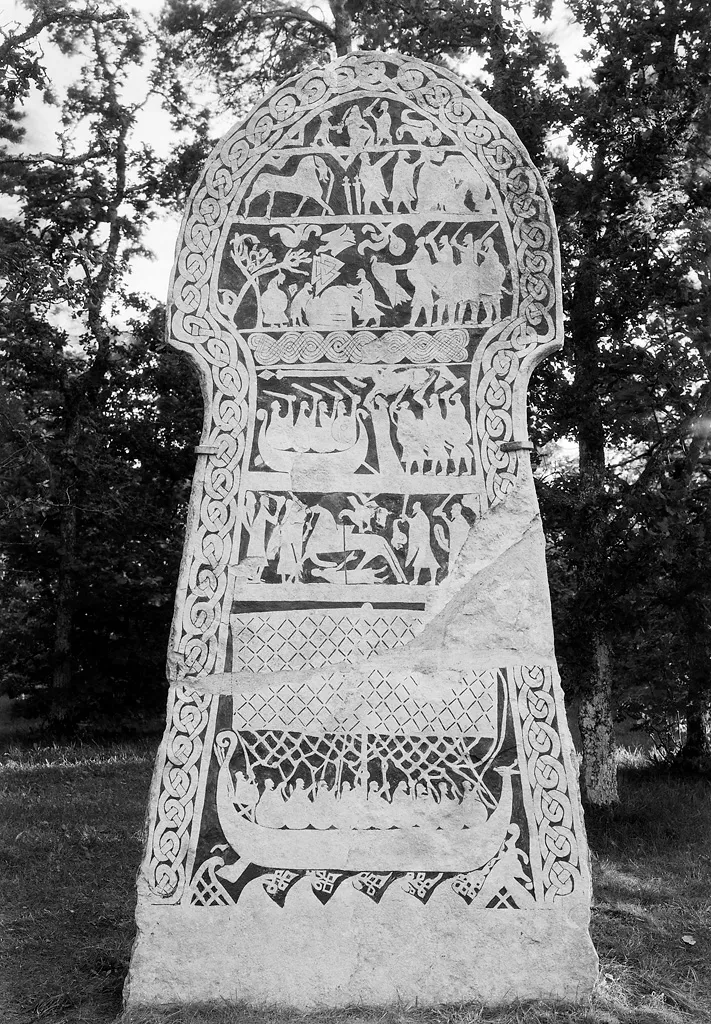
Proponents of the historical ritual frequently point to the Stora Hammars I picture stone, an eighth-century carved limestone monument from Lärbro on the island of Gotland. One panel depicts a man lying facedown on an altar while a figure kneels over him holding an implement, with a flying bird carved overhead.
Yet Scandinavian art historians emphasize that the Stora Hammars carving depicts a classic pagan sacrificial hanging or spear dedication to Odin, accompanied by a symbolic raven or eagle of death. The stone contains no visible ribcage incisions, no spread lungs, and no anatomical butchery. Reading the blood eagle into the monument requires retrofitting late Icelandic saga fiction onto an archaic Gotlandic memorial.
This process of myth-making parallels other Viking legends. Popular culture has embraced theatrical fictions of northern savagery, from nonexistent horned helmets to fantasy double-bladed axes. Just as historical Norsemen relied on practical single-bladed tools, their military culture was guided by practical violence, not elaborate theatrical autopsies in the field.
The Human Turn
The myth of the blood eagle has obscured the real victims of early medieval warfare. Norse raiders were undeniably brutal, but their violence was driven by cold economic calculation rather than sadomasochistic ritual theater.
When the Great Heathen Army captured York in 867 CE, their primary objectives were silver bullion, livestock, and arable farmland. Captives of high social status were ransomed for cash, while ordinary inhabitants were enslaved to work agricultural estates or sold into Mediterranean slave markets. Slicing open a king’s lungs in a complex surgical pageant provided no tactical or financial advantage.
King Ælla of Northumbria almost certainly died on the field of battle outside the crumbling Roman walls of York, cut down by ordinary spears and axes alongside his rival Osberht. His body was stripped of armor, left exposed to scavenging carrion birds, and buried in a common trench. The horror of his death was the horror common to all early medieval warfare: violent, fast, and unheroic.
The Artifact
The limestone surface of the Stora Hammars I stone stands weathered by Baltic winds, preserving the faint figures of warriors, longships, and sacred groves. It represents an archaic Norse cosmology where the eagle was a sacred messenger of Odin, conducting the spirits of the slain to the hall of the dead.
To reduce this complex artistic tradition to a crude torture legend does violence to historical understanding. The Vikings were not cartoonish monsters performing surgical theater in muddy fields. They were practical seafarers, ruthless conquerors, and skilled poets whose metaphorical words were misunderstood by their own descendants.
Primary Sources & Archaeological References
- [01]
- [02]
- [03]
- [04]
Related Dossiers
Viking Berserkers Did Not Fight on Toxic Mushrooms
Toxicological research and Old Norse sagas refute the 1784 mushroom theory, revealing berserk fury was a ritualized military trance, not drug psychosis.
Vikings Never Wore Horned Helmets: The Real Iron Record
The 10th-century Gjermundbu find shows Viking helmets were smooth iron domes with spectacle eye guards, while horned headgear was an opera invention.
Medieval People Did Not Die at Thirty: The Life Expectancy Fallacy
Pop culture claims medieval people died of old age at thirty. Cemeteries and records prove adults routinely lived well into their sixties and seventies.