Ninja Did Not Wear All-Black Suits: The Theater Stagehand Myth
THE MOVIE VERSION
Cinema depicts feudal Japanese ninja sprinting across rooftops in tight black cloth jumpsuits with hooded cowls that expose only their eyes.
THE RECORD
REF #018Historical shinobi disguised themselves as common farmers, traveling monks, or merchants, relying on dark indigo clothing for nocturnal reconnaissance.
Popular culture has made the ninja instantly recognizable: a masked assassin clad head to toe in sleek, jet-black cloth. From twentieth-century cinema to modern video games, the so-called shinobi shozoku body suit has become the universal uniform of medieval Japanese espionage. The silent operative scales castle walls in black boots, balances on cedar beams in a midnight cowl, and fades into the shadows.
It is also a complete historical fiction.
If an authentic historical spy had walked through sixteenth-century Kyoto dressed in a hooded black assassin uniform, town guards and samurai patrols would have executed him on sight. In Sengoku and Edo period intelligence operations, specialized black uniforms did not exist. The all-black ninja suit was not created by military tacticians in Iga or Koka. It was created by urban stagehands working backstage in eighteenth-century puppet theaters.
The Claim
The belief that historical shinobi wore standardized black stealth pajamas stems from a misunderstanding of Japanese theatrical conventions. In Bunraku puppet theater and traditional Kabuki drama, stagehands known as kuroko (literally “black children”) assisted actors during performances.
To help audiences suspend disbelief while stagehands moved props, adjusted strings, or swapped scenery, these workers dressed in loose black robes with black hoods covering their faces. In the shared visual grammar of the Edo playhouse, black symbolized non-existence. Spectators agreed by convention to treat the kuroko as invisible ghosts.
During the late eighteenth century, Kabuki playwrights turned this visual convention into a shocking plot twist. In the middle of an intense palace intrigue scene, a silent figure dressed as a harmless kuroko stagehand would suddenly draw a concealed dagger and strike an unsuspecting daimyo. The audience gasped not because ninja historically wore black jumpsuits, but because a person whom everyone had agreed to ignore had transformed into a killer.
When nineteenth-century woodblock artists and modern filmmakers adapted historical legends of Sengoku reconnaissance agents, they adopted the theater stagehand costume as visual shorthand. Just as Victorian illustrators placed cow horns on Norse warriors to signal savagery, creating the myth explored in our analysis of Viking helmets, modern cinema dressed Japanese infiltrators in black body suits so audiences could immediately recognize their occupational role.
The Mechanism
The physics of night vision and the sociology of feudal surveillance explain why genuine espionage agents rejected solid black garments:
First, pure jet-black fabric is poor camouflage under natural night skies. The human eye perceives contrast far more sharply than absolute illumination. In open countryside, moonlit courtyards, or against starlit night skies, an entirely black silhouette stands out as an unnatural void against ambient light. True darkness in nature is composed of deep indigo, slate blues, and earthen shadows.
Second, authentic historical shinobi treatises instructed operatives on nocturnal color selection. The Bansenshukai (Sea of Myriad Rivers), the definitive military compendium compiled in 1676 by master Fujibayashi Yasutake, explicitly specifies the garments needed for night missions (innin). The manual directs agents to wear everyday work clothes dyed with dark indigo (kon) or treated with persimmon tannin (kakishibu), a reddish-brown wash used by peasant laborers to waterproof cotton and hemp. Deep navy indigo absorbs moonlight and diffuses softly into nighttime shadows, providing superior optical concealment compared to dense black dye.
Third, the primary mechanism of espionage is social invisibility, not visual invisibility. Feudal Japan was a tightly regulated police state with highway checkpoints (sekisho) and neighborhood surveillance units (goningumi). A man caught wearing a specialized nocturnal assault suit could offer no explanation for his attire. By contrast, an operative dressed in ordinary peasant clothes could blend into farm fields or roadside crowds without raising alarm.
The Evidence
The surviving documentary record from feudal Japan provides unanimous testimony regarding authentic shinobi field craft:
Primary manuals preserved in the National Archives of Japan, including the Bansenshukai and the 1681 manual Shoninki (True Ninja Record) by Natori Sanjuro Masazumi, contain extensive chapters on disguises. These manuals divide covert operations into two overarching categories: innin (concealed stealth operations) and yonin (open deception operations).
Under the doctrine of yonin, the manuals instruct operatives to assume one of the shichihode (seven classic traveling disguises):
- Komuso: Itinerant Zen monks who wore woven basket hats (tengai) that completely obscured their faces while playing bamboo flutes.
- Yamabushi: Mountain ascetic priests who traveled freely through provincial borders under religious privilege.
- Shukke: Ordinary Buddhist clerics who could enter temples and listen to regional gossip without suspicion.
- Hokashi: Wandering street entertainers and acrobats who attracted crowds in town squares while observing fortifications.
- Sarugaku: Theatrical performers and musicians invited into elite samurai residences to stage dramas.
- Akindo: Traveling merchants carrying goods, possessing legitimate reasons to measure storehouses and evaluate city gates.
- Peasants (Hyakusho): Common agricultural workers who moved freely around castle moats and rural supply routes.
Nowhere in these manuals is there an instruction to manufacture a black hooded pajama suit. The Shoninki specifically emphasizes dialect mimicry, regional etiquette, and psychological calm over gymnastic wall-climbing. Just as historical combat manuals disproved the myth of heavy clumsy swords in Europe, historical Japanese treatises reveal that espionage was an intellectual craft of social deception rather than acrobatics.
The Human Turn
The transformation of practical intelligence scouts into mythical black-suited specters reflects our romantic desire for the supernatural warrior.
In the brutal civil wars of the Sengoku period, real espionage was gritty and unglamorous. Shinobi were local samurai, farmers, or regional scouts from rugged provinces like Iga and Koka who understood mountainous terrain, river crossings, and signaling techniques. Their value lay in gathering actionable military intelligence: mapping granaries, counting troop banners, monitoring patrols, and occasionally igniting defensive barricades during night sieges, similar to the incendiary tactics examined in our dossier on flaming arrows.
When the Tokugawa shogunate established national peace after 1603, the demand for battlefield scouts evaporated. Former operatives found employment as peacetime police retainers, guards, or castle groundskeepers. To preserve their prestige and secure patronage from regional lords, veteran families compiled secret manuals like the Bansenshukai, systematizing oral traditions and codifying their specialized techniques.
Simultaneously, civilian city dwellers in peaceful Edo craved sensational entertainment. Urban storytellers and woodblock illustrators exaggerated Sengoku-era tales of stealth into impossible superhuman feats. They portrayed shinobi walking on water and vanishing in smoke. When theatrical directors borrowed the kuroko stagehand hood to visualize this supposed invisibility, the modern ninja uniform was born. Pop culture embraced the illusion because a black assassin costume looks dramatic on screen, whereas an operative dressed as an ordinary farmer weeding radishes appears mundane.
The Artifact
The visual transition from functional work clothes to dramatic legend is captured in nineteenth-century Japanese print culture:
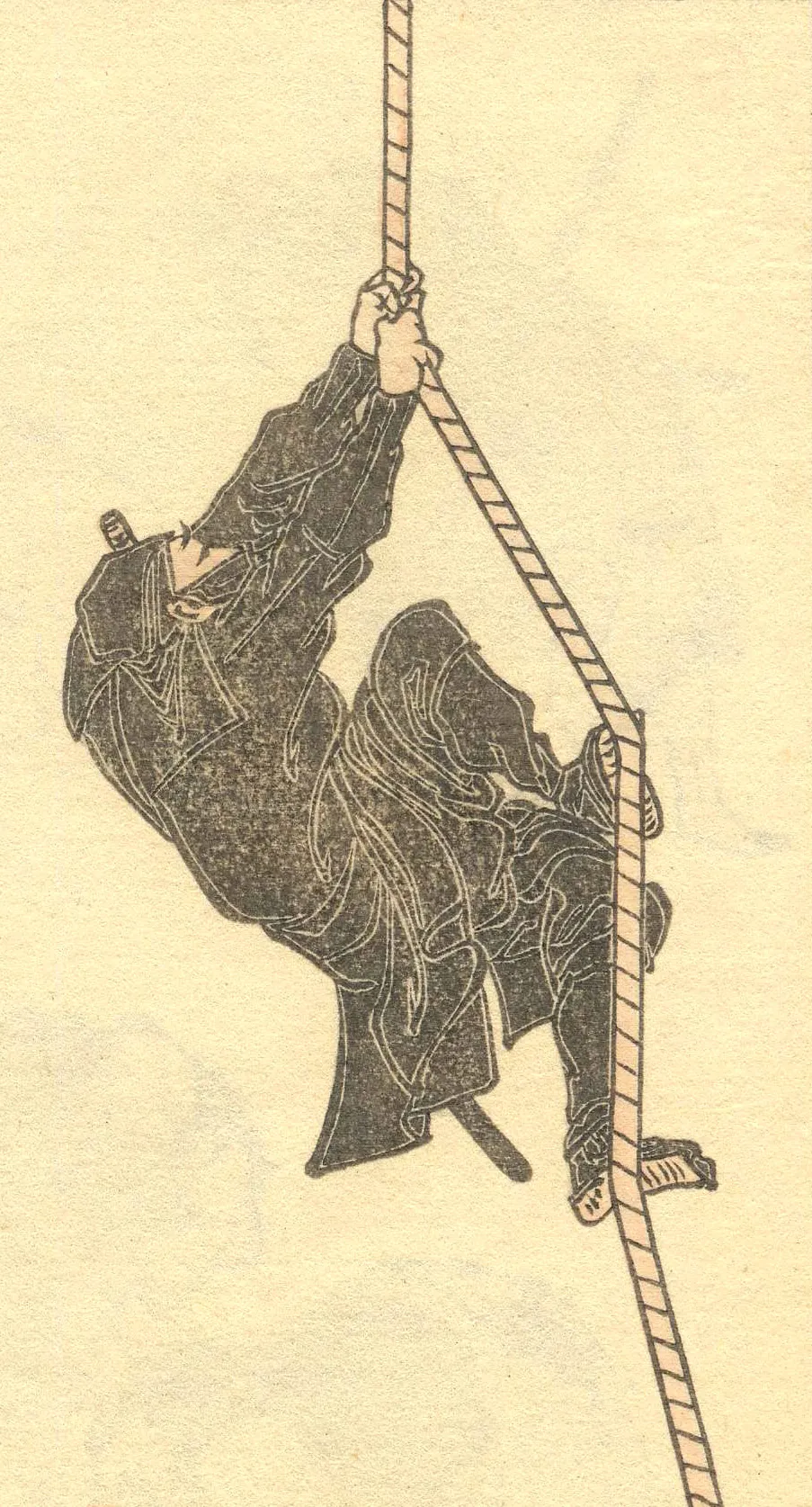
The Metropolitan Museum of Art and the National Diet Library of Japan preserve master prints by Katsushika Hokusai, the celebrated Edo-period artist best known for The Great Wave off Kanagawa. In 1817, Hokusai published Volume 6 of his masterwork sketch collection, Hokusai Manga.
On one famous page, Hokusai depicted a shinobi infiltrating a compound. The figure is not wearing a modern Hollywood bodysuit. Instead, he wears loose utility clothing tied securely at the wrists and shins, equipped with a traditional knotted rope ladder (musubinawa) and climbing hooks. The face is visible, and the gear reflects genuine Edo-era climbing equipment rather than theatrical stage robes.
Later artists, such as Tsukioka Yoshitoshi in his dramatic series Thirty-Six Ghosts (1889), leaned further into the theatrical tradition, drawing historical figures in dark flowing cowls to emphasize mystery. By comparing Hokusai’s practical sketches with late-Edo prints, historians can trace the moment when the real intelligence gatherer was swallowed by the stage persona. The authentic ninja survived not by hiding in a black jumpsuit, but by looking so ordinary that history walked right past him.
Primary Sources & Archaeological References
- [01]
- [02]
- [03]
- [04]
Related Dossiers
The Library of Alexandria Did Not Burn in a Single Cataclysm
Pop culture blames one fire for destroying ancient wisdom. Historical records prove the Library of Alexandria suffered centuries of gradual bureaucratic decay.
Classical Marble Statues Were Painted Garishly
Multispectral imaging and Pliny the Elder prove ancient Greek and Roman sculptures were painted in saturated colors like cinnabar, azurite, and lead white.
Medieval People Did Not Die at Thirty: The Life Expectancy Fallacy
Pop culture claims medieval people died of old age at thirty. Cemeteries and records prove adults routinely lived well into their sixties and seventies.