Nero Did Not Fiddle While Rome Burned: The Antium Relief Record
THE MOVIE VERSION
Cinema depicts Emperor Nero playing a violin on his palace balcony, singing gleefully while the Great Fire ravages ancient Rome.
THE RECORD
REF #021Tacitus records Nero was in Antium thirty miles away, rushing back to open emergency refugee shelters and provide subsidized grain.
No ruler in classical antiquity carries a more notorious reputation than Nero Claudius Caesar Augustus Germanicus. In popular folklore, Hollywood cinema, and everyday idioms, Nero is remembered as the mad tyrant who fiddled while Rome burned. The scene is ingrained in modern culture: as fire ravages tenement blocks and terrified plebeians flee through smoke, the emperor stands atop his marble palace, dressed in theatrical silks, sawing away on a violin while chanting verse about the fall of Troy.
The tableau is dramatic, operatic, and universally recognized.
It is also an absolute historical fabrication.
First, the violin did not exist in the ancient world; bowed string instruments were completely unknown in imperial Rome and would not emerge until fifteen centuries later. Second, contemporary historical records prove Nero was not even in Rome when the Great Fire began. When news of the disaster reached him, Nero rushed back to the capital and personally directed one of the most comprehensive emergency relief efforts in ancient history. The enduring image of the callous royal musician was not history, but hostile political propaganda manufactured after his fall.
The Claim
The legend that Nero burned his capital and celebrated its destruction traces back to senatorial historians who despised the Julio-Claudian dynasty.
Following Nero’s death in 68 CE, the Roman Senate declared damnatio memoriae against him, ordering his statues defaced, his inscriptions erased, and his memory officially cursed. Historians writing under subsequent imperial dynasties, particularly Suetonius and Cassius Dio, repeated every scandalous rumor to legitimize Nero’s overthrow.
In his biographical collection The Twelve Caesars, written half a century after the event, Suetonius claimed outright that Nero ordered the city torched because he disliked its crooked alleys:
SOURCE: Suetonius, The Lives of the Twelve Caesars: Nero, Chapter 38
“He set fire to the city so openly that many men of consular rank caught his attendants on their property with tow and torches, but did not venture to touch them… Viewing the conflagration from the Tower of Maecenas, he sang the whole of the Sack of Ilium in his regular actor’s costume.” Suetonius, Life of Nero 38 (trans. J. C. Rolfe)
Over a century later, Cassius Dio embellished the tale further, claiming Nero mounted his roof dressed in full harpist regalia, delighting in human misery. Seventeenth-century English playwrights translated Nero’s ancient stringed instrument into a modern violin, giving birth to the popular phrase “to fiddle while Rome burns”.
The Mechanism
The physical and chronological reality of the disaster refutes the theatrical narrative:
On the night of July 18, 64 CE, fire broke out in the wooden shops packed between the Circus Maximus and the Palatine Hill. Fanned by summer winds, the blaze consumed dry merchant stalls selling oil and textiles, racing through narrow street valleys where high timber insulae acted as giant chimneys. The fire raged for six days, paused briefly, and reignited for three more days, damaging ten of Rome’s fourteen administrative districts.
Crucially, Nero was not in Rome. As recorded by the historian Publius Cornelius Tacitus, who was living in the capital during the fire, Nero was staying at his coastal villa in Antium (modern Anzio), located thirty miles south of Rome.
When messengers reached Antium with news of the inferno, Nero rode north immediately. He arrived while flames were threatening his own residence, the Domus Transitoria. Far from playing music, Nero faced an unprecedented civic crisis requiring immediate logistical mobilization.
The Evidence
Tacitus provides sober, eyewitness-based testimony that exposes the gap between imperial propaganda and historical reality:
In Book 15 of The Annals, Tacitus details the extraordinary relief operations Nero personally organized upon reaching the burning capital:
SOURCE: Tacitus, The Annals, Book 15, Chapter 39
“Nero opened the Campus Martius, the public buildings of Agrippa, and even his own imperial gardens, and raised temporary structures to receive the destitute multitude. Food supplies were brought up from Ostia and neighboring towns, and the price of grain was reduced to three sesterces a measure.” Tacitus, Annals 15.39 (trans. John Jackson)
Nero opened his private imperial gardens (hortos suos) to thousands of homeless refugees, ordered public buildings converted into emergency dormitories, and supervised the rapid construction of temporary housing. He secured the maritime supply line from the port of Ostia, ensuring grain ships prevented famine, and used his treasury to subsidize grain prices down to three sesterces per peck. Just as gladiator diets were anchored in state grain distributions, as examined in our study of gladiator nutrition, the survival of Rome’s working class depended on this subsidized supply.
Did Nero sing about Troy while Rome burned? Tacitus explicitly addresses this story as an unverified rumor:
SOURCE: Tacitus, The Annals, Book 15, Chapter 39
“Yet these measures, popular though they were, failed of their effect, because a rumor had spread that at the very time the city was burning, he had mounted a private stage and sung of the destruction of Troy, comparing present misfortunes with ancient disasters.” Tacitus, Annals 15.39 (trans. John Jackson)
Tacitus makes clear that nobody verified the performance. It was a piece of urban gossip (rumor) whispered in refugee camps, fueled by Nero’s well-known obsession with Greek poetry.
Furthermore, the instrument Nero played in private was the cithara, a large concert lyre plucked by a plectrum. The violin family did not exist until sixteenth-century Italian luthiers developed bowed wooden resonance boxes. Nero could no more have played a fiddle than he could have piloted a helicopter.
The Human Turn
Why did Roman citizens believe the rumor, and why has the myth persisted for two millennia?
The tragedy of Nero’s response lay in his post-fire urban renewal program. Following the conflagration, Nero enacted progressive, life-saving building codes (Annals 15.43): broad grid streets, mandatory stone construction using fire-resistant volcanic tufa, independent exterior walls without shared party fences, and strict height caps on apartment blocks. These firebreaks paved the way for the monumental crowd engineering later seen in Roman vomitoria.
However, Nero also seized over two hundred acres of prime real estate cleared by the fire to construct his palace complex, the Domus Aurea (Golden House). When plebeians saw a sprawling park with an artificial lake and a thirty-meter bronze colossus of Nero rising where their homes had stood, suspicion exploded into certainty. Citizens concluded that the emperor had burned Rome for personal luxury.
Desperate to divert public anger, Nero made a fateful decision recorded in Tacitus’s famous passage (Annals 15.44): he pinned the blame on an obscure, unpopular Jewish sect known as Christians, arresting and executing them in public spectacles. Just as political violence shaped Roman gladiatorial gestures, political scapegoating became Nero’s fatal undoing.
The Artifact
The material evidence of Nero’s reign and the Great Fire survives in Roman archaeology and numismatics:
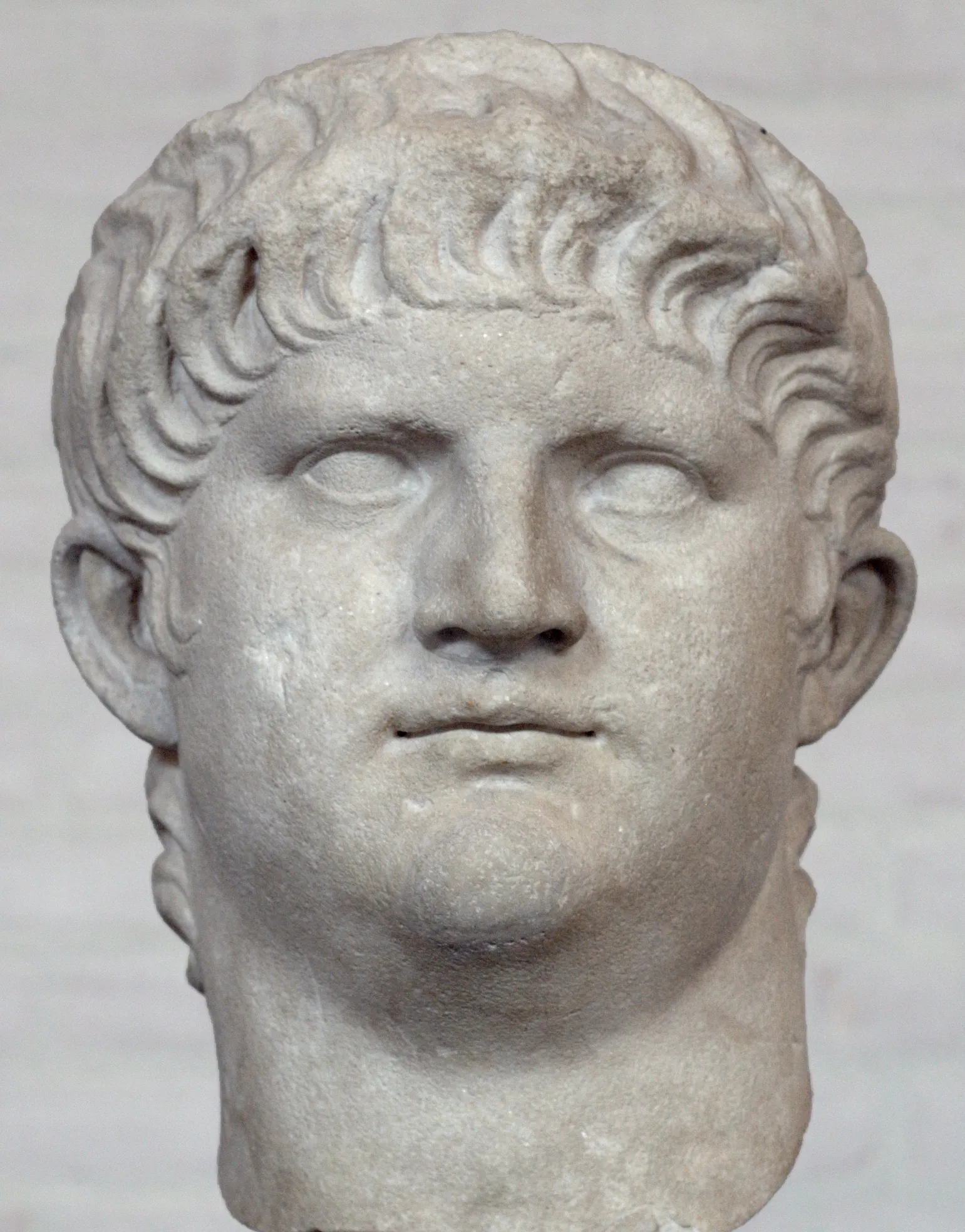
In the Munich Glyptothek, the Roman marble bust of Nero (inventory GL 321) reveals the emperor’s distinctive late portraiture: heavy features, a thick neck, and the elaborate curls of a Greek performing artist, a fashion that scandalized conservative senatorial elites.
Beneath modern Rome on the Oppian Hill, visitors can still explore the vaulted concrete galleries of Nero’s Domus Aurea. The brickwork bears physical testament to post-fire reconstruction: Roman pozzolana concrete walls built to rigid fire-safety standards, decorated with frescoes that inspired Renaissance painters like Raphael.
In coin cabinets across Europe, bronze sestertii struck by Nero after 64 CE depict the newly constructed Macellum Magnum and port facilities at Ostia, recording in metal the infrastructure projects Nero financed to rebuild his capital. The physical stones and bronze coins confirm what classical texts record: Nero was an extravagant autocrat, but he never fiddled while his empire burned.
Primary Sources & Archaeological References
- [01]
- [02]
- [03]
- [04]
Related Dossiers
Romans Did Not Salt the Earth at Carthage: The Myth of Scipio
Pop culture claims Scipio sowed Carthage with salt in 146 BCE. Ancient texts and archaeological record prove this nineteenth-century myth never happened.
Julius Caesar Never Said Et Tu Brute: The Greek Curse Record
Shakespeare invented Et tu Brute in 1599. Roman historians Suetonius and Plutarch prove Caesar died in silence or uttered a chilling Greek curse.
Roman Vomitoriums Were Not for Puking: The Exit Hall Myth
Roman vomitoria were not decadent banquet regurgitation rooms. Classical texts and amphitheater engineering prove they were crowd evacuation tunnels.