Medieval People Did Not Drink Beer Instead of Dirty Water
THE MOVIE VERSION
Pop history claims medieval water was so toxic that everyone from peasants to kings drank ale exclusively to avoid dying of disease.
THE RECORD
REF #020Medical treatises, monastic hydraulic maps, and civic pipe systems prove medieval Europeans drank fresh water daily and prized its purity.
Few historical myths are as widely accepted as the poisoned water trope of the Middle Ages. In popular podcasts, television series, and pub trivia nights, the story is told with absolute confidence: medieval Europe was an open sewer, surface water was teeming with lethal pathogens, and anyone foolish enough to drink from a stream or well died of cholera. Consequently, the narrative claims, medieval Europeans drank beer, ale, or wine exclusively. From toddlers sipping breakfast ale to monastics chugging weak beer during prayer, fermentation was supposedly humanity’s sole defense against toxic hydration.
The story makes for entertaining storytelling.
It is also an absolute historical myth.
In the real Middle Ages, Europeans drank water every single day. Peasants quenched their thirst at clear springs while laboring in rye fields, monastic orders engineered miles of subterranean lead aqueducts to supply drinking basins, and medieval physicians wrote detailed medical treatises analyzing the health benefits of fresh mountain streams. People brewed and drank vast quantities of ale not because water was fatal, but because fermented grain was high-calorie liquid food, culturally prestigious, and enjoyable.
The Claim
The belief that medieval Europeans avoided water out of terror traces back to nineteenth-century industrialization rather than medieval reality.
During the rapid urban growth of the Victorian era, cities like London and Manchester suffered catastrophic waterborne cholera epidemics. Before physician John Snow famously removed the Broad Street pump handle in 1854, nineteenth-century urban centers were choked with untreated industrial waste. Victorian sanitary reformers, looking backward through the lens of their own filthy canals, assumed their feudal ancestors must have lived in even greater squalor.
Twentieth-century writers adopted this Victorian prejudice and added a convenient chemical explanation. Because brewing involves boiling wort, modern observers deduced that medieval people must have stumbled onto boiling as an unintentional sterilization technique, drinking beer to stay alive.
Yet this backward projection ignores the documentary and archaeological record. Medieval people had no knowledge of bacteria or boiling sterilization. More importantly, they had no need to drink fermented grain exclusively to survive, because fresh water was plentiful, clean, and recognized as an essential foundation of human life.
The Mechanism
The true mechanism behind medieval beverage consumption was economics, agricultural nutrition, and culinary preference:
First, consider the economic absurdity of replacing all water with brewed ale. Brewing requires massive quantities of barley, wheat, or oats, along with firewood, copper kettles, and labor. In agrarian Europe, grain was the principal food source. Dedicating every bushel of harvest to brewing beverage for total hydration would have triggered immediate famine.
Second, ale was valuable liquid bread. Agricultural laborers engaged in fourteen hours of manual labor required immense caloric intake, often between 3,500 and 4,500 calories per day. Just as Roman gladiators relied on carbohydrate-dense barley porridge, as examined in our study of gladiator nutrition, medieval peasants drank small beer (an unhopped, low-alcohol ale of 1 to 2 percent ABV) because it delivered carbohydrates, amino acids, and vitamin B. Ale was a calorie supplement, not an antiseptic medicine.
Third, unhopped medieval ale spoiled rapidly. Before the widespread adoption of hops in northwestern Europe during the fourteenth and fifteenth centuries, ale soured within three to five days of brewing. It could not be stored in bulk or transported long distances. When laborers traveled away from home, worked remote timber tracts, or tended upland pastures, their companion was a leather canteen (costrel) filled with fresh spring water.
The Evidence
Surviving medieval medical handbooks and civic records demonstrate that clean water was understood, analyzed, and drunk routinely across all social classes:
In 1256, the prominent Italian physician Aldobrandino of Siena wrote Le Regime du corps (The Regimen of the Body) for Beatrice of Savoy. In his chapter dedicated specifically to drinking water, Aldobrandino does not warn that water is poisonous. On the contrary, he describes it as an essential digestive aid:
SOURCE: Aldobrandino of Siena, Le Regime du corps (1256)
“Water is what best quenches thirst and carries food through the members… The best water is spring water that runs eastward over sand or clean stone, clear, light, and without smell or taste.” Aldobrandino of Siena, Le Regime du corps (trans. Landouzy & Pepin)
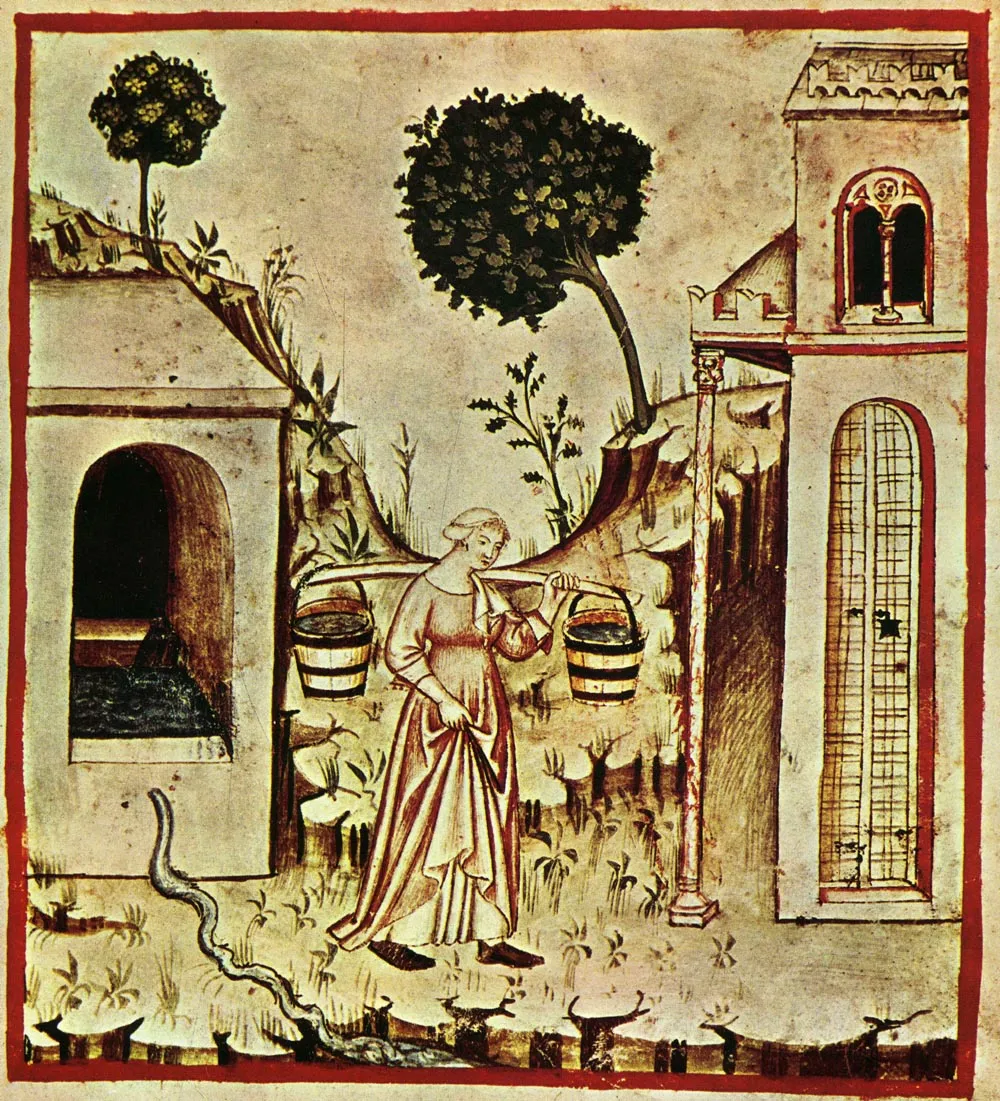
The celebrated health handbook Tacuinum Sanitatis, widely copied across fourteenth-century Europe, dedicated illuminated folios to sweet freshwater (Aqua dulcis), advising readers that pure water preserves natural bodily moisture, aids digestion, and calms internal heat. Physicians warned against stagnant swamp water and warm marshes, but praised running streams and stone wells.
Monastic and penitential records provide further proof. Monastic rules, including the Rule of Saint Benedict, mandated water as the standard drink for monks undergoing fasting periods or penance. If drinking water had been lethal, fasting on bread and water would have functioned as an immediate death sentence.
Furthermore, secular law codes strictly protected urban water sources. Municipal ordinances in medieval London, Paris, and Florence levied massive fines on tanners, butchers, and dyers who washed hides or discarded waste upstream of municipal intake basins. Citizens valued clean water and fiercely guarded its purity through civic legislation.
The Human Turn
The myth of the beer-soaked Middle Ages persists because it flatters our modern sense of superiority.
We like to imagine medieval people as filthy, superstitious brutes who blundered through mud, terrified of washing and terrified of water. This caricature makes modern sanitation seem like a sudden stroke of contemporary genius rather than the continuation of ancient and medieval public health traditions.
In reality, medieval people shared our sensory aversion to foul water. They possessed noses, eyes, and taste buds. They knew that cloudy, stagnant water from a ditch produced belly cramps, so they dug stone-lined wells down to deep aquifers or traveled to hillside springs. Just as medieval knights were agile athletes rather than helpless turtles, as documented in our study of medieval plate armor, and medieval swords were nimble balancing tools rather than blunt iron clubs, as revealed in our analysis of swordsmithing geometry, medieval public health was practical, observant, and grounded in common sense.
The Artifact
The engineering reality of medieval water supply survives in ink and stone across Europe:
Preserved in the library of Trinity College, Cambridge, the Eadwine Psalter (MS R.17.1, circa 1165) contains one of the most astonishing technical drawings of the Middle Ages: a full-color architectural waterworks plan of Canterbury Cathedral Priory.
The plan illustrates a sophisticated hydraulic system created by the prior and his engineers. Spring water was captured from an elevated source over a mile away, directed through settling tanks to remove sediment, and piped through underground lead conduits into the monastery. The drawing maps distribution pipes running to water taps in the cloister lavatorium, the monastic kitchen, the bathhouse, and the infirmary, complete with shut-off valves and clean-out purge pipes.
In municipal life, London’s Great Conduit, constructed in 1245, carried fresh spring water from Tyburn three miles through lead pipes to a public cistern at Cheapside. For centuries, Londoners and guild water-carriers drew free, pristine spring water from its bronze spigots. The stones and parchment records of these projects remain, testifying that medieval civilization ran not on fermented stupor, but on clean, running water.
Primary Sources & Archaeological References
- [01]
- [02]
- [03]
- [04]
Related Dossiers
Medieval People Did Not Die at Thirty: The Life Expectancy Fallacy
Pop culture claims medieval people died of old age at thirty. Cemeteries and records prove adults routinely lived well into their sixties and seventies.
Medieval People Did Not Believe the Earth Was Flat: The 1828 Hoax
Every medieval scholar knew the Earth was spherical. The myth that Columbus had to convince skeptics the world was round was invented by Washington Irving.
Medieval Chastity Belts Were Nineteenth-Century Fakes
Museum metallurgical tests and archival studies revealed that supposed medieval chastity belts are Victorian forgeries inspired by a 1405 satirical joke.