Roman Thumbs Down Did Not Mean Death in the Arena
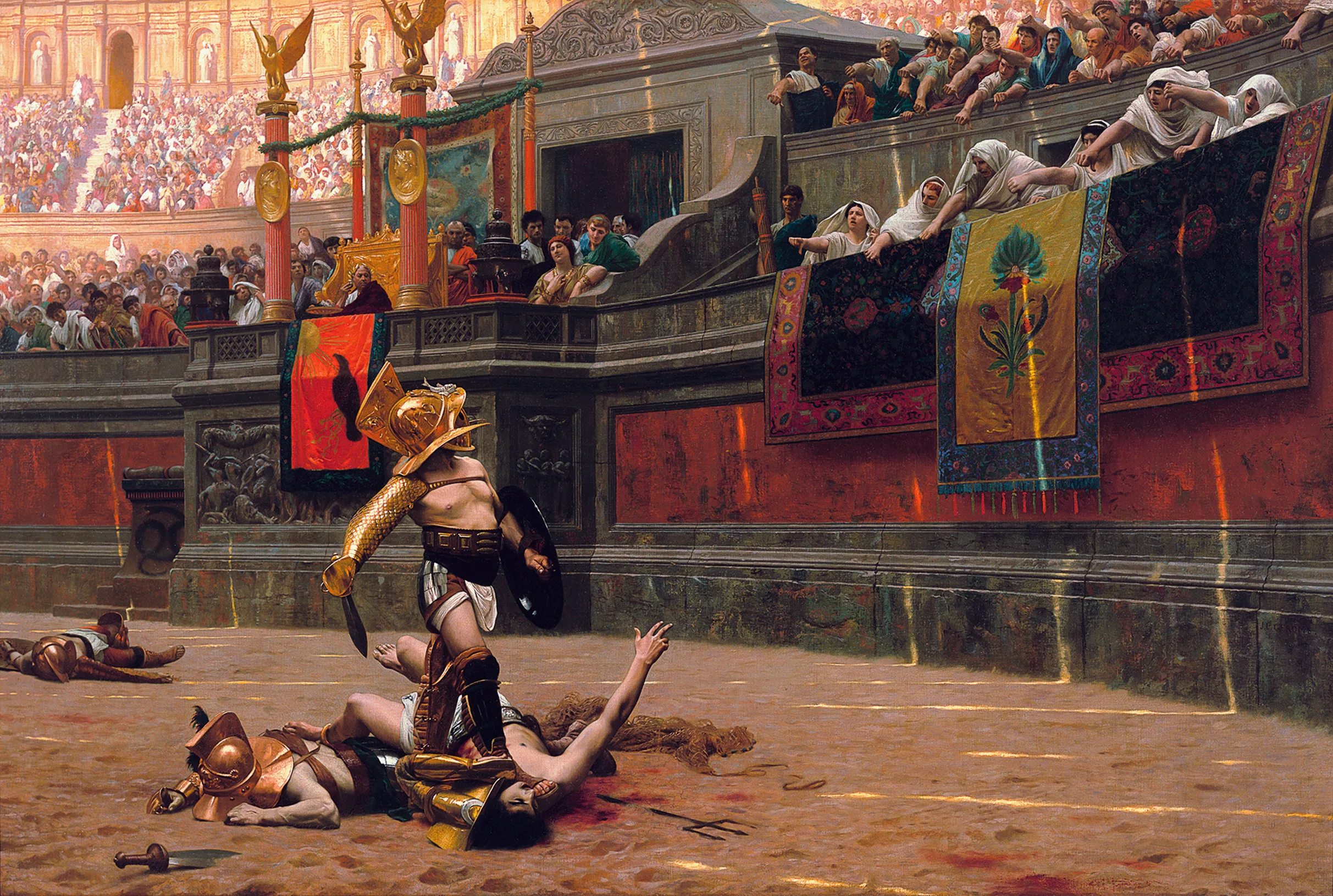
THE MOVIE VERSION
Cinema depicts Roman crowds and emperors thrusting downward-pointing thumbs toward the sand to condemn gladiators to death, while thumbs up signals mercy.
THE RECORD
REF #014Classical philology proves pollice verso meant pointing an upturned thumb toward the throat to mimic a sword thrust, while mercy was signaled by folding the thumb inside the fist.
Few gestures are as universally recognized across the modern globe as the thumb pointed down for disapproval and the thumb pointed up for approval. Modern popular culture attributes this binary signal directly to the Colosseum, where Roman emperors and roaring plebeians supposedly pointed thumbs down to condemn a vanquished fighter to execution. Hollywood blockbusters have repeated this visual cue for decades. Yet classical philology, Roman literature, and archaeological iconography prove that modern cinema inverted Roman arena customs. A downward-pointed thumb never meant death in the Roman world. Ancient spectators ordered an execution by extending an upturned or turned thumb toward their own throat, while mercy was granted by concealing the thumb inside a closed fist.
The Claim
The cinematic image of the gladiator’s fate hinges on modern interpretations of the Latin phrase pollice verso, traditionally translated as “with a turned thumb.” In modern movies, a defeated gladiator lies on the sand while the victor pauses, awaiting the verdict of the editor or the crowd. If the crowd wishes the fighter to die, thousands of spectators thrust their thumbs toward the ground. If they wish him spared, they thrust thumbs toward the sky.
This modern convention stems largely from nineteenth-century Academic painting. In 1872, French artist Jean-Leon Gerome unveiled his famous canvas Pollice Verso. The painting depicts a victorious murmillo standing over a fallen retiarius while Vestal Virgins lean over their balcony rail, thrusting down-turned thumbs toward the arena floor. Gerome misunderstood Latin descriptions of Roman arena signals, confusing the physical direction of the gesture.
Because Gerome’s canvas was celebrated across Europe and later studied directly by Hollywood filmmakers when designing arena sets, his mistaken depiction became entrenched as historical fact. Just as popular media falsely assumes gladiators were chiseled bodybuilders rather than grain-fed fighters with dense defensive subcutaneous fat, as documented in our study of gladiator bone chemistry and diet, the public accepted Gerome’s thumb mechanics without consulting classical texts.
The Mechanism
To understand Roman gestural language, one must examine the physical mechanics of Roman combat and corporal signaling:
In Roman thought, gestures were theatrical, highly standardized, and intended to be visible across an amphitheater holding fifty thousand spectators. Roman combat focused relentlessly on thrusting rather than slashing, an engineering doctrine drilled into soldiers as described in our analysis of Roman legionary stabbing techniques.
When a defeated gladiator raised his left index finger (ad digitum) to concede defeat, he appealed for missio, an honorable release from combat. The presiding editor then observed the crowd’s reaction.
The crowd signaled its judgment using symbolic pantomime:
- The Death Sentence (Pollice Verso): The crowd shouted Iugula (“Cut his throat.”). Spectators emphasized this vocal command with a physical motion that mimicked the fatal strike. The thumb represented the short blade of the gladius. By turning the thumb outward, upward, and pointing it directly toward the throat or upper chest, spectators mimicked the thrusting sword stroke that entered the neck behind the collarbone to sever the jugular vein. The thumb was not pointed down toward the dust. It was turned out and driven toward the body.
- The Grant of Mercy (Pollice Compresso): When the crowd wished to spare a courageous gladiator, they shouted Mitte (“Let him go.”). Spectators signaled this verdict not with a modern thumbs-up, but by clenching their fingers tightly over their thumbs (pollice compresso or pollices premere). By hiding the thumb inside the folded fist, spectators symbolically sheathed the sword. A hidden thumb meant an enclosed weapon.
The Evidence
Direct evidence for Roman thumb gestures survives in classical literature and provincial archaeological finds:
The Roman satirist Juvenal recorded the behavior of ambitious provincial politicians who staged gladiatorial spectacles to win urban votes in his third Satire:
SOURCE: Juvenal, Satires 3.36-37
“Munera nunc edunt et, verso pollice vulgus cum iubet, occidunt populariter.” (“These men now give shows of their own, and, when the mob with turned thumb bids them, slay their man to win applause.”) Juvenal, Satires 3.36-37 (trans. G. G. Ramsay)
The crucial Latin word is verso, from vertere, which means to turn, twist, or alter the position of an object, not to point it downwards. Latin contains specific adverbs for downward motion, such as infesto or deorsum, none of which are paired with pollice in classical accounts of arena verdicts.
The opposite gesture, granting life, is documented by Pliny the Elder in his encyclopedic Naturalis Historia. In book twenty-eight, chapter five, Pliny discussed traditional folk gestures and noted:
SOURCE: Pliny the Elder, Naturalis Historia 28.5.25
“Pollices, cum faveamus, premere etiam proverbio iubemur.” (“We are even bidden by a proverb to press our thumbs when we wish to show favor.”) Pliny the Elder, Naturalis Historia 28.5 (trans. W. H. S. Jones)
Pliny confirmed that pressing the thumb into the palm was an ancient Roman formula for expressing goodwill, protection, and preservation. In the arena context, pollices premere signaled that the sword should remain sheathed, granting the gladiator life.
Archaeological finds confirm this gestural syntax. A second-century Roman terracotta medallion recovered in southern France, cataloged in archaeological collections as the Cavillatio medallion, depicts a defeated gladiator kneeling before an official. Spectators carved into the background hold their hands forward with thumbs enclosed in closed fists, while inscribed text records their shouts granting missio.
The Human Turn
The true nature of arena gestures illuminates how ancient Romans used physical communication to navigate social power. In an autocracy where citizens possessed little democratic influence over state legislation, the amphitheater was one of the few public spaces where ordinary plebeians could express collective will directly to the emperor.
By participating in the collective gesture, Roman citizens asserted their status as masters of the Mediterranean world. Sparing a gladiator was not an act of humanitarian compassion. It was a calculated political negotiation. Gladiators were expensive investments trained in specialized schools, and owners charged exorbitant replacement fees if a rented fighter was killed. When the crowd pressed their thumbs inside their fists, they rewarded a brave display of virtus while acknowledging the commercial realities of arena management.
Just as Roman slingers etched caustic psychological taunts into lead bullets to break enemy morale, as demonstrated in our report on inscribed Roman sling ammunition, amphitheater crowds transformed physical gestures into precise instruments of public command.
The Artifact
The visual turning point that distorted this history remains Jean-Leon Gerome’s canvas Pollice Verso, completed in 1872 and preserved at the Phoenix Art Museum.
Measuring ninety-six by one hundred and forty-nine centimeters, the painting captures the architecture of the Flavian Amphitheater with meticulous academic draftsmanship. Gerome consulted Roman armor in European museums, accurately recreating the crested helmet and heavy arm-guard of the murmillo. Yet in the royal box, the artist painted the Vestal Virgins extending closed fists with thumbs pointed rigidly downward.
Gerome’s painting was exhibited across Paris, London, and New York, shaping the visual literacy of nineteenth-century society. When cinematic directors adapted Roman history for the screen in the twentieth century, they treated Gerome’s canvas as photographic truth.
The painting remains an artistic masterpiece, but an archaeological error. The next time an actor playing a Roman emperor slowly tilts his thumb toward the Colosseum sand, viewers are observing a Victorian misunderstanding, not an authentic Roman decree. In ancient Rome, if a crowd wanted a gladiator dead, they pointed the weapon of the thumb directly at his throat.
Primary Sources & Archaeological References
- [01]
- [02]
- [03]
- [04]
Related Dossiers
Gladiators Were Not Ripped: The High-Carb Fat Defense
Ephesus cemetery bones show gladiators ate a dense barley porridge to gain subcutaneous fat that cushioned nerves and vessels against slashes.
Romans Did Not Salt the Earth at Carthage: The Myth of Scipio
Pop culture claims Scipio sowed Carthage with salt in 146 BCE. Ancient texts and archaeological record prove this nineteenth-century myth never happened.
Julius Caesar Never Said Et Tu Brute: The Greek Curse Record
Shakespeare invented Et tu Brute in 1599. Roman historians Suetonius and Plutarch prove Caesar died in silence or uttered a chilling Greek curse.