Roman Vomitoriums Were Not for Puking: The Exit Hall Myth
THE MOVIE VERSION
Pop culture portrays ancient Roman palaces featuring vomitoriums where aristocrats regurgitated courses with feathers to keep gorging.
THE RECORD
REF #019Classical Latin records prove vomitoria were architectural exit vaults in arenas like the Colosseum that disgorged crowds into public streets.
Few images of imperial Roman decadence are more enduring than the banquet vomitorium. In historical novels, Hollywood cinema, and popular folklore, wealthy patricians recline on silk cushions beside tables laden with roasted dormice, sow udders, and spiced peacock tongues. When their stomachs can hold no more luxury food, guests shuffle into a dedicated side room termed a vomitorium. There, servants tickle their throats with goose feathers, prompting regurgitation so aristocrats can immediately return to the feast.
The image is memorable, grotesque, and deeply satisfying as a moral critique of ancient excess.
It is also an absolute linguistic and architectural fiction.
In the real Roman world, a vomitorium was not a dining room, a lavatory, or a personal regurgitation chamber. Wealthy Romans never built rooms for vomiting in their villas. Instead, a vomitorium was a masterpiece of civic crowd engineering: a wide, arched exit portal through which tens of thousands of citizens were rapidly evacuated from public theaters, circuses, and amphitheaters.
The Claim
The misconception that Roman architecture included rooms for gorging and purging traces back to a false etymological connection popularized in modern English literature.
Readers saw the English root vomit inside the Latin noun vomitorium and assumed the architectural feature was an imperial bathroom designed for emetic relief. Early twentieth-century novelists cemented the trope in the popular imagination. Most notably, British author Aldous Huxley referenced a satirical nightclub vomitorium in his 1923 novel Antic Hay, using the word as a decadent joke. Travel writers, Victorian moralists, and Hollywood scriptwriters repeated the misunderstanding until it became accepted historical fact.
Victorian moralizers loved the story because it matched their narrative of pagan Roman moral collapse. By painting imperial Rome as a society so consumed by sensory indulgence that patricians designed specialized rooms for digestive purging, nineteenth-century commentators created a stark moral contrast with Victorian discipline.
Yet an exhaustive survey of Latin literature, Roman domestic architecture, and archaeological excavations across the Mediterranean reveals that no residential house ever contained an architectural feature called a vomitorium.
The Mechanism
The true mechanism behind the vomitorium is civil engineering, fluid crowd dynamics, and public safety:
The word derives from the Latin verb vomere, which means “to discharge” or “to spew forth”. Roman architects applied the term metaphorically to physical structures that spewed forth human bodies rather than digestive contents.
When the Flavian emperors constructed the Colosseum (the Amphitheatrum Flavium) in the first century CE, they faced a logistical problem that modern stadium architects still study today. The arena accommodated between fifty thousand and seventy thousand spectators who gathered to watch gladiators, whose plant-based diets we examined in our study of gladiator nutrition, or judicial executions decided by political gestures analyzed in our dossier on Roman arena signals.
If a riot erupted or a storm struck the open arena, the entire crowd needed to exit without fatal bottlenecks. Roman engineers solved this using a three-dimensional lattice of barrel-vaulted corridors:
- Radial Distribution: Spectators entered through eighty ground-level numbered arches, climbing internal travertine staircases (scalaria) assigned to their social rank.
- Horizontal Evacuation: Beneath the seating tiers (cavea), vaulted subterranean galleries directed human movement away from the arena floor toward exterior perimeter walls.
- Continuous Flow: The internal passageways terminated in wide, arched openings positioned directly above the seating wedges. These portals were the vomitoria.
Because the tunnels widened as they approached the exterior, human traffic accelerated outward rather than jamming inward. Modern crowd-flow simulations confirm that the eighty vomitoria of the Colosseum could completely empty seventy thousand spectators into the streets of Rome in under fifteen minutes.
The Evidence
The classical documentary record proves unequivocally that Roman authors understood the term purely as an architectural crowd exit:
The earliest surviving definition of the word appears in the Saturnalia, an encyclopedic compendium of classical learning written in the early fifth century CE by the Roman grammarian Macrobius Ambrosius Theodosius:
SOURCE: Macrobius, Saturnalia, Book 6, Chapter 4
“Vomitoria dicuntur loca per quae populus effunditur, sive in theatris sive in circo, quasi evomantur spectatores ad suas quisque sedes vel loca.” Macrobius, Saturnalia 6.4 (trans. Robert A. Kaster)
Translated into English, Macrobius explains: “Vomitoria are called the places through which the people pour forth, whether in theaters or in the circus, as if the spectators were vomited out to their seats or destinations.”
Macrobius was explaining poetic metaphors used by earlier writers such as Virgil, who wrote in the Georgics about majestic palace doorways that “belch forth” tides of clients in the morning. To Roman ears, calling an exit portal a vomitorium was a vivid architectural compliment, honoring a doorway that cleanly discharged crowds.
Did individual Romans ever intentionally vomit during lavish feasts? Yes, occasionally. Roman satirists complained about private gluttony. Lucius Annaeus Seneca, writing to his mother Helvia in the first century CE, bitterly condemned decadent nobles:
SOURCE: Seneca the Younger, Ad Helviam Matrem de Consolatione, 10.3
“Vomunt ut edant, edunt ut vomant, et epulas quas toto orbe conquirunt nec concoquere dignantur.” Seneca the Younger, Ad Helviam 10.3 (trans. John W. Basore)
Seneca wrote that gluttons “vomit that they may eat, and eat that they may vomit.” Suetonius leveled similar accusations against the emperor Vitellius, who reportedly gorged himself four times a day and used emetics to clear his palate.
However, when an overfed Roman felt nauseated at a banquet, he did not walk down the hall to a room marked vomitorium. He leaned over a metal basin in the dining room (triclinium), stepped into the courtyard, or visited the household latrine. Regurgitation was an occasional private act of digestive distress, never a recognized architectural space.
The Human Turn
The persistence of the vomitorium myth demonstrates how easily linguistic confusion transforms into moral fable.
When late Victorian readers encountered Seneca’s critique of imperial excess, they sought concrete physical symbols of ancient corruption. The Latin language, with its robust vocabulary of biological metaphors, offered an easy trap. Just as modern military analysts describe infantry charges with mechanical language, as noted in our analysis of Roman legionary tactics, Roman builders described architecture using human physical functions. Doors belched, corridors swallowed, and arches spewed.
Failing to recognize the architectural metaphor, modern commentators literalized it. We turned an engineering triumph into a symbol of moral degeneration.
The real Roman vomitorium was not a tribute to uncontrolled bodily appetite, but a monument to civic order, mathematics, and public safety. Roman builders recognized that urban life required rapid pedestrian flow. They engineered corridors that respected human geometry, preventing fatal crowd crushes. In turning these brilliant evacuation tunnels into imaginary purging chambers, modern folklore replaced an enduring architectural achievement with a vulgar Victorian bedtime story.
The Artifact
The physical proof of the Roman vomitorium stands in stone across the Mediterranean basin:
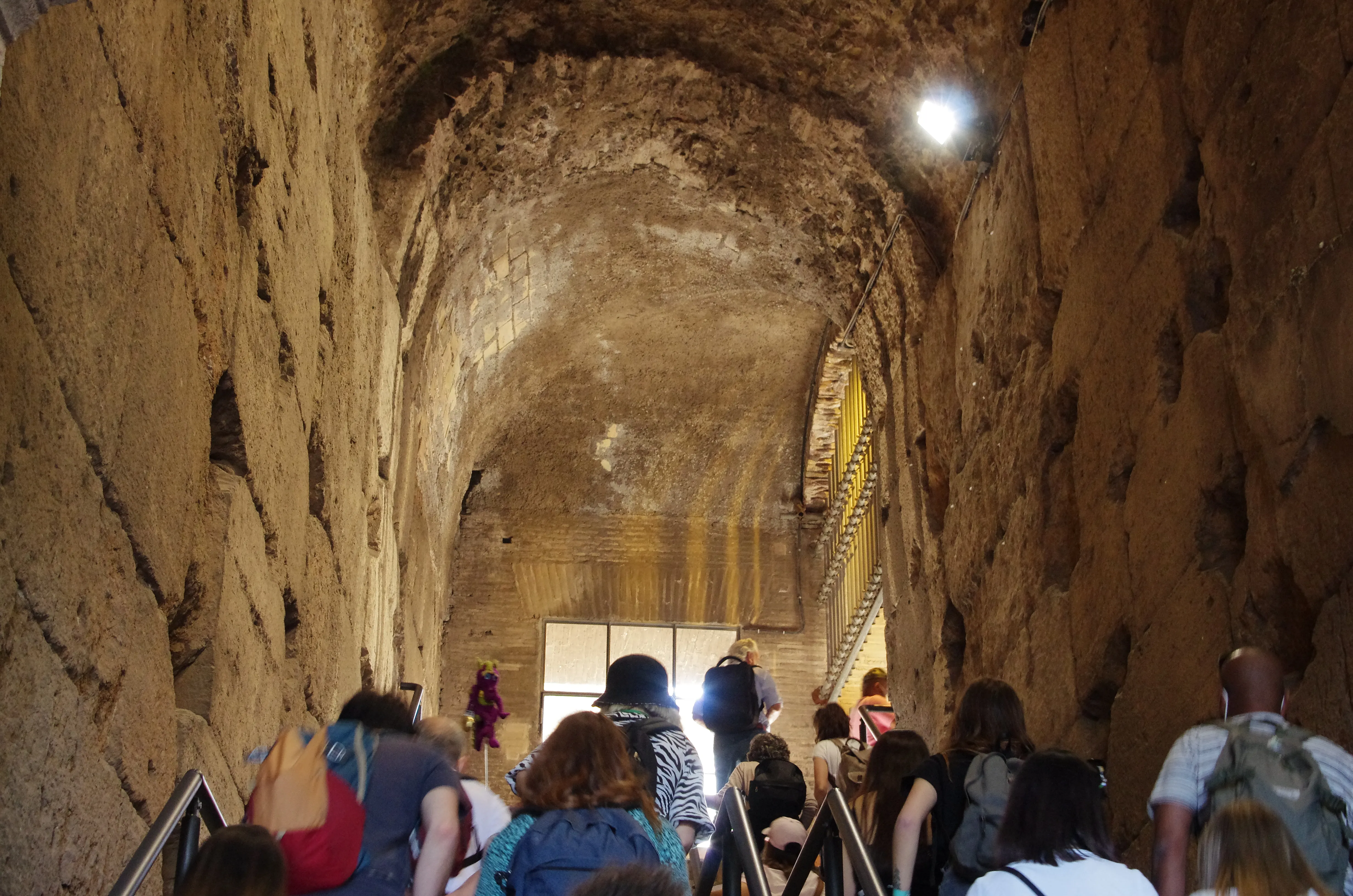
In Rome, visitors to the Colosseum can still walk through the surviving travertine annular arcades on the ground and second tiers. Numbered Roman numerals, carved into the stone above exterior arches XXXVIII through XLIV on the northern facade, mark the precise points where ticket holders entered the vomitorium system.
Inside, the smooth barrel vaults constructed from lightweight Roman pozzolana concrete remain intact. The vaulted tunnels climb at calculated gradients to emerge smoothly onto the marble seating tiers (praecinctiones).
Identical, perfectly preserved vomitoria can be examined in Roman theaters across Europe and North Africa, including the theater of Aspendos in Turkey, the arena at Verona, and the amphitheater of Nimes in France. In each location, archaeologists find no plumbing drains, no feather basins, and no domestic couches. They find only broad stone ramps, worn smooth by the sandals of tens of thousands of citizens moving safely through the ancient world’s most sophisticated evacuation system.
Primary Sources & Archaeological References
- [01]
- [02]
- [03]
- [04]
Related Dossiers
Romans Did Not Salt the Earth at Carthage: The Myth of Scipio
Pop culture claims Scipio sowed Carthage with salt in 146 BCE. Ancient texts and archaeological record prove this nineteenth-century myth never happened.
Julius Caesar Never Said Et Tu Brute: The Greek Curse Record
Shakespeare invented Et tu Brute in 1599. Roman historians Suetonius and Plutarch prove Caesar died in silence or uttered a chilling Greek curse.
Nero Did Not Fiddle While Rome Burned: The Antium Relief Record
Tacitus proves Nero was thirty miles away in Antium when Rome caught fire. He rushed back to build refugee shelters and slash grain prices, not play violin.