The Iron Maiden Was a 19th-Century Museum Hoax
THE MOVIE VERSION
Cinema depicts the iron maiden as a standard medieval torture box lined with interior spikes that impaled prisoners.
THE RECORD
REF #010Not a single medieval record documents the device. Antiquarians fabricated it in the nineteenth century for commercial horror exhibits.
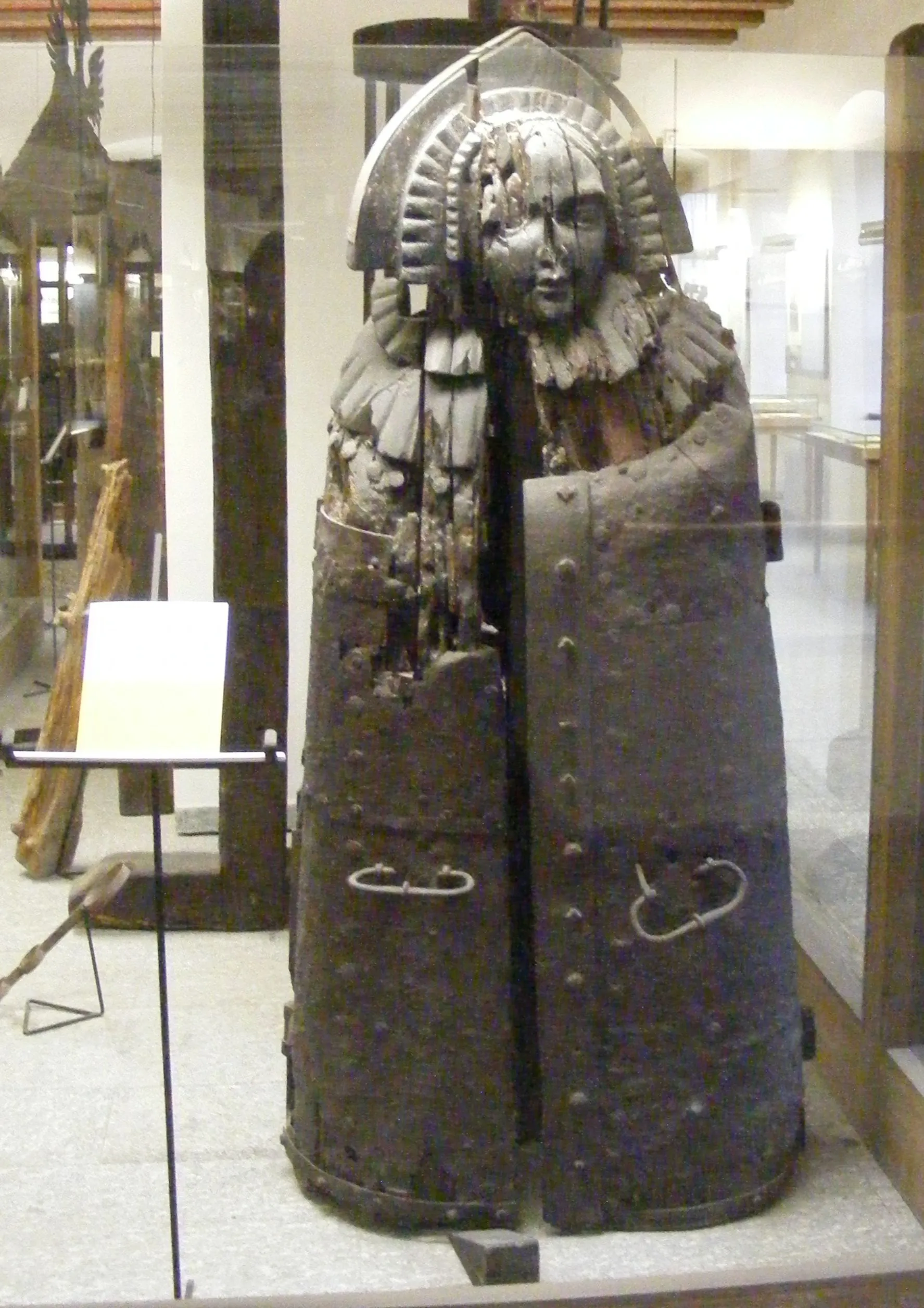
No medieval castle dungeon ever contained a spiked iron maiden. In a monograph published by the Medieval Crime Museum in Rothenburg ob der Tauber, legal historian Wolfgang Schild demonstrated that the famous upright casket lined with interior spikes was fabricated in the late eighteenth and early nineteenth centuries. The device was constructed by antiquarians who cobbled together disparate historical metalwork to sensationalize the Middle Ages for commercial exhibition tickets.
The Claim
A spiked sarcophagus used for judicial torture does not exist in any medieval court record. Popular horror cinema, historical television dramas, and tourist torture museums present the iron maiden as the iconic instrument of medieval cruelty. In these depictions, an accused criminal is forced inside an upright anthropomorphic iron cabinet. The heavy doors close, driving long iron spikes into the victim’s eyes, chest, and arms without touching vital organs, causing a lingering death.
The physical record of European jurisprudence tells a completely different story. Legal historians have reviewed thousands of judicial trial logs, municipal account ledgers, executioner manuals, and court transcripts from fourteenth, fifteenth, and sixteenth-century Germany, France, England, and Italy. The iron maiden appears in zero contemporary documents.
SOURCE: Siebenkees, Materialien zur Nürnbergischen Geschichte (1793)
The earliest mention of an iron maiden in German history dates to 1793, written by philosopher and antiquarian Johann Philipp Siebenkees. In his second volume of materials on Nuremberg history, Siebenkees recorded a claim that an iron maiden executed a coin forger inside the Nuremberg Secret Vaults on August 14, 1533.
Subsequent archival investigations by German legal scholars revealed that Siebenkees fabricated the narrative. The city archives of Nuremberg preserve daily records of executions from 1533, including the detailed ledgers of the municipal executioner. The documents list beheadings by sword, hangings, and drownings, but contain no record of an iron maiden. Siebenkees synthesized classical legends of ancient Spartan tyrants with Gothic Romantic tropes to create an enduring historical myth.
The Mechanism
The mechanics of the fabricated iron maiden contradict the legal logic of medieval criminal procedure. Under the Constitutio Criminalis Carolina, the unified penal code promulgated by Holy Roman Emperor Charles V in 1532, judicial torture (peinliche Befragung) was strictly regulated by statute.
Torture was not a chaotic spectacle of random mutilation. It was a formal legal procedure designed to elicit confessions in capital crimes when direct eyewitnesses were lacking. The imperial law explicitly prohibited permanent mutilation during interrogation. Executioners employed devices that produced severe pain without spilling blood or fracturing bone: thumb screws (Daumenstock), the strappado (Aufziehen), and shin vices.
An iron cabinet with interior spikes violates every principle of the Carolina. The long spikes would immediately puncture arteries, lacerate muscle tissue, and cause fatal internal hemorrhaging. A suspect killed inside an iron box could not sign a formal judicial confession before the municipal court magistrates.
Furthermore, medieval metalworking shops lacked the industrial capacity and economic incentive to cast massive human-shaped iron sarcophagi. Sheet iron was expensive and reserved for essential military applications, such as articulated knights’ plate armor and crossbow components. Municipalities did not invest vast treasury funds to forge elaborate anthropomorphic iron statues when a standard hemp rope, wooden strappado pulley, and executioner’s sword achieved legal execution at minimal civic cost.
The Evidence
Physical examination of surviving iron maidens in European museums confirms their modern construction. In 2000, Professor Wolfgang Schild conducted a metallurgical and stylistic analysis of the famous Rothenburg specimen and the remnants of the Nuremberg device, which was destroyed by Allied bombing in 1945.
SOURCE: Schild, Die eiserne Jungfrau: Dichtung und Wahrheit (2000)
Schild showed that the so-called Nuremberg maiden was manufactured around 1802. Blacksmiths took a sixteenth-century wooden cloak of shame (Schandmantel), an unspiked barrel-like barrel worn by petty thieves as public humiliation, and combined it with modern iron hinges, decorative face carvings, and hand-forged spikes to create a sensational theatrical attraction.
The spikes inside the doors were positioned haphazardly with modern machine-cut threads, proving that they were inserted centuries after the Middle Ages had ended. The interior was never designed to hold human weight under realistic penal conditions; the hinges were weak, and the interior dimensions were inconsistent with historical German armor measurements.
During the nineteenth century, traveling showmen recognized the immense commercial value of medieval horror. British collector Matthew Wyatt purchased a manufactured iron maiden in Nuremberg in 1890 and took it on a touring exhibition across the United Kingdom and the United States, displaying it at the 1893 World’s Columbian Exposition in Chicago.
SOURCE: Medieval Crime Museum Rothenburg Collections Database
Thousands of paying visitors lined up to view the device, accepting Wyatt’s fabricated catalogue descriptions as authentic history. Victorian audiences, eager to view their industrial era as the enlightened pinnacle of human progress, readily accepted the idea that their ancestors were bloodthirsty barbarians who designed clockwork murder cabinets.
This process of retrofitting modern horror onto the pre-modern world parallels other historical fictions. Just as nineteenth-century antiquarians invented the spiked iron maiden, Victorian illustrators invented horned Viking helmets for opera stages and misread Old Norse poetry to create the mythical blood eagle ritual. In each instance, romantic sensationalism replaced historical evidence.
The Human Turn
The true victims of medieval justice faced a system defined by public exposure, not hidden gothic machines. Criminal punishment in the Middle Ages was designed to be witnessed by the entire urban community in broad daylight.
Offenders were marched through city markets wearing wooden collars or shameful neck violins (Halsgeigen). Executions took place outside the city walls on open gallows hills (Galgenberge), where the community gathered to hear the judge read the formal sentence and watch the executioner swing his sword. The system relied on transparent civic theater to re-establish public order, not secret mechanical devices concealed in underground chambers.
For ordinary townsfolk of the sixteenth century, the true terror was the efficiency of municipal courts and the economic cost of legal trials, not clockwork monsters. The invention of the iron maiden tells us little about the real Middle Ages, but reveals a great deal about the nineteenth-century appetite for profitable gothic fiction.
The Artifact
The iron maiden standing in the Medieval Crime Museum in Rothenburg ob der Tauber remains a captivating visual object. Its carved wooden face stares forward with blank serenity, concealing the cold iron spikes mounted inside its hinged doors.
Yet the object is an artifact of Victorian commercial showmanship rather than medieval justice. It stands as a cautionary reminder of how easily historical myths are manufactured, commercialized, and accepted by popular culture when theatrical fantasy is mistaken for the archival record.
Primary Sources & Archaeological References
- [01]
- [02]
- [03]
- [04]
Related Dossiers
Medieval People Did Not Die at Thirty: The Life Expectancy Fallacy
Pop culture claims medieval people died of old age at thirty. Cemeteries and records prove adults routinely lived well into their sixties and seventies.
Medieval People Did Not Believe the Earth Was Flat: The 1828 Hoax
Every medieval scholar knew the Earth was spherical. The myth that Columbus had to convince skeptics the world was round was invented by Washington Irving.
Medieval People Did Not Drink Beer Instead of Dirty Water
Medieval Europeans did not avoid water out of fear of poison. Medical manuscripts and civic pipe records prove clean water was prized and drunk daily.